

HSA or FSA: Which Should I Choose?
Last reviewed: July 2026
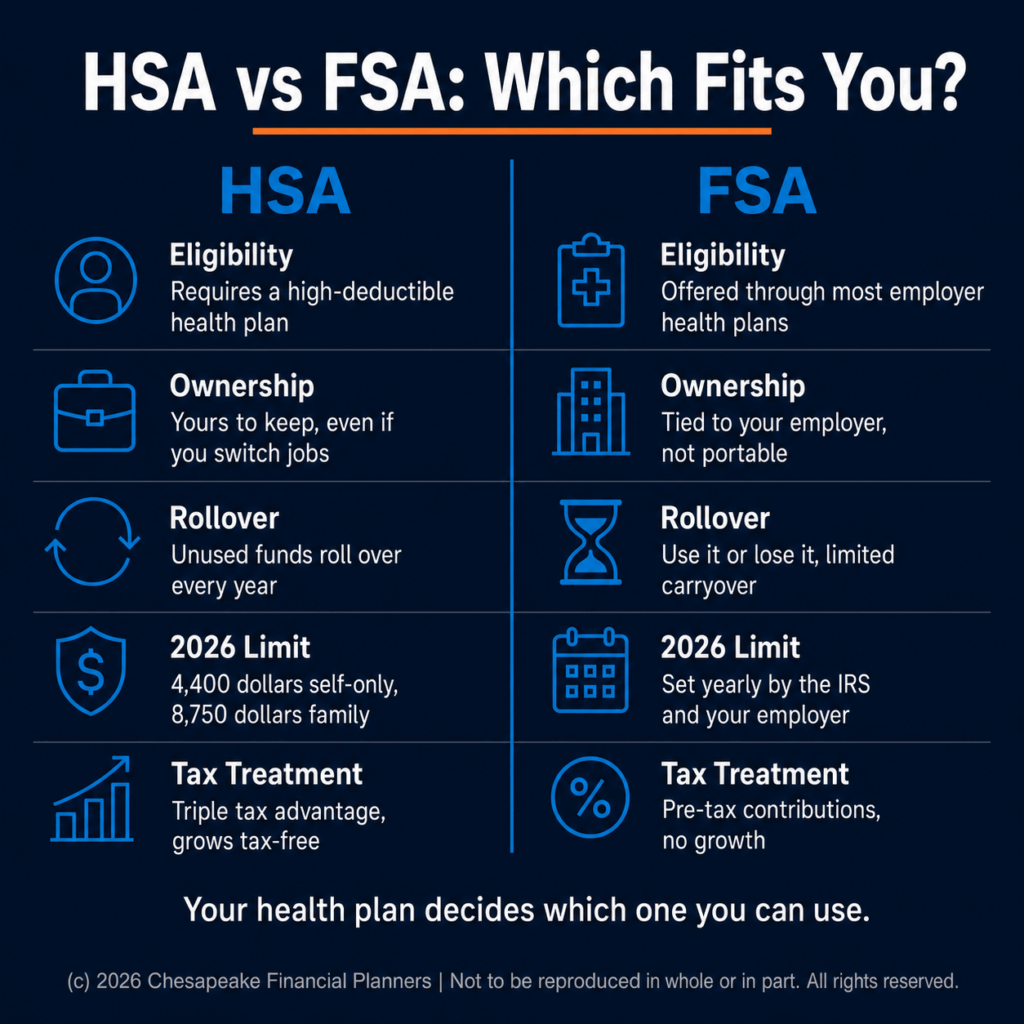
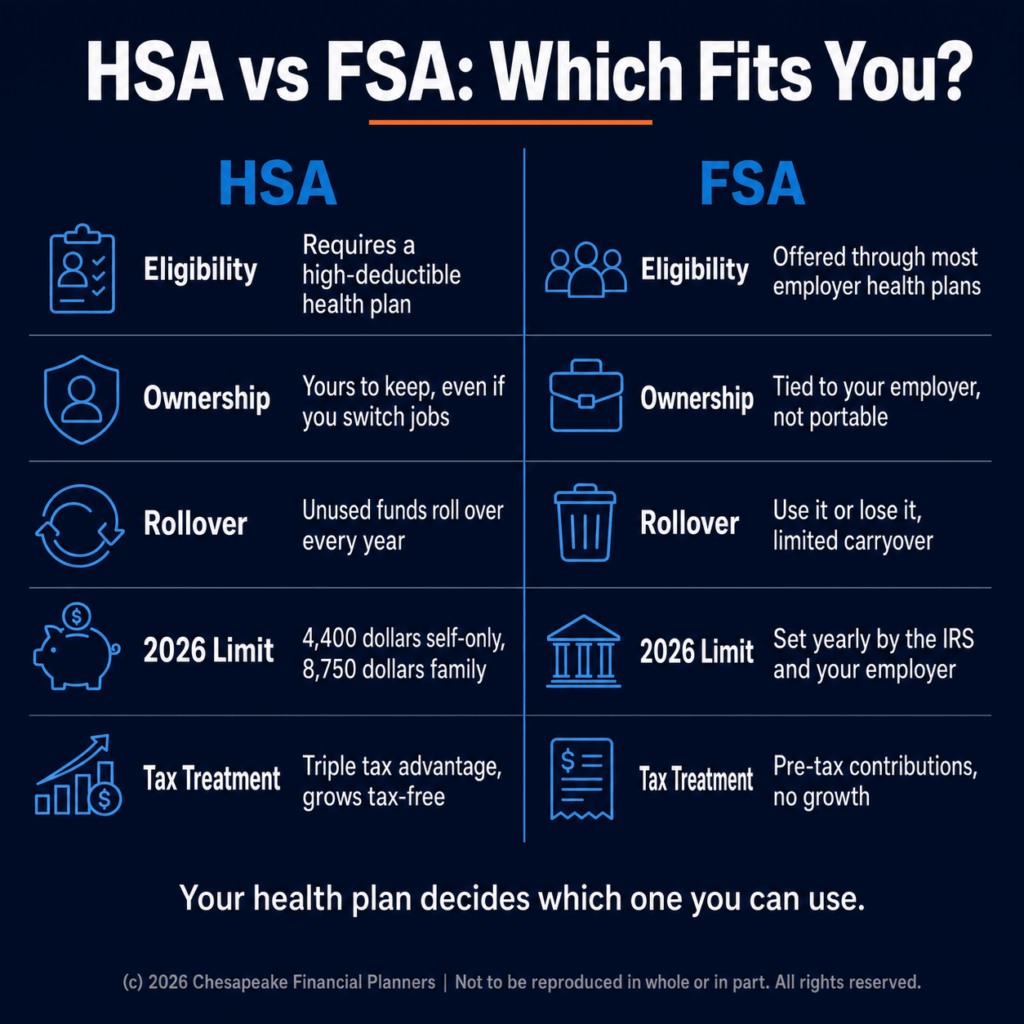
If you have to pick between an HSA and an FSA, choose the HSA whenever you can. A health savings account lets your money grow tax-free, roll over year after year, and follow you when you change jobs. An FSA does none of those three things. The catch is eligibility: you can only open an HSA if you have a high-deductible health plan. The hsa vs fsa decision usually comes down to which health plan you've enrolled in, not which account sounds better on paper.
Key Takeaways
- An HSA requires a high-deductible health plan; an FSA does not, but an FSA money mostly expires each year.
- The 2026 HSA contribution limit is $4,400 for self-only coverage and $8,750 for family coverage.
- The 2026 health FSA limit is $3,400, with a maximum carryover of $680 into the next year.
- HSA funds roll over forever and stay yours after you leave a job; FSA funds usually do not.
- People age 55 and older can add a $1,000 HSA catch-up contribution each year.
About the Author: Jeff Judge, CFP®, AEP®, ChFC®, CLU® is Managing Partner of Chesapeake Financial Planners in Forest Hill, Maryland. He has been helping families and business owners in Harford County and the Baltimore metro area navigate benefits and tax-advantaged accounts since earning his CFP® certification in 2013, by using Chesapeake Financial Planners’ signature process, the R.U.D.D.E.R. method™. Jeff often tells clients the HSA is the most underrated retirement account in the tax code, because most people treat it like a checking account when it can quietly become a second IRA.
What Is the Difference Between an HSA and an FSA?
A health savings account (HSA) is a personal account you own that pairs with a high-deductible health plan (HDHP). A flexible spending account (FSA) is an account your employer sets up that lets you set aside pre-tax money for medical costs. Both lower your taxable income. That's where the similarity ends.
The HSA is yours. The money stays put if you switch jobs, change insurance, or retire. It carries no annual deadline. The FSA belongs to your employer's plan, and most of the balance disappears at year-end unless the plan offers a small carryover or a short grace period.
The other big split is the triple tax advantage. With an HSA, contributions are deductible, growth is untaxed, and qualified withdrawals are untaxed. The IRS confirms an HSA can also be invested, so the balance can grow like a brokerage account. An FSA has no investment option and no growth. It's a spending account, not a savings account.
What are the fundamentals of personal financial planning?
What Are the 2026 Contribution Limits for HSAs and FSAs?
The numbers favor the HSA on raw capacity. For 2026, the IRS set HSA limits at $4,400 for self-only coverage and $8,750 for family coverage. If you're 55 or older, you can add a $1,000 catch-up contribution on top of that. A married couple who are both 55-plus and on a family HDHP can split contributions and each claim their own catch-up.
The 2026 health FSA limit is $3,400, with a maximum carryover of $680 into 2027 if your employer's plan allows it. Many plans cap carryover lower or use a grace period instead, so check your specific plan documents.
To qualify for HSA contributions in 2026, your plan must meet the HDHP rules: a minimum deductible of $1,700 for self-only or $3,400 for family coverage, with out-of-pocket maximums of $8,500 and $17,000.
| Feature | HSA (2026) | Health FSA (2026) |
|---|---|---|
| Contribution limit | $4,400 self / $8,750 family | $3,400 |
| Catch-up (age 55+) | $1,000 | None |
| Requires HDHP | Yes | No |
| Funds roll over | Yes, indefinitely | Up to $680 carryover, if allowed |
| Stays yours after job change | Yes | No |
| Can be invested | Yes | No |
How Much Should I Have in My Emergency Fund?
When Should You Choose an FSA Instead of an HSA?
Choose the FSA when you don't have a high-deductible health plan. That's the simplest rule. If your insurance is a traditional PPO or HMO with low deductibles, you can't contribute to an HSA at all, so the FSA becomes your only pre-tax medical option. It still saves you real money on copays, prescriptions, and predictable annual costs.
The FSA also wins on access timing. Your full annual election is available on day one of the plan year, even though you fund it over twelve months. So if you know you have a $2,000 dental bill coming in January, the FSA can cover it before you've contributed the full amount.
Jeff has watched clients leave hundreds of dollars on the table because they overfunded an FSA and then scrambled to spend it in December. The lesson: only put in what you're confident you'll spend. With an HSA, overfunding is never a problem because nothing expires.
What is the best way to pay off debt quickly?
Frequently Asked Questions
Can you have an HSA and an FSA at the same time?
Generally no, not a standard health FSA. The IRS treats a general-purpose FSA as disqualifying coverage that blocks HSA contributions. The exception is a limited-purpose FSA, which covers only dental and vision expenses. You can pair a limited-purpose FSA with an HSA and use both in the same year.
What happens to my HSA if I change jobs?
Your HSA stays entirely yours when you change jobs. Unlike an FSA, an HSA is a personal account, not an employer account, so the balance follows you regardless of where you work or whether you keep insurance. You can keep spending it on qualified medical costs or let it grow invested for the future.
Does FSA money expire at the end of the year?
Most FSA money does expire at year-end under the use-it-or-lose-it rule. Some employer plans offer a carryover of up to $680 for 2026 or a grace period of up to two and a half months to spend the prior year's balance. Check your specific plan, because not every employer offers either option.
Is an HSA better than an FSA for retirement?
Yes, an HSA is far better for retirement. After age 65, you can withdraw HSA funds for any reason and pay only ordinary income tax, just like a traditional IRA, while medical withdrawals stay tax-free. An FSA has no investment growth and no rollover, so it offers nothing for long-term retirement savings.
Do I need a high-deductible health plan to open an HSA?
Yes, you must be enrolled in a qualifying high-deductible health plan to contribute to an HSA. For 2026, that means a minimum deductible of $1,700 self-only or $3,400 family. You also cannot be enrolled in Medicare or claimed as a dependent on someone else's return.
Make the Most of Your Benefits Decision
The hsa vs fsa choice usually answers itself once you know your health plan, but the smarter move is choosing the plan with the account in mind. If you found this helpful, our financial planning foundations guide covers benefits, tax-advantaged accounts, and the rest of your money picture in depth. Download it at chesapeakefp.com.
Want to go deeper? Our Why Financial Advice Isn’t Just for Retirees walks through this step by step.
Disclosures
The information provided is for educational purposes only and should not be construed as investment advice. Investment strategies should be tailored to individual circumstances, risk tolerance, and goals. Past performance doesn't guarantee future results. Consult with qualified financial professionals regarding your specific situation.
This information is not intended to be a substitute for specific individualized tax, investment or legal advice. We suggest that you discuss your specific situation with a qualified tax, legal or financial advisor.
Advisors associated with Chesapeake Financial Planners may be either (1) LPL Financial Registered Representatives offering securities through LPL Financial, Member FINRA and SIPC, and investment advisor representatives offering investment advice through Great Valley Advisor Group; or (2) solely investment advisor representatives offering investment advice through Great Valley Advisor Group and not affiliated with LPL Financial. Great Valley Advisor Group, and Chesapeake Financial Planners are separate entities from LPL Financial.


