

Social Security Divorced Spouse Benefits: What Are You Entitled To?
Last reviewed: July 2026
If you were married for at least 10 years and are now divorced and unmarried, you may be entitled to Social Security benefits on your ex-spouse's record, worth up to 50% of their full benefit. These social security divorced spouse benefits do not reduce what your ex receives, and your ex is never even notified. Many divorced people, especially the lower-earning spouse in a long marriage, never claim this money simply because they do not know it exists.
Key Takeaways
- A divorced spouse can receive up to 50% of an ex-spouse's full Social Security benefit at full retirement age.
- You must have been married at least 10 years, be currently unmarried, and be at least 62 years old.
- Claiming on your ex's record does not reduce their benefit, and they are not notified that you applied.
- You receive the higher of your own benefit or the divorced-spouse benefit, not both added together.
About the Author: Jeff Judge, CFP®, AEP®, ChFC®, CLU® is Managing Partner of Chesapeake Financial Planners in Forest Hill, Maryland. He has been helping people in Harford County and the Baltimore metro area navigate Social Security since earning his CFP® certification in 2013, by using Chesapeake Financial Planners’ signature process, the R.U.D.D.E.R. method™. Jeff has watched divorced clients, more often women who stepped back from careers to raise families, discover thousands of dollars a year they assumed they had lost in the divorce.
What Are Social Security Divorced Spouse Benefits?
A divorced spouse benefit is a Social Security payment you can collect based on your ex-spouse's earnings record rather than your own. If your ex earned significantly more than you, this can be worth far more than your own benefit. The rule is simple: you receive the higher of your own retirement benefit or the divorced-spouse benefit, which can be up to half of your ex's full benefit. You do not get both stacked on top of each other.
Two features surprise almost everyone. First, claiming ex-spouse Social Security does not reduce your ex's benefit by a single dollar, and it does not affect a current spouse's benefit either. Second, your ex-spouse does not have to agree, does not get notified, and does not even need to know you filed. The benefit is yours by right under federal law if you qualify.
Who Qualifies for Divorced Spouse Benefits?
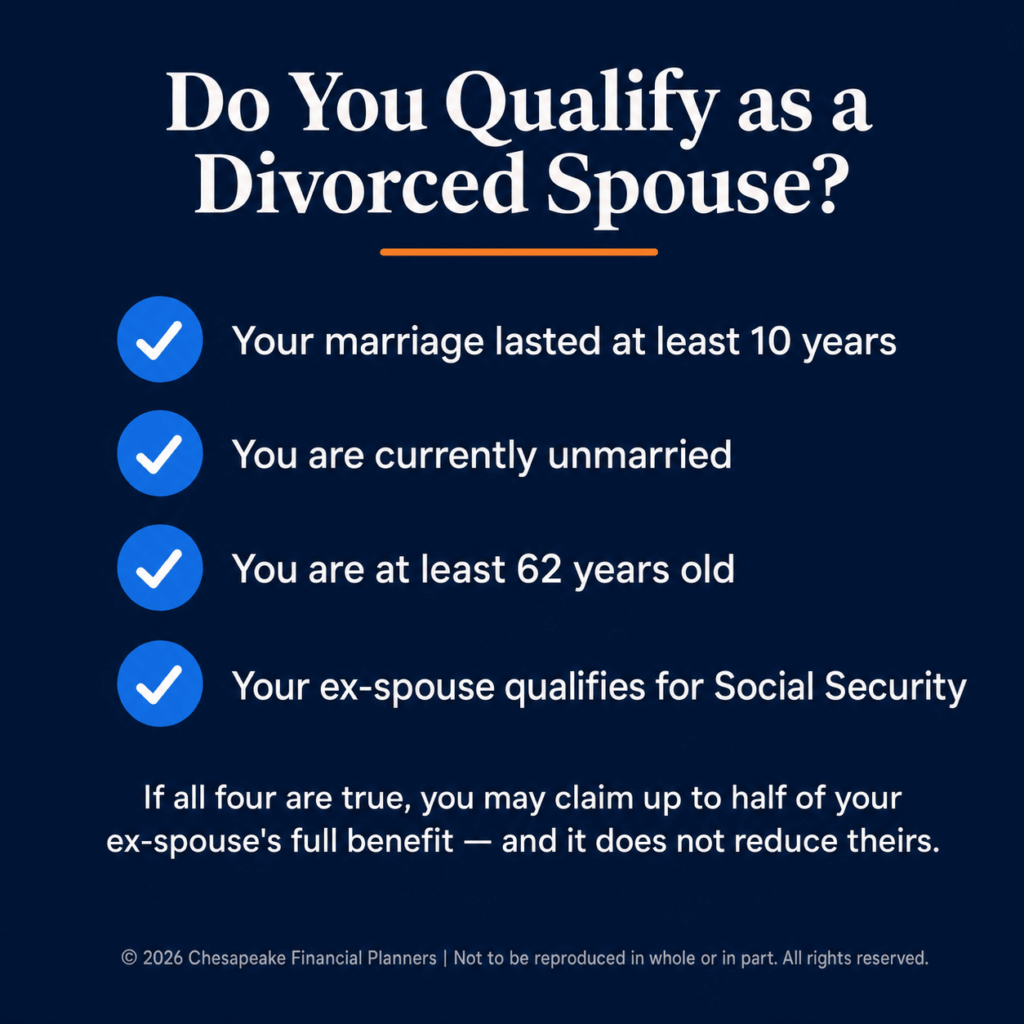
Eligibility comes down to a short checklist set by the Social Security Administration. You qualify to claim on an ex-spouse's record if all of the following are true.
- Your marriage lasted at least 10 years before the divorce was final.
- You are currently unmarried.
- You are at least 62 years old.
- Your ex-spouse is entitled to Social Security retirement or disability benefits.
There is one more helpful rule. If you have been divorced for at least two years, you can claim on your ex's record even if they have not started their own benefits yet, as long as you are both at least 62. This independence is a real advantage over married spouses, who must wait for the higher earner to file first.
How Much Can You Receive?
The maximum divorced spouse benefit is 50% of your ex-spouse's full retirement benefit, and you receive that maximum only if you wait until your own full retirement age to claim. Claim earlier, as early as 62, and the amount is permanently reduced, dropping to roughly a third of your ex's full benefit at the youngest age. Unlike your own retirement benefit, a spousal or divorced-spousal benefit does not grow past your full retirement age, so there is no reason to delay it beyond that point.
Remember that you collect the higher of the two benefits, not both. If your own benefit at full retirement age is larger than half of your ex's, you simply receive your own. The divorced spouse benefits matter most when your own earnings record is modest compared with your ex's. There is also a far larger benefit available if your ex-spouse has died: survivors can receive up to 100% of the deceased ex's benefit, and can claim as early as age 60. Either way, the benefit you receive may be partly taxable depending on your total income, as our Is Social Security Taxable? 2026 Tax Rules Explained guide explains.
How and When Should You Claim?
You apply directly with Social Security, not with your ex, using Form SSA-2 for spouse's or divorced spouse's benefits. You will need your marriage and divorce dates and your ex's Social Security number or enough information to identify their record. The Social Security Administration lets many people apply online within three months of turning 62.
Timing is where planning pays off. If your own benefit could eventually exceed the divorced-spouse amount, it can make sense to claim strategically and let your own benefit grow, a timing question our Should I Take Social Security at 62 or Wait Until 70? guide covers in depth. Jeff Judge often reminds divorced clients of one trap: if you remarry, you generally lose the ability to claim on a living ex-spouse's record. The women-focused nonprofit WISER notes that survivor rules are more forgiving, allowing remarriage after age 60 without losing a deceased ex's benefit. Run the numbers before you say "I do" again, because a remarriage can quietly cost you years of benefits.
Frequently Asked Questions
Can I collect Social Security on my ex-spouse's record?
Yes, if your marriage lasted at least 10 years, you are currently unmarried, you are at least 62, and your ex-spouse qualifies for Social Security. You can receive up to 50% of your ex's full benefit, or your own benefit if it is higher. You apply directly with Social Security, not through your ex-spouse.
Does claiming divorced spouse benefits reduce my ex's benefit?
No. Claiming on your ex-spouse's record has no effect on the amount your ex receives, and it does not reduce benefits for their current spouse either. Social Security pays the divorced-spouse benefit separately. This is true even if multiple ex-spouses from marriages of 10 years or more all claim on the same person's record.
Will my ex-spouse be notified if I claim on their record?
No. Your ex-spouse is not notified and does not need to consent when you claim divorced spouse benefits. The claim is processed by Social Security using their earnings record, and it does not appear to them or affect their account. You only need accurate information about your marriage, divorce, and your ex-spouse's identity.
What happens if I remarried?
If you remarry, you generally cannot collect benefits on a living ex-spouse's record while that new marriage continues. If the later marriage ends by divorce, annulment, or death, eligibility on the prior ex's record can be restored. Survivor benefits are different: you may remarry after age 60 and still collect on a deceased ex-spouse's record.
How long do I have to have been married?
Your marriage must have lasted at least 10 years before the divorce became final to qualify for divorced spouse benefits. A marriage of nine years and eleven months does not count, so the exact dates matter. If you are approaching the 10-year mark during a divorce, the timing of the final decree can have lasting financial consequences worth discussing with an attorney.
So the bottom line on Social Security divorced spouse benefits is that a long marriage that ended can still provide real retirement income, often without you ever contacting your ex. Check whether you qualify before you assume you do not, and coordinate the timing with your own benefit. If you want a simple framework for fitting Social Security into your full retirement plan, our What are the fundamentals of personal financial planning? walks through it step by step. Download it at chesapeakefp.com. Jeff Judge notes: "I have seen divorced clients leave significant Social Security income on the table simply because they assumed a marriage that ended could not still benefit them, so always verify your eligibility and coordinate the claiming age with your own retirement date before you file."
Want to go deeper? Our 10 Signs You're Ready for a Certified Financial Planner walks through this step by step.
This material is for educational purposes only and should not be considered tax or legal advice. Please consult with your tax advisor or attorney regarding your specific situation.
The opinions voiced in this material are for general information only and are not intended to provide specific advice or recommendations for any individual.
All investing involves risk including loss of principal. No strategy assures success or protects against loss.
There is no guarantee that a diversified portfolio will enhance overall returns or outperform a non-diversified portfolio. Diversification does not protect against market risk.
Disclosures
The information provided is for educational purposes only and should not be construed as investment advice. Investment strategies should be tailored to individual circumstances, risk tolerance, and goals. Past performance doesn't guarantee future results. Consult with qualified financial professionals regarding your specific situation.
Advisors associated with Chesapeake Financial Planners may be either (1) LPL Financial Registered Representatives offering securities through LPL Financial, Member FINRA and SIPC, and investment advisor representatives offering investment advice through Great Valley Advisor Group; or (2) solely investment advisor representatives offering investment advice through Great Valley Advisor Group and not affiliated with LPL Financial. Great Valley Advisor Group, and Chesapeake Financial Planners are separate entities from LPL Financial.


