

What is key person insurance, and does my business need it?
Last reviewed: July 2026
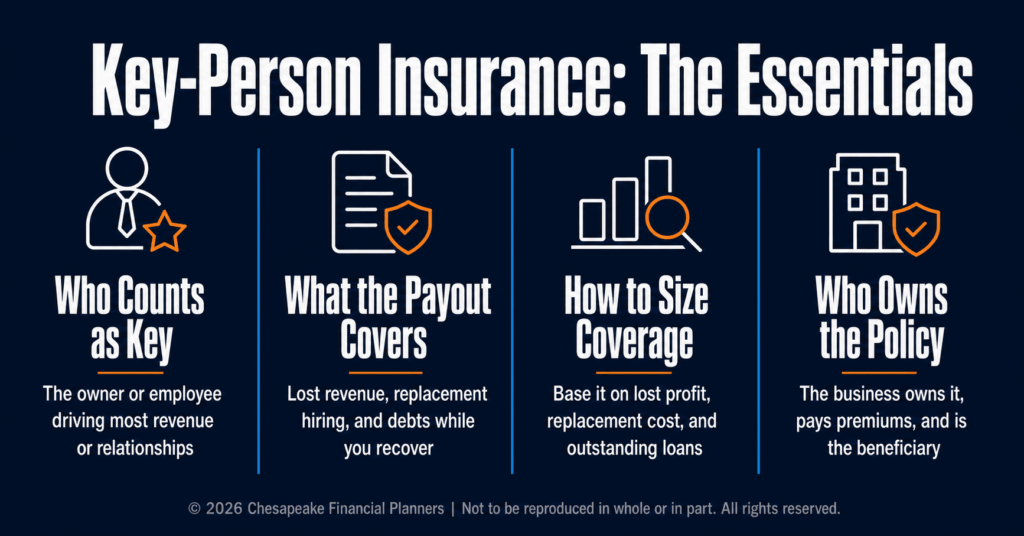
Key person insurance is a life insurance policy a business buys on the life of an owner, executive, or employee whose death would seriously damage the company's revenue, operations, or creditworthiness. The business owns the policy, pays the premiums, and receives the death benefit. That payout gives the company cash to survive the disruption, recruit a replacement, reassure lenders, and buy time to stabilize. If the loss of one person would put your business at real financial risk, the answer is usually yes.
Key Takeaways
- Key person insurance pays the business, not the family, when a critical owner or employee dies unexpectedly.
- About 71% of U.S. businesses say they are highly dependent on one or two key people, per LIMRA research.
- The death benefit funds replacement hiring, debt reassurance, and lost revenue while the company recovers.
- Premiums are generally not tax-deductible, but the death benefit is usually received income-tax-free.
- Lenders and SBA loans frequently require a key person policy as a condition of financing.
About the Author: Jeff Judge, CFP®, AEP®, ChFC®, CLU® is Managing Partner of Chesapeake Financial Planners in Forest Hill, Maryland. He has been helping families and business owners in Harford County and the Baltimore metro area navigate business continuity and risk management since earning his CFP® certification in 2013, by using Chesapeake Financial Planners’ signature process, the R.U.D.D.E.R. method™. Jeff has seen too many owners insure their building and their trucks but never the one person whose absence would actually close the doors.
Most business owners protect their physical assets without a second thought. They insure the warehouse, the equipment, the company vehicles. Then they overlook the single biggest asset on the balance sheet, which is often a person. Key person insurance fixes that gap. Here is how it works, who needs it, and how to size a policy correctly.
What is key person insurance and how does it work?
Key person insurance (sometimes called key man insurance or business continuity insurance) is a policy the business owns on a person it cannot afford to lose. The company is the applicant, the premium payer, and the beneficiary. When that person dies, the company collects the death benefit and uses it to weather the financial shock.
The mechanics are straightforward. The business applies for coverage, the insured person goes through underwriting and a medical exam, and the policy is issued in the company's name. The insured employee has no ownership of the policy and their family receives nothing from it. This is a corporate asset, not a personal benefit.
Why does the business need that cash? A sudden death triggers a cascade. Revenue tied to that person's relationships or skills disappears. Replacing them takes months and recruiting costs money. Lenders may call loans or freeze credit lines. Customers and suppliers get nervous. The death benefit absorbs that hit so the business does not have to liquidate assets or take on emergency debt at the worst possible moment.
According to LIMRA, roughly 71% of small businesses report being highly dependent on one or two key people, yet most carry no coverage protecting against their loss. That gap is exactly what this product fills.
What Is a Buy-Sell Agreement and Why Do Business Partners Need One?
Does my business need key person insurance?
Your business needs key person insurance if the death of a single person would cause a measurable drop in revenue, a loss of financing, or a serious operational gap. That standard covers more businesses than owners realize.
Run a simple test. Picture the most critical person in your company gone tomorrow. Does revenue fall? Do key client relationships walk out the door? Does the company lose its top salesperson, its lead engineer, its rainmaker, or the founder whose name is on the contracts? Would the bank get nervous? If you answered yes to any of these, you have a key person exposure.
Common candidates include the founder or majority owner, a co-owner whose skills are not easily replaced, a top producer responsible for a large share of sales, and a specialized technical employee whose knowledge keeps operations running. In a lot of small companies, that person is the owner. The U.S. Small Business Administration reports there are over 33 million small businesses in the country, and the majority are closely held operations where one or two people drive the entire enterprise.
Jeff Judge often tells business-owner clients that the test is not whether someone is important. Everyone is important. The test is whether the company would face a genuine financial crisis if that specific person were gone. That narrows the list quickly and tells you exactly who to insure.
What Do Business Owners Most Often Forget to Plan Before Exiting?
How much key person insurance do I need?
The right coverage amount equals the financial cost of replacing the person plus the revenue you would lose while the business recovers. Several methods exist, and most advisors blend them rather than relying on a single formula.
The multiple-of-salary method sets coverage at five to ten times the key person's annual compensation. Simple, but it ignores revenue impact for owners who pay themselves modestly.
The replacement-cost method adds up recruiting fees, signing bonuses, training costs, and the salary premium needed to hire someone of equal caliber. This works well for hard-to-replace technical and executive roles.
The contribution-to-earnings method estimates the share of profit directly attributable to the key person and multiplies it by the number of years the business needs to recover, often two to three years. This is usually the most accurate for a true revenue driver.
Here is a simple worked example. Suppose a company's top salesperson generates $1.2 million in annual gross profit, and the business estimates it would take three years to rebuild that revenue with a new hire. Replacing them would cost roughly $90,000 in recruiting and ramp-up. A reasonable coverage figure blends the two: about $300,000 to $400,000 per recovery year for lost contribution, plus the replacement cost, landing in the range of $1 million to $1.5 million of death benefit. Lenders may also dictate a minimum if the policy backs a loan. Jeff Judge notes: "When a lender is in the picture, they will often set their own minimum coverage requirement tied to the loan balance, so the blended calculation of lost earnings plus replacement cost has to be checked against what the bank actually demands before you settle on a face amount."
How much is my business actually worth if I want to sell?
What does key person insurance cost, and which policy type is best?
Key person insurance is typically priced as either term or permanent coverage, and for most businesses term insurance delivers the most protection per dollar. The right choice depends on how long the exposure lasts and whether the policy needs to build cash value.
Term insurance covers a set period, usually 10 to 30 years, with level premiums and no cash value. It is the cheapest way to buy a large death benefit. A healthy 45-year-old key employee might be insured for $1 million of 20-year term coverage for roughly $700 to $1,200 per year, depending on health and the carrier. For a business protecting against a defined-period risk, such as the years until an owner exits or a loan is repaid, term is usually the clear winner.
Permanent insurance (whole or universal life) costs substantially more but builds cash value the business owns and can access. Some owners use permanent key person coverage that later converts into part of a buy-sell arrangement or a retirement bonus. The premium can run five to ten times higher than comparable term coverage, so it only makes sense when the cash value serves a deliberate planning purpose.
| Feature | Term Life | Permanent Life |
|---|---|---|
| Coverage period | Fixed (10, 20, 30 years) | Lifetime |
| Cash value | None | Accumulates over time |
| Annual cost, $1M of 20-yr coverage (healthy 45-year-old) | Roughly $700 to $1,200 | Roughly 5 to 10 times the term premium |
| Best fit | Key employees, cash-flow-conscious firms | Owner succession, dual-purpose policies |
One important note on financing. When a policy backs a business loan, the lender may require a collateral assignment, which gives the bank a claim on the death benefit up to the outstanding loan balance. SBA loans frequently require this. The assignment does not change who owns the policy; it simply directs part of any payout to satisfy the debt before the remainder flows to the business. Jeff has watched lenders make a key person policy a non-negotiable condition of closing, so owners pursuing financing should price coverage early.
How do business owners plan for retirement differently?
How does key person insurance fit into a broader plan?
Key person insurance is one piece of a complete business continuity strategy, and it works best alongside a buy-sell agreement, succession planning, and a clear understanding of what the business is worth. Treating it in isolation leaves gaps.
At Chesapeake Financial Planners, we work through these decisions using the R.U.D.D.E.R. Method™, our six-step planning process: Review and Recognize, Uncover and Understand, Design and Develop, Discuss and Decide, Execute and Empower, and Reassess and Refine. Risk like this surfaces during the Uncover and Understand phase, when we map out which people, contracts, and cash flows the business genuinely depends on.
A key person policy answers one question: what happens if a critical person dies? A buy-sell agreement answers a different one: what happens to the ownership stake. Succession planning answers a third: who runs the company next. Owners who address all three sleep better, and so do their lenders.
Frequently Asked Questions
Is key person insurance tax deductible?
No, key person insurance premiums are generally not tax-deductible because the business is the policy beneficiary. The trade-off works in your favor, though. Per IRS rules under Section 101, the death benefit a business receives is usually income-tax-free, provided the company met the notice and consent requirements when the policy was issued.
Who owns and pays for a key person insurance policy?
The business owns the policy, pays the premiums, and is named as the beneficiary. The insured employee or owner has no ownership interest and their family receives nothing from it. This is a corporate asset designed to protect the company, which is the entire reason the death benefit flows to the business rather than to the insured's estate.
What is the difference between key person insurance and a buy-sell agreement?
Key person insurance replaces lost revenue and covers the cost of recovering from a critical person's death, paying the business directly. A buy-sell agreement governs what happens to that person's ownership stake, funding the purchase of their shares by surviving owners. Many businesses need both because they solve two completely separate problems.
How long does key person insurance last?
Key person insurance lasts as long as the exposure does, which is why term lengths are commonly matched to a specific risk window. A policy might run 10 to 20 years to cover the period until an owner exits, a loan is repaid, or a successor is fully trained. Once the key person is no longer critical, the coverage can be dropped or repurposed.
Can a business deduct the death benefit if a key person dies?
The death benefit is generally received income-tax-free rather than deducted, since it is a payout, not an expense. To preserve that tax-free treatment, the business must have satisfied the employer-owned life insurance notice and consent rules in IRS Section 101(j) before the policy was issued. Skipping that paperwork can make the proceeds taxable.
Does an SBA loan require key person insurance?
Yes, SBA loans frequently require key person insurance, especially when the business depends heavily on one owner or employee. The Small Business Administration and participating lenders often condition financing on a collateral assignment of the policy, which directs the death benefit to repay the outstanding loan balance before any remainder goes to the business.
If you own a business that would struggle to survive the loss of a critical person, key person insurance deserves a place in your planning conversation. Our free guide on business continuity walks through how to identify your key people and size coverage correctly. Download it at chesapeakefp.com.
Want to go deeper? Our 10 Signs You're Ready for a Certified Financial Planner walks through this step by step.
Disclosures
The information provided is for educational purposes only and should not be construed as investment advice. Investment strategies should be tailored to individual circumstances, risk tolerance, and goals. Past performance doesn't guarantee future results. Consult with qualified financial professionals regarding your specific situation.
This material is for educational purposes only. Insurance products contain exclusions, limitations, and terms for keeping them in force. Please contact a qualified insurance professional for costs and complete details.
Advisors associated with Chesapeake Financial Planners may be either (1) LPL Financial Registered Representatives offering securities through LPL Financial, Member FINRA and SIPC, and investment advisor representatives offering investment advice through Great Valley Advisor Group; or (2) solely investment advisor representatives offering investment advice through Great Valley Advisor Group and not affiliated with LPL Financial. Great Valley Advisor Group, and Chesapeake Financial Planners are separate entities from LPL Financial.


