

What Is Key Person Insurance and Does My Business Need It?
Last reviewed: July 2026
Key person insurance is a life insurance policy a business owns on an individual whose death or disability would seriously damage the company's revenue or operations. The business pays the premiums, owns the policy, and collects the death benefit, then uses that cash to absorb lost income, recruit a replacement, and reassure lenders and clients. If your company would lose a meaningful chunk of revenue the day one specific person walked out the door, you likely need it.
Key Takeaways
- Key person insurance pays the business, not the family, when a critical employee or owner dies or becomes disabled.
- Roughly one in four of today's 20-year-olds will experience a disability before retirement, per Social Security Administration data.
- Coverage is commonly set at 5 to 10 times the key person's annual compensation, or by projected lost revenue.
- Lenders frequently require key person coverage as a condition of business loans.
- Term policies cost less; permanent policies build cash value the business can tap later.
About the Author: Jeff Judge, CFP®, AEP®, ChFC®, CLU® is Managing Partner of Chesapeake Financial Planners in Forest Hill, Maryland. He has been helping families and business owners in Harford County and the Baltimore metro area navigate business continuity and risk planning since earning his CFP® certification in 2013, by using Chesapeake Financial Planners’ signature process, the R.U.D.D.E.R. method™. Jeff has watched profitable companies stall for a year because no one calculated what a single key departure would actually cost until it happened.
What Does Key Person Insurance Actually Cover?
Key person insurance covers the financial hit a business takes when someone essential dies or becomes too disabled to work. The company owns the policy and receives the benefit, so the money goes straight to the business rather than to a family or estate.
That cash does several jobs at once. It offsets revenue that walks out with the person. It funds the real cost of recruiting and training a replacement, which for a senior or specialized role can run six to twelve months before the new hire is productive. It reassures banks, investors, and clients that the company can survive the transition. And it buys time to execute a backup plan without the pressure of a cash crunch.
The point is not to replace the person. Often that is impossible. A founder's technical judgment or a rainmaker's relationships cannot be bought with a check. What the benefit buys is runway, the financial breathing room to adapt instead of scramble.
The risk this addresses is concentrated dependence. According to the U.S. Small Business Administration, the overwhelming majority of U.S. businesses are small firms, and in many of them a single owner or employee drives most of the revenue. That concentration is exactly what makes one departure so dangerous.
Does My Business Actually Need Key Person Insurance?
Your business needs key person insurance if losing one specific individual would cause immediate revenue loss, operational chaos, or a financing problem you could not quickly fix. Run through these questions to find out.
Would losing this person cause immediate revenue loss? If a salesperson controls major accounts or a professional bills the bulk of the firm's billable hours, their exit opens an instant financial gap.
How long would it take to replace them? Specialized technical roles and senior leadership often take many months to fill competently. The longer that timeline, the more cash you need to bridge it.
Is critical knowledge concentrated in one head? When key processes, vendor relationships, or expertise live with one person and nowhere else, losing them creates problems that reach well beyond a revenue dip.
Do lenders or investors worry about key person risk? Banks frequently require key person coverage as a loan condition for companies that lean on one or two people. Check your existing loan covenants. The requirement may already be there.
Would their loss jeopardize major contracts? Some clients buy because of one specific person. That person's departure can trigger cancellations before you've even posted the job opening.
Jeff Judge tells business owners a blunt version of this: if you can name the one person whose absence would keep you up at night, you already have your answer. If two or more of these questions land hard, the conversation is worth having now, not after.
How Much Key Person Insurance Coverage Do You Need?
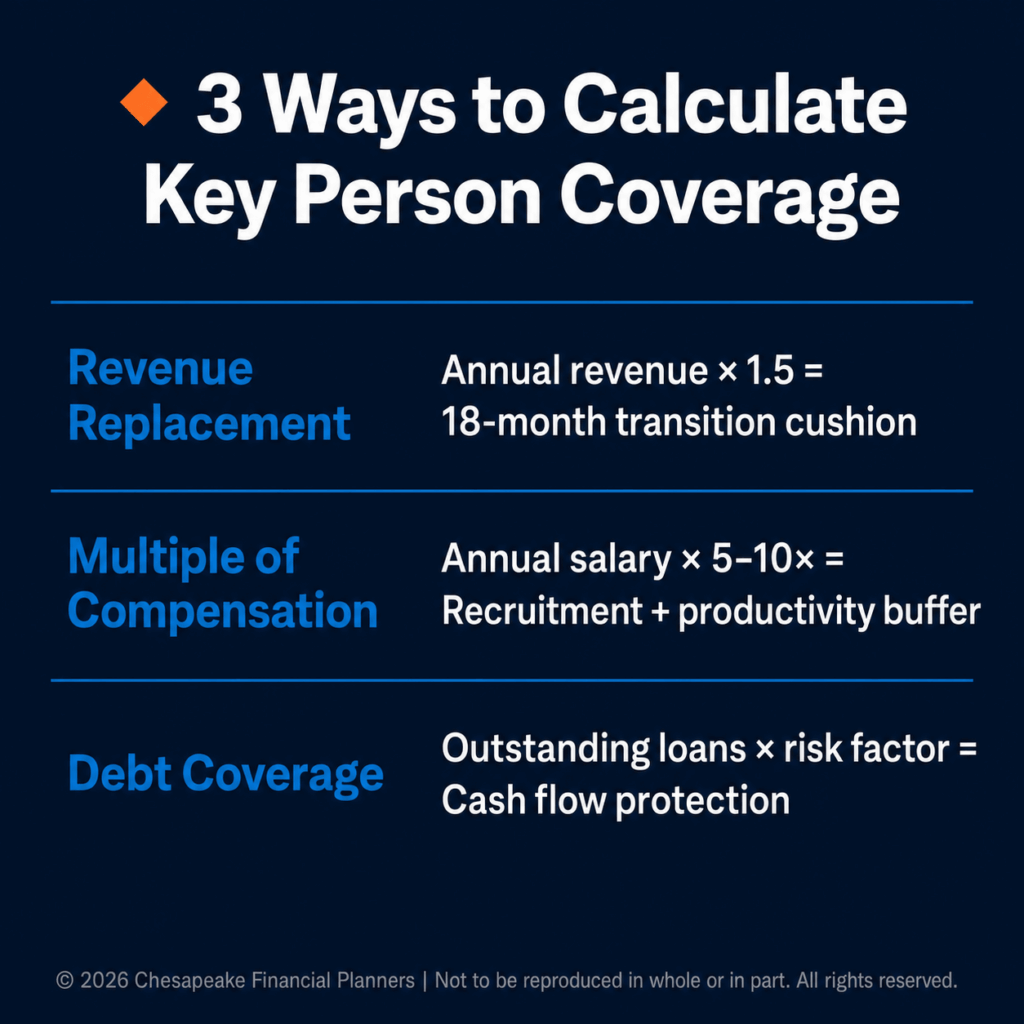
There is no single formula, but three methods cover most situations. Pick the one that matches how the key person creates value.
| Method | How it works | Best for |
|---|---|---|
| Revenue replacement | Coverage equals lost revenue across the time to replace and ramp up a successor | Sales leaders, billing professionals |
| Multiple of compensation | 5 to 10 times the person's annual pay | Executives, general key roles |
| Debt coverage | Enough to service loan payments through a revenue downturn | Leveraged businesses, loan covenants |
Revenue replacement method. Calculate the revenue the person generates, then estimate how long replacement and ramp-up take. A salesperson producing $2 million a year who takes 12 months to replace and six months to ramp points toward roughly $2 to $3 million of coverage to bridge an 18-month transition.
Multiple of compensation. A faster rule of thumb is 5 to 10 times annual compensation. A key executive earning $200,000 lands around $1 to $2 million, enough cushion for recruiting, training, and lost productivity.
Debt coverage method. If the business carries debt, make sure coverage can service payments through a downturn. With $1.5 million in loans and cash flow that would drop sharply without the key person, coverage in the $500,000 to $1 million range often keeps the company current while it recovers.
For owner-dependent businesses, key person planning rarely stands alone. It usually sits alongside a What Is a Buy-Sell Agreement and Why Do Business Partners Need One? and a broader When Should Business Exit Planning Start Before a Sale?. Jeff's R.U.D.D.E.R. Method™, Chesapeake Financial Planners' six-step planning process of Review and Recognize, Uncover and Understand, Design and Develop, Discuss and Decide, Execute and Empower, and Reassess and Refine, treats key person risk as one piece of a connected plan rather than a standalone policy purchase. Jeff Judge notes: "I rarely see a key person policy make sense in isolation — it almost always needs to be coordinated with the buy-sell agreement and the owner's exit timeline, otherwise you're solving one piece of the puzzle while leaving the rest of the business exposed."
What Types of Key Person Insurance Are Available?
Three structures cover the common scenarios, and they are not mutually exclusive.
Term life insurance covers a set period, typically 10, 20, or 30 years. Premiums run lower, but coverage ends if you don't renew. It fits younger key employees or temporary, defined risk windows.
Permanent life insurance covers the person for life and builds cash value the business can access later. It costs more, but that cash value can support How Should Business Owners Pay Themselves Salary vs Distributions? or future liquidity needs. It suits owner-operators and long-tenured key executives.
Disability coverage protects against the more likely event. The Social Security Administration notes that roughly one in four of today's 20-year-olds will become disabled before reaching retirement age, which makes disability a more common working-age threat than death. A key person who survives but can no longer work still leaves the same revenue gap, so many businesses pair death and disability coverage.
The Insurance Information Institute and major carriers underwrite these policies based on the insured's health and the business's documented dependence, so expect to justify the coverage amount during underwriting.
Frequently Asked Questions
Who owns and pays for key person insurance?
The business owns the policy, pays the premiums, and is named as the beneficiary. Because the company collects the death benefit directly, the proceeds are available to cover operating losses, recruiting, and debt rather than passing to the insured person's family or estate.
Are key person insurance premiums tax deductible?
Key person insurance premiums are generally not tax deductible because the business is the beneficiary. The trade-off is that the death benefit is usually received income-tax-free if certain notice and consent requirements are met. Confirm your specific situation with your tax advisor, since rules around employer-owned life insurance are detailed.
How is key person insurance different from a buy-sell agreement?
Key person insurance replaces lost income and operating value when a critical person dies or is disabled, paying the company directly. A buy-sell agreement governs the transfer of ownership and is often funded by a separate policy. Many businesses need both, because they solve two different problems: continuity versus ownership succession.
Can I insure a business partner or co-founder as a key person?
Yes, a business can insure a partner, co-founder, or owner as a key person when that individual drives significant revenue or operations. The company must demonstrate an insurable interest and the person must consent in writing. Co-founders are among the most common subjects of key person coverage for small companies.
What happens to the policy if the key person leaves the company?
When a key person leaves, the business can let the policy lapse, surrender a permanent policy for its cash value, or sometimes transfer ownership to the departing individual. The right move depends on the policy type and any remaining business need. Review the decision rather than letting coverage drift on autopilot.
Key person insurance is one of the simplest ways to protect a business that quietly depends on one person, and most owners underestimate the gap until they model it out. If you want to think through whether this fits your company, our guide to protecting owner-dependent businesses walks through the full picture. Download it at chesapeakefp.com.
Want to go deeper? Our 10 Signs You're Ready for a Certified Financial Planner walks through this step by step.
Disclosures
The information provided is for educational purposes only and should not be construed as investment advice. Investment strategies should be tailored to individual circumstances, risk tolerance, and goals. Past performance doesn't guarantee future results. Consult with qualified financial professionals regarding your specific situation.
This material is for educational purposes only. Insurance products contain exclusions, limitations, and terms for keeping them in force. Please contact a qualified insurance professional for costs and complete details.
Advisors associated with Chesapeake Financial Planners may be either (1) LPL Financial Registered Representatives offering securities through LPL Financial, Member FINRA and SIPC, and investment advisor representatives offering investment advice through Great Valley Advisor Group; or (2) solely investment advisor representatives offering investment advice through Great Valley Advisor Group and not affiliated with LPL Financial. Great Valley Advisor Group, and Chesapeake Financial Planners are separate entities from LPL Financial.


