

Should I rebalance my investment portfolio every year?
Last reviewed: July 2026
A fixed annual schedule is not the only smart way to rebalance, and for many investors it is not the best one. Portfolio rebalancing frequency should be driven by how far your asset allocation has drifted, not by the calendar. The strongest evidence supports a hybrid approach: check your portfolio at least once a year, but only trade when an asset class drifts past a set threshold, usually around 5 percentage points.
Key Takeaways
- Rebalancing realigns your portfolio to its target allocation, which controls risk rather than chasing higher returns.
- Threshold-based rebalancing trades only when an asset class drifts past a set band, often 5 percentage points.
- FINRA recommends rebalancing as part of routine portfolio maintenance to keep risk aligned with your goals.
- A hybrid method combines a yearly review with a drift threshold, cutting unnecessary trades and taxes.
- In taxable accounts, rebalancing with new cash and dividends often beats selling appreciated positions outright.
About the Author: Jeff Judge, CFP®, AEP®, ChFC®, CLU® is Managing Partner of Chesapeake Financial Planners in Forest Hill, Maryland. He has been helping families and business owners in Harford County and the Baltimore metro area navigate investment and asset allocation decisions since earning his CFP® certification in 2013, by using Chesapeake Financial Planners’ signature process, the R.U.D.D.E.R. method™. Jeff often reminds clients that rebalancing is a risk-control tool first and a return tool a distant second, and the investors who get it wrong usually do so by overtrading.
What Does Portfolio Rebalancing Actually Do?
Rebalancing is the process of realigning your portfolio back to your target asset allocation. Over time, some investments grow faster than others. If stocks outrun bonds, a portfolio built at 60/40 can drift to 70/30 without you placing a single trade. That drift quietly changes your risk profile. A mix designed for moderate risk becomes more aggressive, and the next downturn hits harder than you planned for.
Rebalancing does two jobs. First, it manages risk by keeping your allocation aligned with your tolerance. You picked your original mix for a reason. Second, it imposes discipline: you sell what has run up and buy what has lagged, which is buying low and selling high without the emotion. According to Morningstar, the durable benefit of rebalancing is risk control, not a reliable return boost. That distinction matters, because investors who chase returns through frequent trading usually pay for it in costs and taxes. Jeff Judge notes: "Rebalancing isn't about squeezing out extra returns — it's about making sure the risk you're taking in year ten still matches the risk you agreed to take in year one."
This is where the R.U.D.D.E.R. Method™ earns its keep. The R.U.D.D.E.R. Method™ is Chesapeake Financial Planners' six-step planning process: Review and Recognize, Uncover and Understand, Design and Develop, Discuss and Decide, Execute and Empower, and Reassess and Refine. Rebalancing lives in that final step, Reassess and Refine, where you check whether your plan still matches reality.
How should my investment mix change as I get closer to retirement?

Is Annual Rebalancing the Right Frequency?
Annual rebalancing is the default many platforms recommend because it is simple and predictable. Set a calendar reminder, review once, rebalance if needed, and move on. You do not need to watch markets daily, and you can fold the review into year-end tax planning in December, harvesting losses or timing gains while you trade.
The weakness is the calendar itself. Nothing is special about December 31. Your portfolio might drift sharply in March and sit out of alignment for nine months before your annual check catches it. Worse, fixed annual rebalancing can be too frequent in calm years, generating trading costs you did not need, or not frequent enough during volatile stretches when drift accelerates fast.
Research from Vanguard found that rebalancing frequency matters far less than the simple act of rebalancing at all. Annual, semiannual, and threshold methods produced broadly similar risk-adjusted results across long horizons. The takeaway is not that timing is irrelevant, but that obsessing over the perfect calendar date is wasted effort. Pick a sensible rule and stick to it.
Jeff has watched clients talk themselves into quarterly rebalancing because it feels more diligent. In a taxable account, that diligence often backfires, racking up short-term gains and trading costs that erode the very returns they were trying to protect.
What Is Threshold-Based Rebalancing?
Threshold-based rebalancing trades only when an asset class drifts beyond a set percentage from its target, instead of on a fixed schedule. Say your target stock allocation is 60% with a 5-point band. You rebalance only when stocks reach 65% or fall to 55%, a move large enough to justify the cost and tax of trading.
The appeal is responsiveness. You address risk when it actually exists, not arbitrarily on a date. In stable markets you might go years without a trade, keeping costs and taxes low. During a sharp selloff, when drift can spike quickly, the threshold triggers a response immediately rather than waiting for an annual review.
The cost is attention. You have to monitor the portfolio periodically to know whether a band has been breached, which takes more discipline than a once-a-year calendar note. And in whipsaw markets, a tight threshold can fire repeatedly, generating excess trades. The fix is a sensible band width. A 5-point absolute band, or a relative band of roughly 20% to 25% of the target weight, keeps trading from getting twitchy.
Is my portfolio diversified enough to handle market volatility?
How Do Taxes Change Your Rebalancing Strategy?
Taxes are where rebalancing frequency stops being academic. In a tax-deferred account like an IRA or 401(k), you can rebalance freely because trades do not trigger taxable events. In a taxable brokerage account, every sale of an appreciated position can create a capital gain. Under current IRS rules, assets held longer than a year are taxed at long-term capital gains rates, while positions sold within a year face higher ordinary income rates.
That reality reshapes the smart approach. The most tax-efficient way to rebalance a taxable account is often to avoid selling at all. Direct new contributions, dividends, and interest toward the underweight asset class. Over time, fresh cash nudges the portfolio back toward target without realizing a single gain. When you do need to sell, pair it with tax-loss harvesting where possible, and favor lots with the lowest embedded gains.
Jeff often tells business owners with lumpy, irregular income that this cash-flow rebalancing is a quiet advantage. A strong year that lands a big deposit becomes a chance to top up the lagging asset class instead of a trade that hands the IRS a bill.
How can I reduce investment fees and keep more returns?
Which Rebalancing Approach Should You Choose?
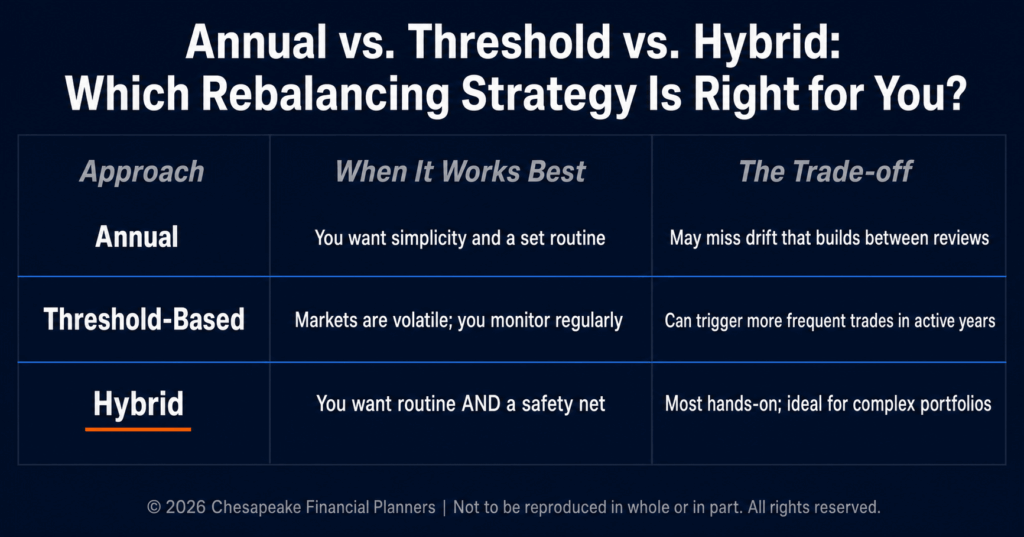
For most investors, the hybrid approach wins: review your portfolio at least annually, but only rebalance when an asset class has drifted past your threshold. If nothing has moved more than 5 points, you leave it alone. This gives you the discipline of a regular review without paying for trades that do not change your risk in any meaningful way.
The table below compares the three common methods on the dimensions that actually matter.
| Dimension | Annual (calendar) | Threshold-based | Hybrid (review + threshold) |
|---|---|---|---|
| Trading frequency | Fixed, once a year | Only when drift exceeds band | Low; trades only on breach |
| Monitoring effort | Minimal | Ongoing | Moderate (annual check) |
| Risk responsiveness | Lags between reviews | Fast | Fast on review, capped between |
| Tax efficiency | Moderate | Depends on band width | High when paired with cash flow |
| Best fit | Hands-off investors | Active monitors | Most long-term investors |
Whatever you choose, the rule beats the impulse. The investors who hurt themselves are not the ones on the "wrong" schedule. They are the ones who abandon any schedule when markets get scary and either freeze or overtrade.
How Can I Avoid Making Emotional Investment Decisions?
Frequently Asked Questions
How often should I rebalance my portfolio?
Most long-term investors should review their portfolio at least once a year and rebalance only when an asset class drifts more than about 5 percentage points from its target. Vanguard research found that frequency matters less than consistently rebalancing at all, so a yearly review paired with a drift threshold works well for the majority of investors.
What is a good rebalancing threshold percentage?
A common threshold is 5 percentage points in absolute terms, meaning you rebalance when a 60% stock target reaches 65% or falls to 55%. Some investors use a relative band of 20% to 25% of the target weight instead. Wider bands reduce trading and taxes, while tighter bands keep risk more closely controlled but can trigger more trades.
Does rebalancing too often hurt my returns?
Rebalancing too often can hurt after-tax returns by generating unnecessary trading costs and taxable capital gains, especially in a taxable brokerage account. Frequent trades may also realize short-term gains taxed at higher ordinary income rates. The goal of rebalancing is risk control, not maximizing returns, so trading only when drift is meaningful usually leaves you with more.
Should I rebalance in a taxable account or wait?
In a taxable account, the most tax-efficient method is often to rebalance with new contributions, dividends, and interest rather than selling appreciated positions. Direct fresh cash toward the underweight asset class so the portfolio drifts back to target without realizing gains. When selling is unavoidable, pair it with tax-loss harvesting and choose lots with the smallest embedded gains.
What happens if I never rebalance my portfolio?
If you never rebalance, the faster-growing asset class steadily takes over your portfolio and quietly raises your risk. A 60/40 mix can drift toward 80/20 over a long bull market, exposing you to far larger losses in the next downturn than you intended. Rebalancing exists to keep that risk drift from sneaking up on you.
Is automatic rebalancing in a target-date fund enough?
For many investors, the automatic rebalancing inside a target-date fund or balanced fund is enough, because the fund maintains its allocation for you without taxable events inside a retirement account. The trade-off is less control over timing and tax placement. If you hold individual funds across multiple accounts, a coordinated rebalancing plan usually serves you better.
At Chesapeake Financial Planners, we walk through rebalancing strategy with clients every week, weighing drift, taxes, and cash flow together rather than in isolation. If you are unsure whether your current portfolio rebalancing frequency still fits your risk tolerance, a second opinion costs you nothing. Visit chesapeakefp.com to learn more.
Disclosures
The information provided is for educational purposes only and should not be construed as investment advice. Investment strategies should be tailored to individual circumstances, risk tolerance, and goals. Past performance doesn't guarantee future results. Consult with qualified financial professionals regarding your specific situation.
Rebalancing a portfolio may cause investors to incur tax liabilities and/or transaction costs and does not assure a profit or protect against a loss.
This information is not intended to be a substitute for specific individualized tax, investment or legal advice. We suggest that you discuss your specific situation with a qualified tax, legal or financial advisor.
Advisors associated with Chesapeake Financial Planners may be either (1) LPL Financial Registered Representatives offering securities through LPL Financial, Member FINRA and SIPC, and investment advisor representatives offering investment advice through Great Valley Advisor Group; or (2) solely investment advisor representatives offering investment advice through Great Valley Advisor Group and not affiliated with LPL Financial. Great Valley Advisor Group, and Chesapeake Financial Planners are separate entities from LPL Financial.


