

How can I reduce investment fees and keep more returns?
Last reviewed: July 2026
To reduce investment fees, replace high-cost actively managed funds with low-cost index funds, eliminate load fees and unnecessary advisory costs, and use tax-aware moves like asset location and tax-loss harvesting. Fees are the one part of investing you fully control, and lowering them improves your net return with certainty. According to FINRA, even a small annual fee difference compounds into a large gap over a multi-decade horizon.
Key Takeaways
- The average equity mutual fund expense ratio was 0.42% in 2024, while index equity funds averaged just 0.05%.
- Load fees of 3% to 5% create an immediate loss you must earn back before profiting.
- Asset location and tax-loss harvesting reduce tax drag without changing your investment risk.
- Total cost equals your advisory fee plus the expense ratios of every fund you hold.
About the Author: Jeff Judge, CFP®, AEP®, ChFC®, CLU® is Managing Partner of Chesapeake Financial Planners in Forest Hill, Maryland. He has been helping families and business owners in Harford County and the Baltimore metro area navigate portfolio costs and tax-efficient investing since earning his CFP® certification in 2013, by using Chesapeake Financial Planners’ signature process, the R.U.D.D.E.R. method™. Jeff has watched clients obsess over chasing returns while ignoring a full percentage point in fees quietly leaking out the back door every single year.
Fees feel small in any single year. A fraction of a percent here, a modest annual charge there. But cost is the most predictable drag on your money, and unlike market returns, you can do something about it today. Here's how to find what you're paying and how to keep more of it working for you.
Where Do Investment Fees Hide?
Most investors underestimate their total cost because fees come from several places at once, and almost none of them arrive as a bill. They're deducted quietly before the return ever hits your statement.
Start with expense ratios. Every mutual fund and ETF charges one to cover operating costs. The Investment Company Institute reports the asset-weighted average expense ratio for equity mutual funds was 0.42% in 2024, while index equity funds averaged just 0.05%. Actively managed funds frequently charge 0.50% to 1.50%, and some specialty products run above 2.00%. You never write a check, but you pay it every year.
Next come advisory fees. If you work with an advisor, you typically pay an assets-under-management charge of roughly 0.50% to 1.50% annually. This sits on top of your fund expense ratios. Pay 1.00% to your advisor with funds averaging 0.50%, and your true cost is 1.50% per year.
Then there are transaction and embedded costs. Stock and ETF commissions have largely disappeared, but front-end and back-end loads (3% to 5%), 12b-1 marketing fees, and bid-ask spreads on thinly traded securities still exist. The SEC warns investors to read fund disclosures carefully because these charges directly reduce returns.
Finally, watch the hidden drag: high portfolio turnover in active funds, capital gains distributions in taxable accounts, and cash that sits uninvested. None of these are labeled "fee," but each one lowers what you actually keep.
How Do Low-Cost Index Funds Reduce Fees?
Switching to low-cost index funds is the single fastest way to cut investment costs. Replacing an actively managed fund charging 0.75% with an index fund charging 0.05% saves 0.70% every year, on every dollar, with no change to your diversification.
A total stock market index fund gives you instant exposure to thousands of companies for a few hundredths of a percent. Add a total bond fund and an international index fund, and you've built a complete, diversified portfolio at minimal cost. The SEC notes that index funds generally carry lower costs than actively managed funds because they require less trading and research.
Jeff often tells clients that the math here is rare in investing: it's one of the few decisions where you get a guaranteed improvement to your net return. You aren't predicting anything. You're just refusing to overpay. For a fuller breakdown of how these costs work, see How Do Investment Fees Impact My Long-Term Returns?.
What Tax Moves Lower Your Real Costs?
Taxes function exactly like fees: they reduce what you keep. Two strategies cut tax drag without changing your investment risk.
Asset location means holding tax-inefficient investments (actively managed funds, taxable bonds, REITs) inside tax-advantaged accounts, and tax-efficient holdings (broad index funds and ETFs) in taxable accounts. This costs nothing to implement and can save a meaningful amount each year for investors holding both account types.
Tax-loss harvesting sells positions at a loss to offset realized gains, and up to $3,000 of ordinary income per year according to IRS guidance, with excess losses carried forward. In taxable accounts, harvesting losses lowers your tax bill, which is functionally the same as recovering part of your fees. Many robo-advisors and full-service planners automate it. To see how this fits the bigger picture, review How do financial advisors choose investments for my portfolio?.
ETFs deserve a mention here too. In taxable accounts, their structure generally produces fewer capital gains distributions than comparable mutual funds, reducing your annual tax bill and leaving more money compounding.
When Is Paying an Advisory Fee Still Worth It?
A fee is only a problem when you're not getting value for it. The question isn't "what's the cheapest option," it's "what am I receiving for what I pay?"
If your advisor delivers only investment management, paying 1.00% on top of fund costs is hard to justify when a robo-advisor charges 0.15% to 0.35% for automated allocation, rebalancing, and tax-loss harvesting. But comprehensive planning, including tax strategy, retirement income design, and estate coordination, can be worth far more than its cost. Many advisors will also negotiate; a 0.25% reduction on a $1 million portfolio saves $2,500 every year.
This is where Jeff applies the firm's structured process. The R.U.D.D.E.R. Method™ is Chesapeake Financial Planners' six-step planning process: Review and Recognize, Uncover and Understand, Design and Develop, Discuss and Decide, Execute and Empower, and Reassess and Refine. Fee review lives in the very first step, because you can't fix what you haven't measured. If you're weighing the build-or-hire question, see Should I manage my own investments or hire a financial advisor?.
One more cost to avoid: variable annuities frequently carry total expenses of 2% to 3% annually plus surrender charges. The SEC flags these fees explicitly. Unless you have a specific need such as guaranteed lifetime income, they're rarely the lowest-cost path.
Frequently Asked Questions
What is a good expense ratio for an index fund?
A good index fund expense ratio is 0.10% or lower, and the best broad-market funds charge 0.03% to 0.05%. According to the Investment Company Institute, index equity funds averaged 0.05% in 2024. Paying more than 0.20% for a plain index fund usually signals you can find a cheaper, nearly identical alternative.
How much do investment fees actually cost me over time?
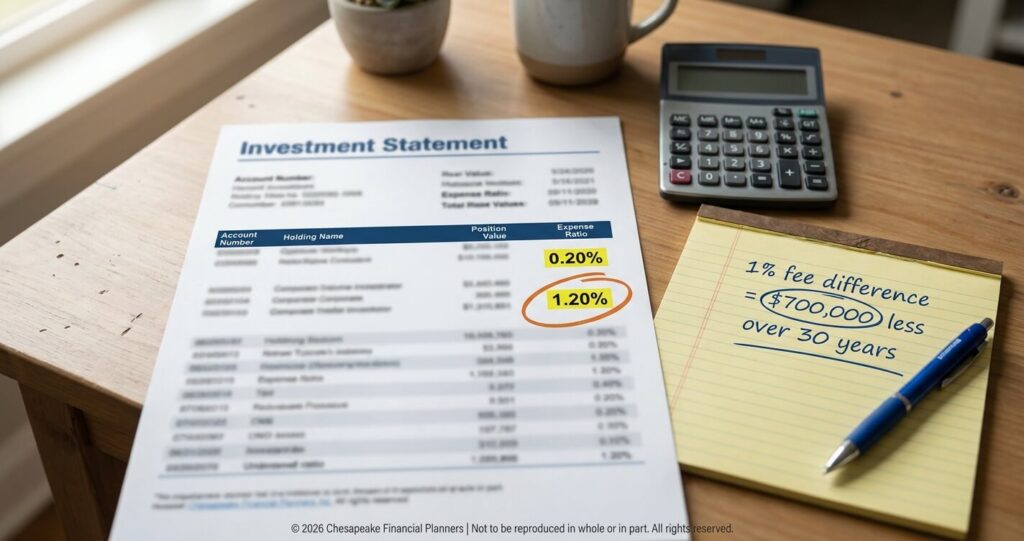
Investment fees compound against you for as long as you stay invested, so a 1% difference in annual cost can reduce your final balance by a substantial percentage over decades. Because fees are deducted before returns compound, every dollar lost to cost also loses all the future growth that dollar would have earned.
Should I avoid actively managed funds entirely?
Not necessarily, but you should require active funds to justify their higher cost with consistent after-fee outperformance, which most do not deliver. If you hold an active fund charging above 0.75%, compare its long-term net return against a low-cost index equivalent. When the index wins, the higher fee is buying you nothing.
Are robo-advisors a cheaper alternative to a human advisor?
Robo-advisors are cheaper for straightforward situations, charging 0.15% to 0.35% for automated allocation, rebalancing, and tax-loss harvesting. They work well if you don't need comprehensive planning. A human advisor becomes worth the higher fee when you need tax strategy, retirement income planning, estate coordination, or behavioral coaching during volatile markets.
Can I negotiate the fee my financial advisor charges?
Yes, many advisors will negotiate their fee, especially on larger portfolios. If you have $1 million or more invested, ask directly about a reduction or breakpoint pricing. Even a 0.25% cut saves $2,500 annually on a $1 million account, which compounds meaningfully over a long investing horizon.
Does tax-loss harvesting really reduce my costs?
Yes, because lowering your tax bill increases what you keep, which is functionally identical to reducing fees. The IRS allows realized losses to offset capital gains and up to $3,000 of ordinary income per year, with excess carried forward. It only works in taxable accounts, not inside IRAs or 401(k)s.
If you're trying to keep more of your returns, you may also want to confirm your underlying mix is built correctly. See How should my investment mix change as I get closer to retirement?.
At Chesapeake Financial Planners, we run a fee and tax-drag review with clients to find every percentage point quietly leaking out of a portfolio. If you're not sure what you're actually paying, a second opinion costs you nothing. Visit chesapeakefp.com to learn more about how a clear plan can help you reduce investment fees and keep more of what you earn.
Disclosures
The information provided is for educational purposes only and should not be construed as investment advice. Investment strategies should be tailored to individual circumstances, risk tolerance, and goals. Past performance doesn't guarantee future results. Consult with qualified financial professionals regarding your specific situation.
All indices are unmanaged and may not be invested into directly.
This information is not intended to be a substitute for specific individualized tax, investment or legal advice. We suggest that you discuss your specific situation with a qualified tax, legal or financial advisor.
Advisors associated with Chesapeake Financial Planners may be either (1) LPL Financial Registered Representatives offering securities through LPL Financial, Member FINRA and SIPC, and investment advisor representatives offering investment advice through Great Valley Advisor Group; or (2) solely investment advisor representatives offering investment advice through Great Valley Advisor Group and not affiliated with LPL Financial. Great Valley Advisor Group, and Chesapeake Financial Planners are separate entities from LPL Financial.


