

Should I choose a Solo 401(k) or SEP IRA for my business?
Last reviewed: July 2026
For most self-employed people with no employees, a Solo 401(k) is the stronger choice, because it lets you contribute more at lower incomes, offers a built-in Roth option and a loan provision, and adds catch-up contributions after 50, while a SEP IRA wins on pure simplicity. Both let you shelter tens of thousands of dollars a year with a tax deduction, and both cap at the same overall limit, but the Solo 401(k)'s extra features usually tip the balance unless you value a truly hands-off plan or have employees. The right answer depends on your income, age, and whether anyone works for you.
Key Takeaways
- Both plans share the same 2026 overall limit of $72,000, but a Solo 401(k) lets you reach it at lower income thanks to the employee deferral.
- The Solo 401(k) adds a Roth option, a loan provision, and an extra catch-up after 50; under the SECURE 2.0 Act, some SEP IRAs can offer a Roth option too, but availability and implementation are limited by the plan/provider.
- The SEP IRA is simpler to set up and maintain, the "set it and forget it" option.
- A Solo 401(k) requires having no employees other than a spouse; a SEP requires contributing the same percentage for eligible employees.
About the Author: Jeff Judge, CFP®, AEP®, ChFC®, CLU® is Managing Partner of Chesapeake Financial Planners in Forest Hill, Maryland. He has helped self-employed Harford County and Baltimore-area business owners choose and fund retirement plans since earning his CFP® certification in 2013, by using Chesapeake Financial Planners’ signature process, the R.U.D.D.E.R. method™. Jeff puts it plainly: "Most solo business owners default to whatever plan a friend mentioned, but a Solo 401(k) usually lets them save more for the same income, and the small amount of extra paperwork is well worth it."
How do the contribution limits compare?
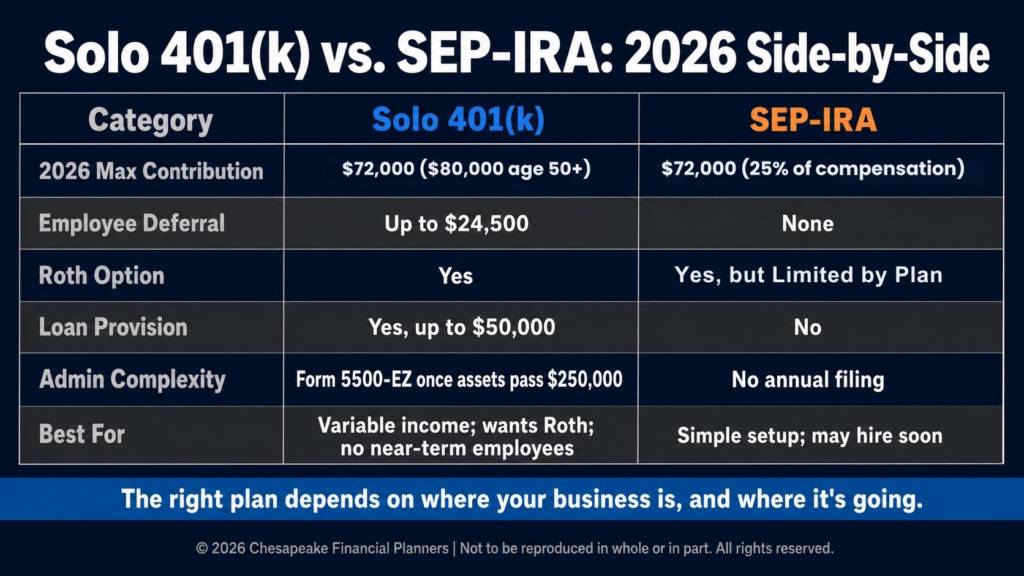
Both plans cap at the same overall 2026 limit, but a Solo 401(k) can usually get you there at a lower income because it adds an employee deferral on top of the employer contribution. That difference is the single biggest reason to prefer it.
For 2026, a Solo 401(k) allows an employee deferral of $24,500 ($32,500 if you are 50 or older, using the $8,000 catch-up, and a larger catch-up applies for ages 60 to 63), plus an employer contribution of up to 25% of compensation (about 20% of net self-employment income), all capped at a combined $72,000 ($80,000 if 50 or older with the catch-up). As the IRS puts it, "The annual contribution limit for employees who participate in 401(k), 403(b), governmental 457 plans, and the federal government's Thrift Savings Plan is increased to $24,500, up from $23,500 for 2025." A SEP IRA allows only the employer contribution, up to 25% of compensation (about 20% of net self-employment income), capped at the same $72,000, with no catch-up. The practical effect is that at lower and middle incomes, the Solo 401(k)'s employee deferral lets you contribute substantially more, because you are not limited to a percentage of income for the whole contribution.
A simple comparison shows it: a 52-year-old earning a moderate net self-employment income can add the full employee deferral plus catch-up on top of the employer percentage in a Solo 401(k), reaching a much higher total than a SEP IRA, which only allows the employer percentage, would permit at that income. At very high incomes, both plans hit the same $72,000 cap, so the gap narrows, but for most solo earners below that ceiling the Solo 401(k) clearly allows more. That advantage compounds over a career.
What about Roth options, loans, and simplicity?
The Solo 401(k) adds a Roth option and a loan provision, while under the SECURE 2.0 Act some SEP IRAs can offer a Roth option too, but availability and implementation are limited by the plan/provider. These features often decide the choice once contribution room is equal.
On Roth and loans, the Solo 401(k) is usually the clearer winner. It allows Roth employee deferrals and in-plan Roth conversions, which can be valuable if you want tax-free growth or expect higher future tax rates. It can also help keep the backdoor Roth IRA cleaner, because a SEP IRA counts as a traditional IRA balance that can complicate a backdoor Roth through the pro-rata rule. A Solo 401(k) may also permit a loan of up to $50,000 or 50% of your vested balance (repaid with interest), a safety valve a SEP IRA does not offer, though tapping retirement funds for non-retirement purposes is generally best avoided. Under the SECURE 2.0 Act, some SEP IRAs can offer a Roth option, but availability and implementation are limited by the plan/provider (and many plans may not support it yet). Even when a Roth SEP is available, SEP IRAs still do not offer loans.
On simplicity, the SEP IRA wins decisively. It sets up in minutes with a simple one-page form, costs little to nothing, requires essentially no annual filing, and demands minimal recordkeeping, the true "set it and forget it" plan. A Solo 401(k) takes a bit longer to establish, may carry small setup or custodian fees, and requires filing Form 5500-EZ once plan assets exceed $250,000, though the plan document is provided by the custodian. So if minimizing administrative effort matters more to you than every last dollar of contribution room, the SEP IRA is the easier path. Weighing these trade-offs against your goals is exactly what the R.U.D.D.E.R. Method™ is built for. The R.U.D.D.E.R. Method™ is Chesapeake Financial Planners' six-step planning process: Review and Recognize, Uncover and Understand, Design and Develop, Discuss and Decide, Execute and Empower, and Reassess and Refine, and plan selection lives in Design and Develop, matched to your income, age, and appetite for paperwork.

How do employees and flexibility affect the choice?
Employees are the dividing line: a Solo 401(k) requires you to have none (besides a spouse), while a SEP IRA forces you to contribute the same percentage for eligible employees, and both plans are flexible on timing. This is where the decision can be made for you.
A Solo 401(k) is only available if you have no employees other than a spouse, so the moment you hire your first non-spouse employee, you generally must move to a different plan. A SEP IRA, on the other hand, can cover employees, but it requires you to contribute the same percentage of compensation for every eligible employee (generally those 21 or older who have worked for you in three of the last five years and earned at least $750 in 2026) that you contribute for yourself, which gets expensive quickly as you add staff. So for a true solo operator, the Solo 401(k) is ideal; for someone with a few employees they want to include, a SEP can work but at real cost; and once you have more than a handful of employees, neither is the right tool and you need a different plan design.
Both plans are pleasantly flexible on contributions and deadlines. You can contribute different amounts each year, skip years when cash flow is tight, with no mandatory contributions, which makes both well-suited to variable self-employment income (unlike a defined benefit plan, which requires fixed annual funding). And both let you contribute up to your tax-filing deadline, including extensions. You can also switch between them, just not mid-year, and many owners start with a SEP for simplicity, then move to a Solo 401(k) once they appreciate the contribution and Roth advantages. Note you cannot fund both for the same business in the same year, since the limits are combined across your employer plans, though a Solo 401(k) or SEP for a side business can coexist with a 401(k) at a separate W-2 job (your employee deferral limit is shared across all 401(k)s).
Which should you choose?
Choose a Solo 401(k) if you are a solo operator who wants to maximize contributions, a built-in Roth option, and flexibility, and choose a SEP IRA if you prize simplicity or have employees to include. The decision follows your situation more than any rule of thumb.
Lean toward a Solo 401(k) if you are over 50 (the catch-up adds meaningfully to what you can save), you want Roth options for tax-free growth, you have no employees besides a spouse, you want to maximize contributions at any income level, you value the loan provision as an emergency backstop, and you are willing to handle slightly more paperwork. Lean toward a SEP IRA if you value extreme simplicity, you have a few employees you want to contribute for, administrative burden is a major concern, you are confident you will not need Roth options, or you earn enough that both plans hit the same cap anyway, making the SEP's simplicity essentially free.
To implement either, you open the account with a major brokerage, complete the plan paperwork (a short SEP form, or plan-adoption documents for a Solo 401(k)), and contribute by your tax deadline, with the Solo 401(k) adding an annual Form 5500-EZ once assets pass $250,000. Whichever you choose, the real win is funding it consistently, because a self-employed person who maxes one of these plans can shelter far more than a typical employee while cutting the current tax bill. Coordinating the choice with your CPA and overall plan ensures you capture the full benefit.
Related Topics Worth Reading
Choosing a retirement plan connects to the rest of a business owner's finances. These related topics go deeper.
- The complete financial plan for a business owner. What does comprehensive financial planning look like for a business owner?
- Setting a defensible salary under an S corporation. How much salary do I have to pay myself in an S-corp?
- A cash balance plan for owners who want to save even more. Cash Balance Plans for High-Income Business Owners
- The backdoor Roth and the pro-rata trap a SEP can trigger. How does a backdoor Roth IRA work, and what is the pro-rata rule?
- A tax strategy for owners with college-age children. Hiring Your Children Tax Strategy: Can I Legitimately Hire My Kids?
Frequently Asked Questions
Is a Solo 401(k) or SEP IRA better for the self-employed?
For most self-employed people with no employees, a Solo 401(k) is better because it lets you contribute more at lower and middle incomes (thanks to the employee deferral), offers a Roth option and a loan provision, and adds a catch-up after age 50. A SEP IRA is better if you value extreme simplicity or have employees you want to include. Both share the same 2026 overall limit of $72,000, but the Solo 401(k)'s features usually tip the balance.
How much can I contribute to a Solo 401(k) versus a SEP IRA in 2026?
For 2026, both cap at a combined $72,000 ($80,000 for a Solo 401(k) if you are 50 or older with the catch-up). A Solo 401(k) reaches the limit through an employee deferral of $24,500 ($32,500 if 50+) plus an employer contribution of up to 25% of compensation. A SEP IRA allows only the employer contribution of up to 25% of compensation, with no employee deferral or catch-up, so it usually permits less at lower incomes.
Can I have a Roth option with a SEP IRA?
Under the SECURE 2.0 Act, some SEP IRAs can offer a Roth option, but availability and implementation are limited by the plan/provider (and many plans may not support it yet). If a Roth option matters to you, a Solo 401(k) is still often the better choice, since it allows Roth employee deferrals and in-plan Roth conversions. A SEP IRA also counts as a traditional IRA balance, which can complicate a backdoor Roth IRA through the pro-rata rule, another reason Roth-focused savers often prefer a Solo 401(k).
Can I have both a Solo 401(k) and a SEP IRA?
Not for the same business in the same year, because the contribution limits are combined across your employer plans, so you choose one or the other. However, if you also have a W-2 job with a separate 401(k), you can still maintain a Solo 401(k) or SEP for a side business, though your employee deferral limit is shared across all your 401(k)s. You can also switch between the two plans, just not mid-year.
What happens to my Solo 401(k) if I hire employees?
A Solo 401(k) is only available if you have no employees other than a spouse, so if you hire your first non-spouse employee, you generally must move to a different plan, such as a regular 401(k) or a SEP IRA that covers them. A SEP IRA can include employees, but it requires contributing the same percentage of compensation for each eligible employee that you contribute for yourself, which becomes costly as you add staff.
Building retirement wealth to match your business
For a self-employed business owner, both the Solo 401(k) and the SEP IRA offer powerful, tax-deductible retirement saving, but they are not interchangeable. The Solo 401(k) usually lets you save more at a given income and adds a built-in Roth option, a loan provision, and catch-up contributions, while the SEP IRA wins on pure simplicity and the ability to cover employees. The right choice follows your income, age, and staffing, and the most important step is funding the plan consistently. Jeff Judge and the Chesapeake Financial Planners team help self-employed owners across Harford County and the Baltimore metro pick and maximize the right plan, alongside their CPAs. Schedule a complimentary consultation at chesapeakefp.com.
Want to go deeper? Our 10 Signs You're Ready for a Certified Financial Planner walks through this step by step.
Disclosures
The information provided is for educational purposes only and should not be construed as investment advice. Investment strategies should be tailored to individual circumstances, risk tolerance, and goals. Past performance doesn't guarantee future results. Consult with qualified financial professionals regarding your specific situation.
Contributions to a traditional IRA may be tax deductible in the contribution year, with current income tax due at withdrawal. Withdrawals prior to age 59 ½ may result in a 10% IRS penalty tax in addition to current income tax.
A Roth IRA offers tax deferral on any earnings in the account. Qualified withdrawals of earnings from the account are tax-free. Withdrawals of earnings prior to age 59 ½ or prior to the account being opened for 5 years, whichever is later, may result in a 10% IRS penalty tax. Limitations and restrictions may apply.
Advisors associated with Chesapeake Financial Planners may be either (1) LPL Financial Registered Representatives offering securities through LPL Financial, Member FINRA and SIPC, and investment advisor representatives offering investment advice through Great Valley Advisor Group; or (2) solely investment advisor representatives offering investment advice through Great Valley Advisor Group and not affiliated with LPL Financial. Great Valley Advisor Group, and Chesapeake Financial Planners are separate entities from LPL Financial.


