

What Is the Difference Between Active and Passive Investment Management?
Last reviewed: July 2026
Active investment management means a manager picks securities and times trades to beat a market benchmark. Passive management means owning a broad index to match the market at the lowest possible cost. The core difference comes down to cost, tax efficiency, and whether anyone is trying to outsmart the market. For most long-term investors, the math favors passive. For specific situations, active still earns its keep. This is one of the most consequential decisions in active vs passive investing, and it affects your fees, your tax bill, and the returns you actually keep.
Key Takeaways
- Active management tries to beat the market; passive management tries to match it at minimal cost.
- Most actively managed U.S. stock funds underperform their benchmark over 15-year periods, per S&P Dow Jones Indices.
- Index funds often charge under 0.10% annually, while active funds commonly charge 0.50% to 1.00% or more.
- Active management can still add value through tax-loss harvesting, less efficient markets, and behavioral coaching.
- The right choice depends on your goals, tax situation, and how much fee drag you can tolerate over decades.
About the Author: Jeff Judge, CFP®, AEP®, ChFC®, CLU® is Managing Partner of Chesapeake Financial Planners in Forest Hill, Maryland. He has been helping families and business owners in Harford County and the Baltimore metro area navigate investment strategy decisions since earning his CFP® certification in 2013, by using Chesapeake Financial Planners’ signature process, the R.U.D.D.E.R. method™. Jeff has watched business owners spend years chasing market-beating managers while quietly losing six figures to fees that compounded against them.
What Is Active Investment Management?
Active investment management is an approach where a portfolio manager makes deliberate buy and sell decisions to outperform a benchmark like the S&P 500. The manager researches individual companies, forecasts economic shifts, and adjusts the portfolio based on where they think opportunity lies.
In practice, active managers do a few things. They select individual stocks they believe are undervalued. They time exposure, increasing or decreasing stock and bond weightings based on their read of the market. They make tactical sector bets, overweighting what they expect to rise and underweighting what they expect to lag. And they trade frequently as new information arrives.
The promise is simple: returns that beat the market after fees. The challenge is that beating the market consistently is hard, and the cost of trying is high. Active funds typically charge meaningfully more than index funds, and that gap has to be overcome before the investor sees any benefit. For business owners weighing this against simpler options, the fee structure deserves a hard look. See How Do Investment Fees Impact My Long-Term Returns? for a deeper breakdown.
What Is Passive Investment Management?
Passive investment management is an approach that aims to match a market index rather than beat it. Instead of picking winners, a passive strategy owns all or most of the securities in an index in the same proportions, accepting market returns at the lowest possible cost.
Passive managers replicate an index, build portfolios that mirror benchmarks like the S&P 500 or a total market index, and hold those positions with minimal trading. Because holdings rarely change, turnover stays low, which keeps trading costs and taxable events down. Rebalancing happens by rule, not by forecast.
The goal is to capture market returns cheaply. You will not beat the market, but you also will not lag it badly because of fees and bad timing. Index funds and ETFs are the most common vehicles here. For investors who want broad market exposure without paying someone to guess, this is the default starting point. How do financial advisors choose investments for my portfolio? explains how advisors blend these tools.
What Does the Performance Evidence Say?
The performance evidence strongly favors passive investing over long horizons. The central question is whether active managers can consistently beat their benchmark after fees, and the data answers it bluntly: most cannot.
According to the SPIVA Scorecard published by S&P Dow Jones Indices, the large majority of actively managed U.S. equity funds underperform their benchmark over 15-year periods. The longer the window, the worse active funds tend to look. Past success offers little predictive power either; a manager who beats the market for five years has roughly even odds of doing it over the next five.
Fees explain much of the gap. As FINRA notes, fund expenses directly reduce your returns, and that drag compounds. Markets are also broadly efficient, meaning new information spreads fast and mispricings get corrected quickly. And consistent market timing requires being right twice, on the sell and the buy back, with each wrong call eroding results.
Jeff Judge often tells clients that the fee conversation is not academic. On a large portfolio, a one-percentage-point difference in annual cost can mean hundreds of thousands of dollars over a few decades. That is money the market gave you and a fee structure took back.
When Does Active Management Actually Add Value?
Active management adds the most value in less efficient markets, in tax management, and in keeping investors from making emotional mistakes. The evidence against active investing is real, but it is not a blanket verdict.
Some markets are genuinely harder to index well. Emerging markets, small-cap stocks, and certain fixed-income segments are less efficient than large-cap U.S. equities, and a skilled manager may find mispricings there. Active management also shines in tax-efficient investing. A manager doing disciplined tax-loss harvesting, selling losing positions to offset gains, can sometimes save more in taxes than the management fee costs. For investors with concentrated holdings, this matters; see How do I diversify a concentrated company stock position without a huge tax bill?.
There is also a behavioral case. The best advisor value often comes from keeping a client invested through a downturn rather than from stock picking. In Jeff's experience, the investor who panic-sold in a crash usually lost more than any expense ratio ever would. The R.U.D.D.E.R. Method™ is Chesapeake Financial Planners' six-step planning process: Review and Recognize, Uncover and Understand, Design and Develop, Discuss and Decide, Execute and Empower, and Reassess and Refine, and that disciplined structure is built to prevent exactly those emotional errors.
How Do the Costs Compare?
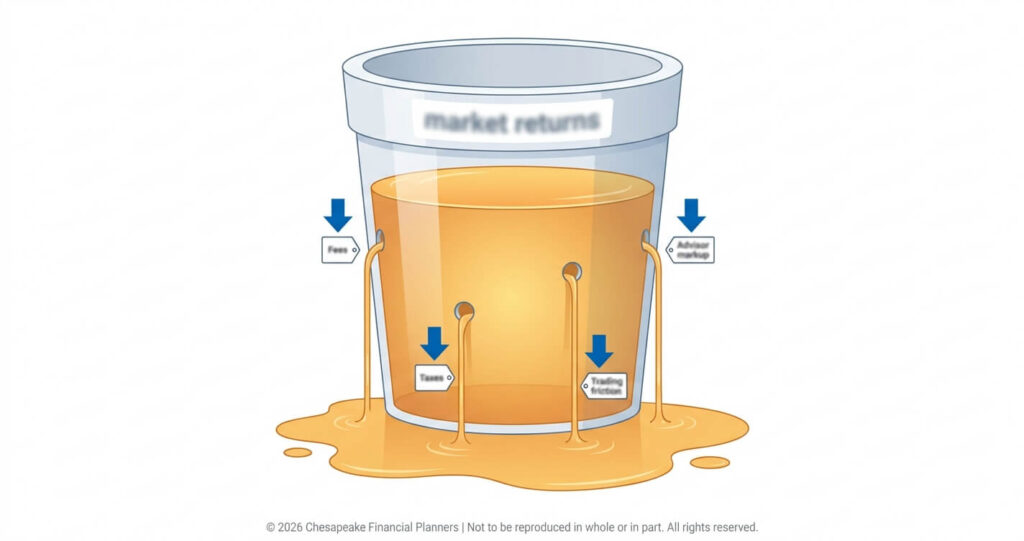
The cost difference between active and passive management is substantial and compounds over time. Index funds commonly charge under 0.10% annually, while active mutual funds frequently charge 0.50% to 1.00% or more. Add an advisor fee on top of an actively managed lineup, and the all-in cost can climb meaningfully higher.
Consider $500,000 invested for 20 years at a 7% gross annual return. At a 0.10% fee, the portfolio grows to roughly $1.86 million. At a 1.00% all-in fee, it grows to roughly $1.55 million. That difference of more than $300,000 is not driven by worse investments. It is driven entirely by fees compounding against you. If you want to attack that drag directly, How can I reduce investment fees and keep more returns? is the practical next step.
Frequently Asked Questions
Is passive investing always better than active investing?
No, passive investing is not always better, but it wins for most long-term investors in efficient markets like large-cap U.S. stocks. The data shows most active funds underperform after fees over 15 years. Active management can still add value in less efficient markets, in tax-loss harvesting, and in behavioral coaching during volatility.
What are the main fee differences between active and passive funds?
Index funds commonly charge under 0.10% annually, while actively managed funds frequently charge 0.50% to 1.00% or more. When you layer an advisor fee on top of active funds, total annual costs can climb higher still. Over decades, even a one-percentage-point difference compounds into hundreds of thousands of dollars on a large portfolio.
Can active managers beat the market consistently?
Want to go deeper? Our R.U.D.D.E.R Audit for DIY Investors walks through this step by step.
Most active managers cannot beat their benchmark consistently after fees, according to S&P Dow Jones Indices SPIVA research. A manager who outperforms for five years has roughly even odds of repeating it. Strong past performance provides little reliable signal about future results, which is why fee-driven and rules-based passive strategies hold up so well over long horizons.
Is active or passive investing more tax-efficient?
Passive index funds are generally more tax-efficient because their low turnover triggers fewer taxable capital gains distributions. However, skilled active management can deliver targeted tax-loss harvesting that offsets gains and sometimes saves more in taxes than the management fee costs. The most tax-efficient approach depends on your account types, income, and overall plan.
Which approach is better for business owners?
Business owners often benefit from a low-cost passive core combined with active strategies in specific areas like tax management or concentrated stock positions. The right mix depends on your liquidity needs, tax situation, and how much of your net worth sits inside the business. A coordinated plan matters more than choosing one camp over the other entirely.
Want to see how active and passive strategies fit your full picture? Our free investment strategy guide breaks down fees, tax efficiency, and portfolio construction in plain language. Download it at chesapeakefp.com and put real numbers behind your active vs passive investing decision.
Disclosures
The information provided is for educational purposes only and should not be construed as investment advice. Investment strategies should be tailored to individual circumstances, risk tolerance, and goals. Past performance doesn't guarantee future results. Consult with qualified financial professionals regarding your specific situation.
All performance referenced is historical and is no guarantee of future results. All indices are unmanaged and may not be invested into directly.
R-squared indicates what percentage of a manager's movement in performance is explained by movement in performance in its benchmark. R-squared ranges from 0 to 100 and a score of 100 suggests that all movements of a manager's performance are completely explained by movements in the index.
This information is not intended to be a substitute for specific individualized tax, investment or legal advice. We suggest that you discuss your specific situation with a qualified tax, legal or financial advisor.
Advisors associated with Chesapeake Financial Planners may be either (1) LPL Financial Registered Representatives offering securities through LPL Financial, Member FINRA and SIPC, and investment advisor representatives offering investment advice through Great Valley Advisor Group; or (2) solely investment advisor representatives offering investment advice through Great Valley Advisor Group and not affiliated with LPL Financial. Great Valley Advisor Group, and Chesapeake Financial Planners are separate entities from LPL Financial.


