

What is the difference between total comp and base salary?
Last reviewed: July 2026
Base salary is just the guaranteed cash on your offer letter, while total compensation adds your bonus, equity (RSUs or options), and benefits, which in tech often makes the real number 50% to 100% higher than base alone. Judging an offer by base salary alone can be a large miscalculation, but counting equity at face value, especially illiquid startup options, can mislead you the other way. The skill is reading the whole package, risk-adjusting the equity, and then structuring your life around the part you can actually count on.
On This Page
- Key Takeaways
- What goes into total compensation?
- How do you calculate and compare true total compensation?
- What should you ask before signing, and how does equity really vest?
- How should total comp shape your financial decisions?
- Related Topics Worth Reading
- Frequently Asked Questions
- Reading your offer for what it's really worth
- Disclosures
Key Takeaways
- Total compensation is base salary plus bonus, equity, and benefits; in tech the total is frequently far above base.
- Equity is the wild card: RSUs in a public company are liquid, while startup options are illiquid and may be worth nothing.
- When comparing offers, annualize equity, risk-adjust startup options, and count only the equity likely to vest in your first couple of years.
- Structure your lifestyle around base salary and treat equity and bonuses as savings, not spending.
- A reliable base lets you save the variable pay; in 2026 you can defer up to $24,500 to a 401(k), and employer match is part of total comp too.
About the Author: Jeff Judge, CFP®, AEP®, ChFC®, CLU® is Managing Partner of Chesapeake Financial Planners in Forest Hill, Maryland. As Jeff puts it: "The offer letter shows you a single number, but your financial life runs on the structure underneath it, and the people who do best treat base salary as their income and equity as a savings opportunity, never the other way around." He has been helping families and business owners in Harford County and the Baltimore metro area navigate complex equity compensation packages and total rewards strategies since earning his CFP® certification in 2013, by using Chesapeake Financial Planners’ signature process, the R.U.D.D.E.R. method™.
What goes into total compensation?
Total compensation has four parts, base salary, annual bonus, equity, and benefits, and only the first is fully guaranteed. Understanding each component is what separates a real comparison from a headline-number trap.
Base salary is the straightforward piece: the annual cash on your offer letter, paid across the year, and it is your guaranteed income as long as you are employed. The annual bonus is performance-based and tied to company and individual goals, with typical targets running roughly 10% to 20% of base for individual contributors, 20% to 30% for managers, and higher for executives, but the key word is target, payouts can range from zero to above target depending on results, so a bonus is not guaranteed. Equity, granted as RSUs, stock options, or both, is where it gets complicated: RSUs are granted as a dollar value and typically vest over four years (often 25% after year one, then quarterly), while options are granted as a number of shares, and the value of either rises and falls with the stock, so a grant worth a certain amount today could be worth far more or far less by the time it vests. The IRS notes that with options, "if you receive an option to buy stock as payment for your services, you may have income when you receive the option, when you exercise the option, or when you dispose of the option or stock received when you exercise the option," so the tax timing of equity is its own consideration. RSU vesting is generally taxed as wages, often with 22% federal withholding on supplemental wages up to $1 million. Benefits round it out, health insurance (with the employer usually covering most of the premium), a 401(k) match (commonly in the range of 3% to 6% of pay), an employee stock purchase plan with a discount where offered, and various stipends, all of which add meaningful annual value that offer comparisons routinely overlook. Cash compensation is also subject to payroll tax only up to the 2026 Social Security wage base of $184,500, a detail high earners feel in their take-home. Jeff Judge notes: "When I sit down with someone comparing two offers, the first thing I do is strip out the equity and the bonus targets, because those numbers can be zero, and what's left is what you can actually count on to pay your mortgage next month."
The four components break down like this.
| Component | What it is | How reliable |
|---|---|---|
| Base salary | Guaranteed annual cash on the offer | Fully guaranteed while employed |
| Annual bonus | Target percent of base, tied to results | Variable; can be zero to above target |
| Equity (RSUs or options) | Shares that vest over time | RSUs liquid; options uncertain |
| Benefits | 401(k) match, health, ESPP, perks | Steady annual value |
So the same job can have very different "real" pay depending on the mix of these four. The instinct to focus on base salary is understandable, since it is the one certain number, but it can dramatically understate, or, via shaky equity, overstate, what an offer is actually worth. Seeing all four parts clearly is step one.
How do you calculate and compare true total compensation?
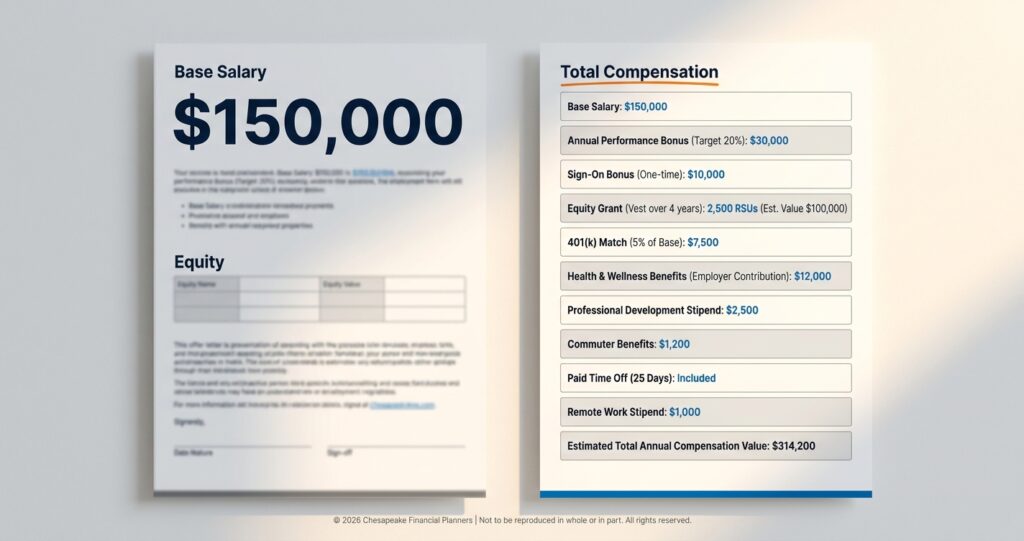
You calculate true total comp by adding base, the annualized equity grant, the target bonus, any first-year signing bonus, and benefits, then risk-adjusting equity before comparing offers. A consistent method keeps you from being dazzled by a big-but-illiquid number.
The basic formula for a first-year figure is base salary plus signing bonus plus the equity grant divided by its vesting years plus the target bonus plus the value of benefits. Run that and a tech offer's true first-year compensation often lands well above the stated base, sometimes close to double, once equity, bonus, and benefits are included. But two adjustments matter enormously when comparing two offers. First, risk-adjust the equity: RSUs in a public company are essentially liquid and can be valued near face, while startup stock options are illiquid, risky, and potentially worthless, so a common approach is to discount startup option value substantially (often by 30% to 50% or more) before comparing. A startup offer can look richer on paper because of a larger equity number yet be worth less on a risk-adjusted basis than a big-tech offer with more cash and liquid RSUs.
Second, be realistic about vesting. Recruiters present equity as a tidy annual figure, but it vests on a schedule, and many employees leave before fully vesting, so a useful guideline when comparing offers is to count only the equity likely to vest within your first couple of years, plus any refresher grants you can actually confirm, rather than the full multi-year headline. This disciplined, apples-to-apples comparison is exactly what the R.U.D.D.E.R. Method™ encourages. The R.U.D.D.E.R. Method™ is Chesapeake Financial Planners' six-step planning process: Review and Recognize, Uncover and Understand, Design and Develop, Discuss and Decide, Execute and Empower, and Reassess and Refine, and an offer comparison lives in Uncover and Understand, where the real, risk-adjusted value of each package is surfaced.

What should you ask before signing, and how does equity really vest?
Before signing, ask detailed questions about your equity, bonus, benefits, and future-year comp, and understand that annualized equity is not the same as what actually lands in your account. The answers determine what your offer is genuinely worth.
On equity, ask whether you are getting RSUs or options, the exact vesting schedule, whether there is a refresher grant program and what typical grant sizes are, and the relevant pricing (the current share price for RSUs, or the strike price and 409A valuation for options); for a startup, ask about the path to liquidity and any IPO timeline. On bonuses, ask the target percentage, the historical payout distribution (do most people hit, exceed, or miss target), and the payout frequency. On benefits, ask the 401(k) match formula, ESPP availability and discount, health-coverage details, and any standout perks like education reimbursement. And on multi-year pay, ask about typical refresher grant sizes and frequency for your level and what your compensation looks like in years two through four once any signing bonus is gone, because that is your real ongoing pay.
The vesting point deserves emphasis. Equity presented as a smooth annual number actually vests in chunks over four years, and if you leave after two years you receive only the portion vested by then, not the full grant or the refreshers you were counting on. That is why counting only near-term vesting is the prudent way to compare, and why a refresher program, confirmed in writing, matters so much to years three and four. Treat the recruiter's annualized figure as a ceiling, not a promise.
How should total comp shape your financial decisions?
Total comp should inform how you evaluate offers, but you should structure your actual lifestyle around base salary and treat equity and bonuses as savings. This single habit is the most important financial move a high-earning tech employee can make.
The psychological trap is real: a large base offer makes you mentally a high earner, but your take-home after taxes is considerably less than the headline, while your total comp on paper is considerably more, so the question is which number drives your spending. Inflating your lifestyle to total-comp levels creates real fragility, because equity values can fall and jobs can change, and a life built on stock that has dropped or a job that ended is precarious. Building your lifestyle around your reliable base salary, by contrast, creates the capacity to save and invest the equity and bonus income, turning the volatile part of your pay into wealth rather than overhead.
Compensation is also not the whole decision. Learning and growth, work-life balance, the quality of your manager, the company's trajectory, and how a role expands or limits your future options can all matter more to your long-term outcome than a modest difference in pay, a slightly higher offer at a stagnant company can be a worse choice than a slightly lower one at a fast-growing firm with better learning. When you do evaluate the money, calculate full total comp, risk-adjust startup equity, count near-term vesting, and remember that equity and signing bonuses are often more negotiable than base. Then live on the base and invest the rest. This kind of equity-aware planning connects closely to the FAANG-versus-startup decision and to managing the concentrated stock that equity comp creates.
Related Topics Worth Reading
Reading a comp package connects to the offer decision and the equity it creates. These related topics go deeper.
- Choosing between a big-tech and a startup offer. Should I Take a FAANG Job or Startup Offer?
- What to do with the company stock your equity builds up. How do I diversify a concentrated company stock position without a huge tax bill?
- How double-trigger RSUs vest at a startup. What do double-trigger RSUs at a private company mean for me?
- The psychology of holding too much company stock. Why is it so hard to sell my company stock?
- Handling stock options when you change jobs. What Happens to My Stock Options When I Leave My Job?
Frequently Asked Questions
What is the difference between total comp and base salary?
Base salary is the guaranteed annual cash on your offer letter, while total compensation adds your annual bonus, equity (RSUs or stock options), and benefits. In the tech sector, total compensation is frequently 50% to 100% or more above base salary once equity and benefits are counted. Evaluating an offer by base salary alone understates its value, but counting equity at face value, especially illiquid startup options, can overstate it, so you need to weigh the whole package.
How do I calculate my total compensation?
Add your base salary, any first-year signing bonus, your equity grant divided by its vesting period, your target bonus, and the value of your benefits. For example, the equity portion of a multi-year grant is typically annualized by dividing it across its vesting years. When comparing offers, risk-adjust startup stock options downward because they are illiquid and may be worthless, and count only the equity likely to vest in your first couple of years rather than the full headline grant.
Is total comp or base salary more important?
Both matter, but for different purposes. Total compensation is the better measure of an offer's overall value and what you should use to compare jobs. Base salary, however, is the number to build your lifestyle around, because it is guaranteed, while bonuses and equity are variable and can disappear. The healthiest approach is to evaluate offers on total comp but live on your base salary and treat equity and bonuses as savings to invest.
How should I value startup equity versus RSUs?
Value them very differently. RSUs in a publicly traded company are essentially liquid and can be valued close to their stated amount, since you can sell shares as they vest. Startup stock options are illiquid, depend on a future liquidity event that may never happen, and can end up worthless, so a common approach is to discount their value substantially, often by 30% to 50% or more, before comparing. A larger startup equity number can be worth less on a risk-adjusted basis than a smaller RSU grant.
Should I base my lifestyle on my total compensation?
No. You should base your lifestyle on your base salary, not your total compensation. Total comp includes variable, uncertain components, bonuses and equity, that can fall sharply if the stock drops or your job changes, so building fixed expenses around them creates financial fragility. Living within your reliable base salary lets you save and invest the equity and bonus income, converting the volatile part of your pay into lasting wealth rather than lifestyle.
Reading your offer for what it's really worth
In tech, base salary is only part of the story, total compensation, including bonus, equity, and benefits, is often far higher, but the equity that makes it higher ranges from liquid and reliable to illiquid and uncertain. The way to use this is to compare offers on full, risk-adjusted total comp, count only the equity you are likely to actually receive, and then run your life on the guaranteed base while investing the rest. Your base salary is your income; your equity is your savings opportunity. Jeff Judge and the Chesapeake Financial Planners team help tech professionals read their offers clearly and turn equity comp into lasting wealth. Schedule a free fit call at chesapeakefp.com.
Want to go deeper? Our Evaluating Your Total Compensation Package walks through this step by step.
Disclosures
The information provided is for educational purposes only and should not be construed as investment advice. Investment strategies should be tailored to individual circumstances, risk tolerance, and goals. Past performance doesn't guarantee future results. Consult with qualified financial professionals regarding your specific situation.
Advisors associated with Chesapeake Financial Planners may be either (1) LPL Financial Registered Representatives offering securities through LPL Financial, Member FINRA and SIPC, and investment advisor representatives offering investment advice through Great Valley Advisor Group; or (2) solely investment advisor representatives offering investment advice through Great Valley Advisor Group and not affiliated with LPL Financial. Great Valley Advisor Group, and Chesapeake Financial Planners are separate entities from LPL Financial.


