

How Much Should I Save to Become Financially Independent?
Last reviewed: July 2026
Your financial independence number is your annual spending multiplied by 25. If you spend $60,000 a year, you need roughly $1.5 million invested to cover your costs indefinitely. That figure comes from the 4% withdrawal rate, which research shows lets most portfolios last 30 years or longer. Your real number shifts based on your lifestyle, your timeline, and how much market risk you can stomach.
Key Takeaways
- Your financial independence number equals annual expenses times 25, derived from the 4% safe withdrawal rate.
- The 2026 401(k) employee contribution limit is $24,500, giving savers a larger tax-advantaged runway.
- Younger retirees with 50-year horizons often use a more conservative 3% to 3.5% withdrawal rate.
- Tracking actual spending for three to six months produces a far more accurate target than guessing.
- The 4% rule is a starting framework, not a guarantee, and should flex with your situation.
About the Author: Jeff Judge, CFP®, AEP®, ChFC®, CLU® is Managing Partner of Chesapeake Financial Planners in Forest Hill, Maryland. He has been helping families and business owners in Harford County and the Baltimore metro area navigate retirement income and early-independence planning since earning his CFP® certification in 2013, by using Chesapeake Financial Planners’ signature process, the R.U.D.D.E.R. method™. Jeff has watched clients chase a precise number while ignoring the one variable they actually control: their annual spending.
What Is a Financial Independence Number?
A financial independence number is the amount of invested assets you need so that withdrawals alone cover your living expenses for the rest of your life. Once your portfolio can fund your lifestyle without a paycheck, you are financially independent. Work becomes optional.
This idea anchors the FIRE movement, short for Financial Independence, Retire Early. But you do not have to retire at 40 to want it. Plenty of Jeff's clients have no intention of quitting work. They want the freedom to walk away from a bad job, take a sabbatical, or start a business without panic.
The number is personal. Two people who both spend $80,000 a year land on the same target on paper, yet one feels secure at that figure while the other wants a cushion. Your tolerance for running lean late in life is part of the math, even though no calculator captures it. This is where the firm leans on the R.U.D.D.E.R. Method™, our six-step planning process: Review and Recognize, Uncover and Understand, Design and Develop, Discuss and Decide, Execute and Empower, and Reassess and Refine.
Is Early Retirement (FIRE) Right for Tech Professionals?
How Do You Calculate Your Financial Independence Number?
Start with what you spend, not what you earn. The whole framework rests on one input: your real annual expenses.
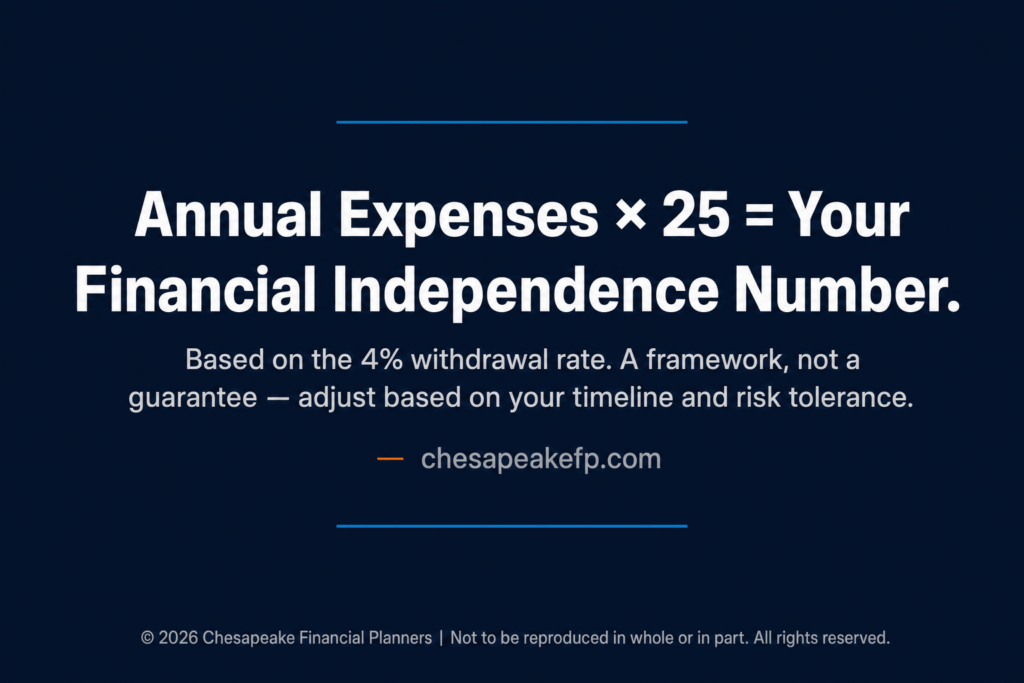
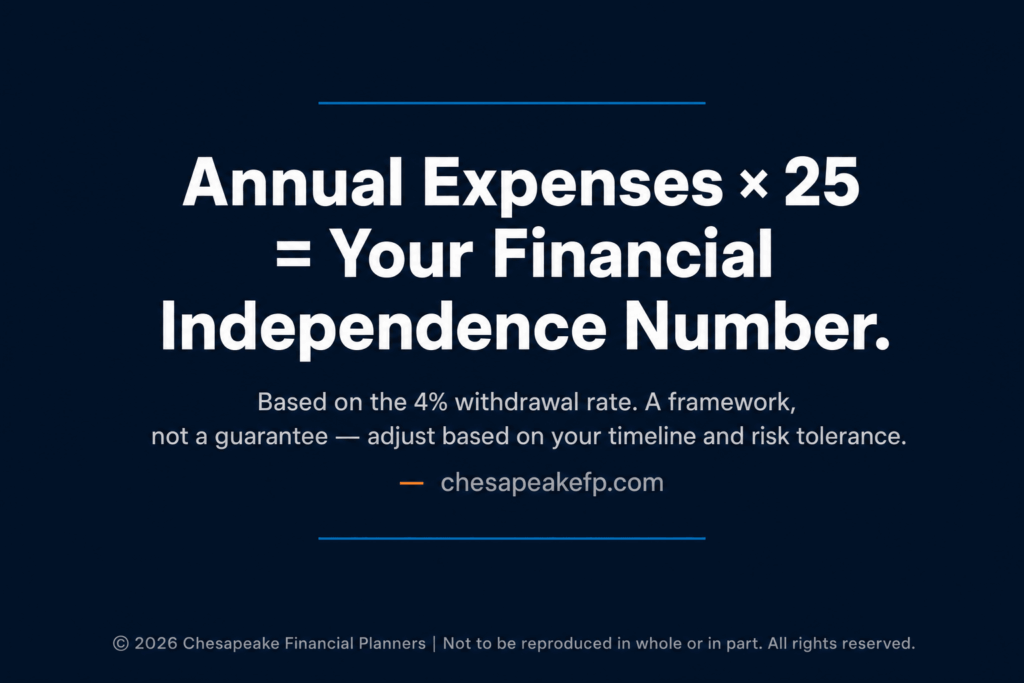
The most common rule of thumb is the 25x rule, built on the 4% withdrawal rate. The logic is simple. If you can safely pull 4% of your portfolio each year, you need 25 times your annual spending saved. Multiply your annual expenses by 25 and you have your target.
If you spend $60,000 per year, $60,000 times 25 equals $1.5 million. With $1.5 million invested in a balanced portfolio, you could withdraw $60,000 in year one, adjust that figure for inflation each year after, and have a strong probability of your money lasting three decades or more.
This 25x math traces back to the Trinity Study and the earlier research of financial planner William Bengen, who tested withdrawal rates against historical market returns. Bengen found that a 4% starting withdrawal rate, adjusted annually for inflation, survived every 30-year period in his data set. According to the Social Security Administration, a 65-year-old today can expect to live roughly two more decades on average, and many will live far longer, which is exactly why a multi-decade withdrawal rule matters. Jeff Judge notes: "The 4% rule was stress-tested against some brutal historical markets, but it was built around a 30-year horizon, and with clients retiring at 60 who may live to 95, we often model a more conservative withdrawal rate to account for that extra runway."
What is the best order to withdraw from my 401k, Roth IRA, and taxable accounts in retirement?
Why Is the Safe Withdrawal Rate Set at 4%?
The 4% safe withdrawal rate is the rate at which a balanced portfolio historically lasted at least 30 years without running dry. It assumes a mix of stocks and bonds, annual inflation adjustments to your withdrawals, and a roughly 30-year time horizon. Change any of those assumptions and the right rate changes too.
Is 4% too conservative? Sometimes. If you retire in your mid-60s with a shorter horizon, you might sustain 4.5% or even 5% without trouble, especially if you stay flexible in down markets.
Is 4% too aggressive? Also sometimes. If you reach independence in your 30s or 40s, you may be funding 50 years, not 30. Many in the FIRE community drop to a 3% or 3.5% withdrawal rate to protect against a long retirement that runs into a bad early market stretch. Jeff puts it plainly to clients: the earlier you stop working, the more the math punishes a sloppy withdrawal rate. The rule is a guideline, not gospel.
Should I max out my 401(k) or invest somewhere else?
How Do You Determine Your Annual Spending?
Your spending number drives everything, so get it right. Track every dollar for three to six months rather than guessing from memory. Most people underestimate their true spending by a wide margin, and that gap compounds across a 25x calculation into hundreds of thousands of dollars.
Capture these categories: housing including taxes and insurance, food, transportation, healthcare premiums and out-of-pocket costs, debt payments, and discretionary spending like travel and hobbies. Do not count the money you currently save and invest, since that is what builds the number rather than something you need to replace.
Then adjust for what life will actually look like once you are independent. Some costs fall: no commute, no work wardrobe, no daycare. Others rise: more travel, and health insurance you buy yourself before Medicare eligibility. For most people, total spending in independence looks similar to working-life spending, just rearranged. The bigger your annual number, the bigger your target, so building good saving habits early gives the math room to work.
How much should I save in an emergency fund during a job change?
Frequently Asked Questions
What is a good financial independence number?
A good financial independence number is 25 times your annual spending, based on the 4% withdrawal rate. If you spend $50,000 a year, your number is $1.25 million; at $100,000 a year, it is $2.5 million. The figure scales directly with your lifestyle, so lower spending means a lower target and a faster path.
How much do I need to save each year to reach financial independence?
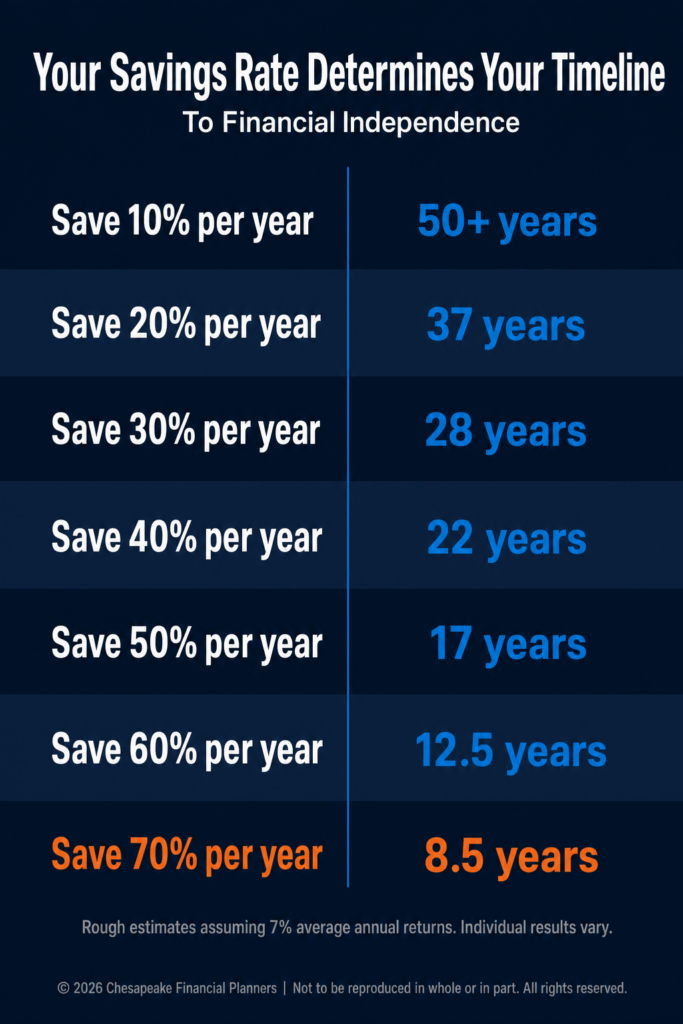
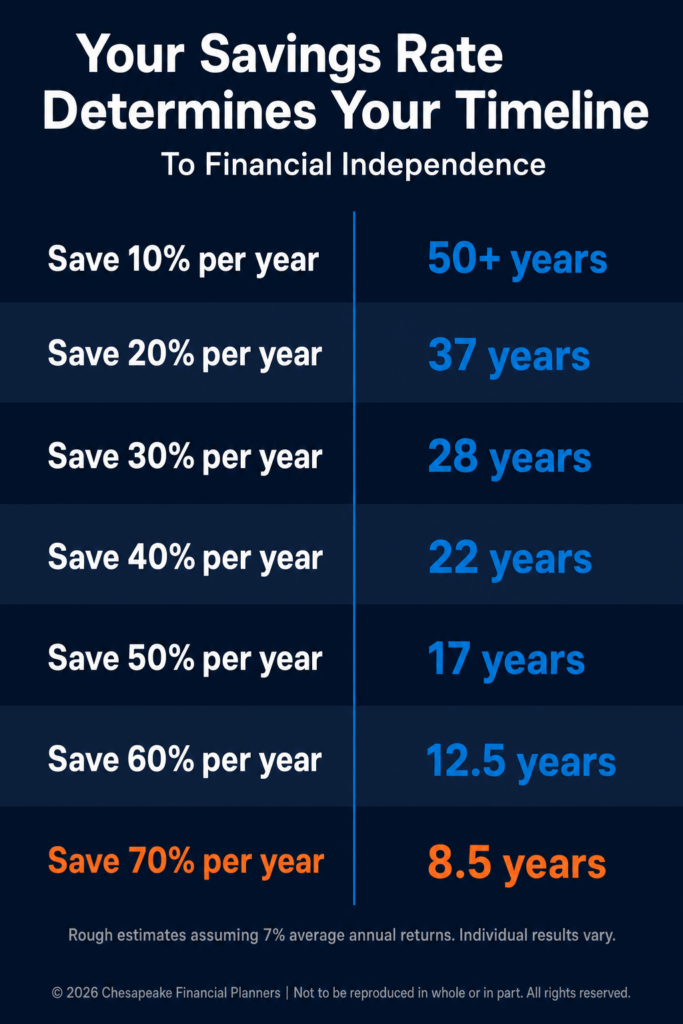
The amount depends on your target, your timeline, and your investment returns. A saver investing aggressively toward a $1.5 million goal over 20 years needs to set aside a substantial share of income, often 25% or more. Maxing tax-advantaged accounts helps; the 2026 401(k) employee contribution limit is $24,500 according to the IRS.
Is the 4% rule still accurate?
The 4% rule remains a widely used starting point, though many planners treat it as a guideline rather than a guarantee. It was built on historical U.S. market data and a 30-year horizon. Retirees with longer timelines often use 3% to 3.5% for safety, while those with shorter horizons may sustain a slightly higher rate.
Can I reach financial independence on an average income?
Yes, financial independence is achievable on an average income, though it requires a high savings rate and time. The math rewards spending discipline more than a large paycheck, because a lower annual spending figure shrinks your target number. Two earners with identical incomes can have wildly different timelines based solely on what they spend.
How does financial independence differ from traditional retirement?
Financial independence means your assets can cover your expenses indefinitely, regardless of age, while traditional retirement is typically tied to leaving work in your 60s. You can be financially independent and still work by choice. The distinction is about freedom and optionality rather than a specific retirement date.
Should I use 25x or a different multiple?
Use 25x as a baseline, then adjust for your situation. A longer retirement horizon argues for a larger multiple, such as 28x to 33x, which corresponds to a 3% to 3.5% withdrawal rate. A shorter horizon or significant flexibility to cut spending in down markets can justify staying at 25x or slightly lower.
Reaching your number is less about predicting markets and more about knowing your real spending and building a plan that flexes when life does. At Chesapeake Financial Planners, we work through financial independence math with clients every week, pressure-testing withdrawal rates against actual timelines. If you want a second set of eyes on your number before you make an irreversible decision, Jeff Judge and the Chesapeake team serve families and business owners across Harford County and the Baltimore metro. Schedule a free fit call at chesapeakefp.com.
Disclosures
The information provided is for educational purposes only and should not be construed as investment advice. Investment strategies should be tailored to individual circumstances, risk tolerance, and goals. Past performance doesn't guarantee future results. Consult with qualified financial professionals regarding your specific situation.
Advisors associated with Chesapeake Financial Planners may be either (1) LPL Financial Registered Representatives offering securities through LPL Financial, Member FINRA and SIPC, and investment advisor representatives offering investment advice through Great Valley Advisor Group; or (2) solely investment advisor representatives offering investment advice through Great Valley Advisor Group and not affiliated with LPL Financial. Great Valley Advisor Group, and Chesapeake Financial Planners are separate entities from LPL Financial.


