
Should I Pursue the FIRE (Financial Independence, Retire Early) Movement?
Last reviewed: July 2026
The FIRE movement can work, but it demands a savings rate most people never attempt and a plan that survives 50-plus years instead of 30. FIRE (Financial Independence, Retire Early) means saving aggressively, often 50% to 70% of your income, then living off investment returns decades before a traditional retirement age. Whether you should pursue it comes down to your real numbers, your tolerance for risk, and an honest answer to what you'd actually do with the time.
Key Takeaways
- FIRE means saving 50% to 70% of income to retire decades early and live off portfolio withdrawals.
- The 4% rule was built for 30-year retirements, so early retirees often need a 3% to 3.5% rate.
- Retiring before 65 means buying your own health insurance until Medicare eligibility begins.
- In 2026, individual HSA contributions cap at $4,400, a useful early-retirement tool.
- Fewer working years can permanently lower your Social Security benefit, which uses your highest 35 years of earnings.
About the Author: Jeff Judge, CFP®, AEP®, ChFC®, CLU® is Managing Partner of Chesapeake Financial Planners in Forest Hill, Maryland. He has been helping families and business owners in Harford County and the Baltimore metro area navigate early retirement and income planning since earning his CFP® certification in 2013, by using Chesapeake Financial Planners’ signature process, the R.U.D.D.E.R. method™. Jeff often tells clients that the people who succeed with FIRE aren't the ones running from a job they hate, but the ones running toward a life they've actually mapped out.
What Is the FIRE Movement?
The FIRE movement is a financial strategy built on extreme saving and disciplined investing so you can accumulate enough wealth to live on investment returns instead of a paycheck. The core idea is simple: if your portfolio is large enough, the income it generates covers your expenses indefinitely, and employment becomes optional.
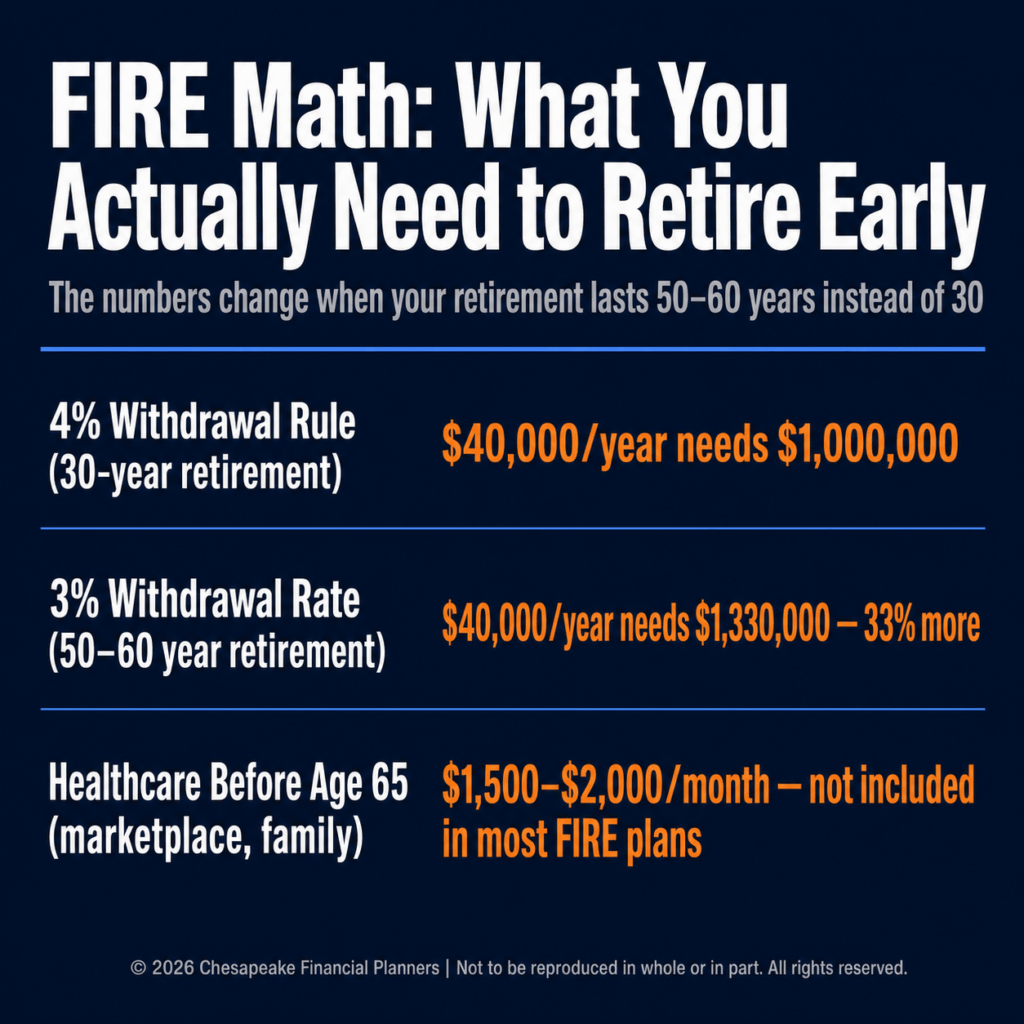
The math usually runs through the 4% rule, which holds that you can withdraw 4% of your portfolio in your first retirement year, adjust that amount for inflation each year after, and have strong odds of not running out of money over 30 years. This guidance traces back to financial planner William Bengen's 1994 research and was reinforced by the Trinity Study. Under a 4% rule, a household needing $40,000 a year would target a $1 million portfolio.
Reaching seven figures in 10 to 15 years is mathematically possible, but only with a high income, an aggressive savings rate, and a tolerance for frugality that most people underestimate.
What Are the Main Types of FIRE?
FIRE is not one path. Different versions reflect different tradeoffs between how hard you save now and how you want to live later.
- Lean FIRE: Living on a minimal budget, often $30,000 to $40,000 a year. It requires extreme frugality during both the accumulation years and retirement.
- Fat FIRE: Accumulating enough to fund a comfortable or even luxurious lifestyle, perhaps $100,000-plus a year. It needs a high income but asks for less lifestyle sacrifice.
- Barista FIRE: Saving enough to cover most expenses, then working part-time, frequently for the health insurance benefit and a little extra income. This shrinks the portfolio you need.
- Coast FIRE: Saving aggressively early, then stopping contributions and letting compounding finish the job while you keep working without the pressure to save more.
Each variation moves the levers differently. The right financial independence approach depends on your income, your spending floor, and how early you genuinely want to stop.
Does the Math of Early Retirement Actually Work?
The biggest flaw in copy-paste FIRE math is the time horizon. The 4% rule was designed for a 30-year retirement, not the 50 or 60 years a 35-year-old retiree needs to fund. When your money has to last twice as long, the safe withdrawal rate has to drop.
Most longevity-adjusted research suggests early retirees plan around a 3% to 3.5% withdrawal rate. That single change reshapes the whole plan:
| Annual Income Need | At 4% Withdrawal | At 3% Withdrawal |
|---|---|---|
| $40,000 | $1,000,000 | $1,333,333 |
| $60,000 | $1,500,000 | $2,000,000 |
| $80,000 | $2,000,000 | $2,666,667 |
A move from 4% to 3% raises the portfolio requirement by roughly a third. For most people pursuing early retirement planning, that gap translates into several more years of saving before they can safely walk away.
Sequence-of-returns risk makes this worse. If a market downturn hits in your first few retirement years while you are withdrawing, the damage compounds and your portfolio may never fully recover. Jeff has watched this single risk turn an otherwise sound retire-early plan into a forced return to work. The earlier you retire, the more this timing matters.
What Does the FIRE Movement Get Right?
FIRE advocates are correct about several fundamentals worth adopting even if you never plan to retire early.
The savings rate is the most powerful wealth lever, far more than chasing investment returns. FIRE also forces deliberate lifestyle design, pushing you to separate what you actually need from what you've simply gotten used to spending. And it leans on low-cost index funds and tax-advantaged accounts, which are sound principles for any investor.
This is where the R.U.D.D.E.R. Method™ fits naturally: it is Chesapeake Financial Planners' six-step planning process, Review and Recognize, Uncover and Understand, Design and Develop, Discuss and Decide, Execute and Empower, and Reassess and Refine. FIRE handles the saving and investing well. The structured planning process is what stress-tests whether the early-retirement target is realistic before you commit a decade to it.
What Does the FIRE Movement Underestimate?
The accumulation math is the easy part. The risks that derail early retirees usually show up after they stop working.
Healthcare is the first wall. Retire before 65 and you are not yet eligible for Medicare, so you buy coverage on the ACA marketplace. Premiums for a family can run well over $1,500 a month depending on income and plan, which raises the income your portfolio must produce. This is one reason an HSA matters so much for early retirees; in 2026 the individual contribution limit is $4,400 and the family limit is $8,750, and those dollars can offset medical costs tax-free.
Longevity is the second. Retiring at 35 may mean funding 60-plus years, and inflation over that span can quietly erode purchasing power until your comfortable budget no longer covers your life. The Social Security Administration calculates your benefit from your highest 35 years of earnings, so a decade-long career followed by zeros in the formula can permanently shrink the benefit you eventually claim.
Then there are the human factors the spreadsheet ignores. Career reentry after a long gap is hard. Skills fade, networks thin, and many early retirees discover that full-time leisure isn't as fulfilling as they pictured. Purpose and structure matter more than most people expect.
Frequently Asked Questions
What is the 4% rule and does it apply to early retirement?
The 4% rule says you can withdraw 4% of your portfolio in year one, then adjust for inflation annually, with strong odds of lasting 30 years. It does not transfer cleanly to early retirement. A 50- or 60-year horizon usually calls for a more conservative 3% to 3.5% withdrawal rate, which requires a noticeably larger portfolio.
How much money do I need to retire early with FIRE?
Your FIRE number depends on annual spending and your safe withdrawal rate. At a 3% rate, multiply your yearly expenses by about 33; at 4%, multiply by 25. So a household spending $50,000 a year needs roughly $1.25 million at 4% or about $1.67 million at 3%. Early retirees should plan toward the more conservative figure.
What happens to my health insurance if I retire before 65?
If you retire before 65, you are not yet eligible for Medicare and must buy coverage yourself, usually through the ACA marketplace. Premiums vary by income, age, and plan, but family coverage can exceed $1,500 a month. Budgeting realistically for this gap is one of the most common things FIRE plans get wrong.
Does retiring early reduce my Social Security benefit?
Yes, it usually does. The Social Security Administration averages your highest 35 years of earnings to calculate your benefit. Retiring after only 10 or 15 working years leaves several zeros in that 35-year formula, which lowers your eventual monthly benefit compared with someone who works a full career.
Is lean FIRE or fat FIRE better?
Neither is universally better; they fit different lives. Lean FIRE means a smaller portfolio funded by a tight budget, which works if you genuinely enjoy frugal living. Fat FIRE funds a comfortable lifestyle but requires far more savings and a higher income. The right choice depends on your spending floor and how much flexibility you want in retirement.
Conclusion
The FIRE movement gets the fundamentals right: save aggressively, design your lifestyle on purpose, and invest in low-cost funds. Where it stumbles is the long horizon, healthcare before 65, sequence risk, and the question of what you'll actually do with five decades of free time. If you're weighing early retirement, run the numbers at a 3% withdrawal rate and pressure-test your Plan B before committing.
If you found this helpful, our retirement income planning guide covers turning your portfolio into sustainable income in depth. Download it at chesapeakefp.com.
For related reading, see Is Early Retirement (FIRE) Right for Tech Professionals?, What is the best order to withdraw from my 401k, Roth IRA, and taxable accounts in retirement?, and Should I use my HSA as an investment account? for the healthcare-funding piece. If you're still in the accumulation phase, How do I balance saving for retirement and enjoying life now? is a useful companion.
Want to go deeper? Our Retirement Income Blueprint Workbook walks through this step by step.
Disclosures
The information provided is for educational purposes only and should not be construed as investment advice. Investment strategies should be tailored to individual circumstances, risk tolerance, and goals. Past performance doesn't guarantee future results. Consult with qualified financial professionals regarding your specific situation.
Advisors associated with Chesapeake Financial Planners may be either (1) LPL Financial Registered Representatives offering securities through LPL Financial, Member FINRA and SIPC, and investment advisor representatives offering investment advice through Great Valley Advisor Group; or (2) solely investment advisor representatives offering investment advice through Great Valley Advisor Group and not affiliated with LPL Financial. Great Valley Advisor Group, and Chesapeake Financial Planners are separate entities from LPL Financial.


