
When Is the Best Time to Leave a Job for Financial Reasons?
Last reviewed: July 2026
The best time to leave a job for financial reasons is right after your equity vests, after your annual bonus pays out, and once you have crossed any 401(k) match vesting milestone. Timing your exit around these dates can mean the difference between walking away clean and forfeiting tens of thousands of dollars. The focus keyword here is simple: when you leave a job, the calendar matters as much as the offer letter.
Key Takeaways
- Leaving a job before your equity vests can forfeit thousands; check your RSU vesting schedule before you set a departure date.
- Most annual bonuses require active employment on the payout date, often in Q1 of the following year.
- 401(k) employer match vesting can run up to six years; leaving early may mean forfeiting unvested matching funds.
- In 2026, the IRS 401(k) employee contribution limit is $24,500, worth front-loading before you leave.
About the Author: Jeff Judge, CFP®, AEP®, ChFC®, CLU® is Managing Partner of Chesapeake Financial Planners in Forest Hill, Maryland. He has been helping families and business owners in Harford County and the Baltimore metro area navigate job transitions and equity compensation since earning his CFP® certification in 2013, by using Chesapeake Financial Planners’ signature process, the R.U.D.D.E.R. method™. Jeff has watched clients resign three weeks before a vesting cliff and leave $40,000 on the table. The fix was almost always a calendar conversation, not a complicated strategy.
What Should You Check Before You Leave a Job?
Before you set a departure date, you need a clear inventory of what you are walking away from. The biggest financial mistakes happen when people resign emotionally and forget the money still tied to the calendar. When you leave a job, six things deserve a hard look first.
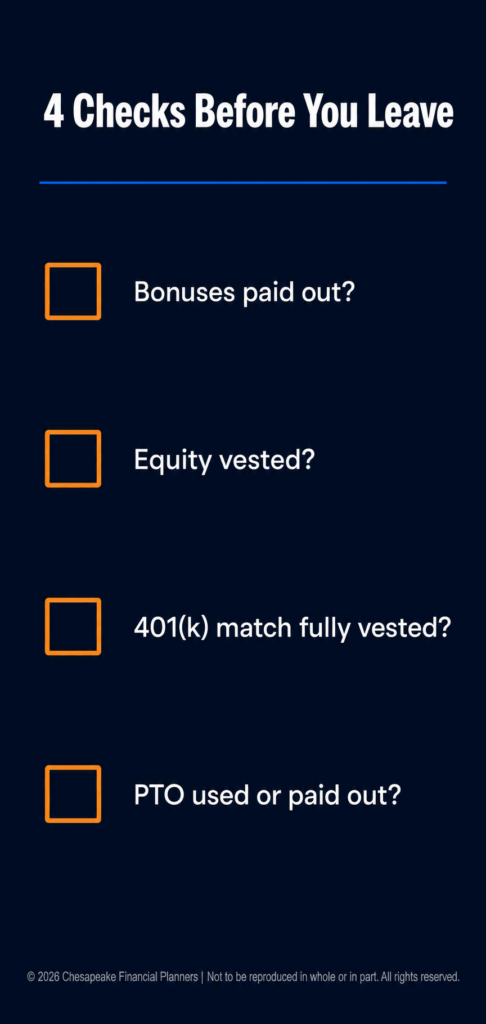
The list is short but expensive to ignore: unvested equity such as RSUs and stock options, unpaid bonuses or commissions, your 401(k) employer match vesting schedule, accrued PTO that may or may not pay out, the gap in health insurance coverage, and any raise or promotion that is close to landing. Each of these has a date attached, and dates are negotiable far less often than people assume.
Jeff Judge tells clients to pull three documents before doing anything else: your equity grant agreement, your bonus plan summary, and your 401(k) summary plan description. Those three pages contain almost every number you need. Reading them before you give notice is the single highest-return hour in any job transition.
This is also where the R.U.D.D.E.R. Method™, Chesapeake Financial Planners' six-step planning process of Review and Recognize, Uncover and Understand, Design and Develop, Discuss and Decide, Execute and Empower, and Reassess and Refine, earns its keep. A job departure is a perfect Review and Recognize moment, because the deadlines are fixed and the dollar amounts are knowable in advance.
How Does Equity Vesting Affect the Timing of Your Departure?
Equity vesting is usually the largest single number on the table, which makes RSU vesting and stock option timing the first thing to map. If your company granted you RSUs or stock options, your vesting schedule tells you exactly how much money is still conditional on your continued employment.
Most equity vests over three to four years, often with a one-year cliff. A cliff means nothing vests until you hit twelve months, at which point a chunk (commonly 25%) vests at once, with the rest vesting monthly or quarterly afterward. Walk away one month before a vest date and you forfeit that tranche entirely.
Here is the math that catches people. Say you hold $100,000 in RSUs vesting over four years. Year one vests $25,000 at the cliff, then roughly $6,250 vests every quarter for years two through four. Resign one month before a quarterly vest and you hand back $6,250 for nothing.
The rule of thumb Jeff uses with clients: if your next vest is within one to three months, the math almost always favors waiting. If your next meaningful vest is years away, the opportunity cost of staying in a bad situation usually outweighs the unvested equity. One exception overrides all of this. If your health is suffering or you have a genuinely time-sensitive opportunity, do not trade your well-being for a vesting date. Money is recoverable. Burnout is expensive in ways a spreadsheet will not show you.
| Scenario | Next vest timing | Smart move |
|---|---|---|
| Close to a cliff or quarterly vest | Within 1-3 months | Strongly consider waiting |
| Mid-cycle, modest amount | 3-9 months out | Weigh against the new offer |
| Early in a 4-year grant | 1+ years out | Opportunity cost likely wins |
How Should You Time Your Departure Around a Bonus?
Bonus timing is the second-largest variable, and it trips up more people than equity does. Many companies pay annual bonuses in the first quarter (January through March) for the prior year's work, and most plans require you to be actively employed on the payout date to collect.
That single clause creates the trap. You can work the entire calendar year, earn every dollar of that bonus on paper, and forfeit all of it by giving notice in December before the check clears. According to the Bureau of Labor Statistics, supplemental pay including nonproduction bonuses is a standard component of total compensation, which means it is real money you have already earned, not a gift.
Run the numbers before you decide. If your bonus pays out February 15 and you are ready to leave in January, waiting six weeks to collect $15,000 is almost always worth it. The exception is when your new offer is time-sensitive. In that case, ask whether the new employer will provide a signing bonus to offset what you are forfeiting. Jeff has negotiated exactly this for clients more than once, and most hiring managers would rather write a one-time check than lose a candidate over timing.
What Happens to Your 401(k) Match When You Leave?
Your own 401(k) contributions are always yours, but the employer match may not be. Many plans vest the match over time, often on a graded schedule running two to six years, which means leaving early can forfeit matching dollars you assumed were already in the bank.
There are three common structures. Immediate vesting means the match is yours the day it lands, which is the best case. Cliff vesting means you own nothing until a specific year (say year three), then own 100% at once. Graded vesting means you own a growing percentage each year, commonly 20% per year over five years. Your summary plan description spells out which one applies to you.
In 2026, the IRS set the 401(k) employee contribution limit at $24,500, with a standard catch-up of $8,000 for those age 50 and older. If you are leaving mid-year, front-loading contributions before your last paycheck can let you capture more match and more tax-deferred savings before the door closes. The IRS also allows you to roll an old 401(k) into an IRA or a new employer plan, so you rarely need to cash out and trigger taxes and penalties.
What should I do with my 401(k) when I change jobs?
Frequently Asked Questions
Should I wait to quit until after my RSUs vest?
Yes, if your next RSU vest is within one to three months, waiting almost always makes financial sense. Forfeiting a quarterly tranche can cost several thousand dollars for the sake of a few weeks. If your next vest is years out, the opportunity cost of staying in a poor situation usually outweighs the unvested equity.
Do I lose my bonus if I leave before it pays out?
In most cases, yes. The majority of annual bonus plans require you to be actively employed on the payout date, which often falls in the first quarter for the prior year's performance. Confirm the exact payout date and employment requirement in your bonus plan summary before giving notice, since the clause is rarely flexible.
What happens to my 401(k) employer match if I leave a job early?
You keep your own contributions, but unvested employer match dollars are typically forfeited when you leave a job before satisfying the vesting schedule. Matches commonly vest over two to six years under cliff or graded schedules. Check your summary plan description to see how much of the match you actually own today.
Can I negotiate a signing bonus to replace forfeited compensation?
Yes, and you should ask. If leaving means forfeiting an unpaid bonus or unvested equity, many new employers will provide a signing bonus to offset the loss rather than risk losing you over timing. Bring specific numbers to the conversation, because hiring managers respond better to a concrete figure than a vague request.
Is it ever worth leaving before my equity vests?
Yes, when the cost of staying exceeds the value walking away. A serious health toll, a clearly better long-term opportunity, or a vesting date that is years out can all justify leaving early. Jeff Judge reminds clients that money is recoverable, while burnout and missed once-in-a-career moves often are not.
What should I do with my old 401(k) after I leave?
You generally have three options: leave it in the former employer's plan, roll it into your new employer's plan, or roll it into an IRA. A direct rollover avoids taxes and the early withdrawal penalty. Cashing out is almost always the worst choice because it triggers ordinary income tax and, before age 59½, a 10% penalty.
Ready to Time Your Exit the Right Way?
Leaving a job is rarely just a numbers decision, but the numbers are the part you can control with a calendar and a few documents. If you found this helpful, our free Job Transition Financial Checklist walks through equity vesting, bonus timing, and the 401(k) decisions step by step. Download it at chesapeakefp.com and make sure you do not leave a job leaving money behind.
Should I update my financial plan after a big life event?
Can I roll my old 401(k) into an IRA instead?
Want to go deeper? Our 10 Signs You're Ready for a Certified Financial Planner walks through this step by step.
Prefer a different starting point? Our Transition Readiness Questionnaire is worth a look.
Disclosures
The information provided is for educational purposes only and should not be construed as investment advice. Investment strategies should be tailored to individual circumstances, risk tolerance, and goals. Past performance doesn't guarantee future results. Consult with qualified financial professionals regarding your specific situation.
Advisors associated with Chesapeake Financial Planners may be either (1) LPL Financial Registered Representatives offering securities through LPL Financial, Member FINRA and SIPC, and investment advisor representatives offering investment advice through Great Valley Advisor Group; or (2) solely investment advisor representatives offering investment advice through Great Valley Advisor Group and not affiliated with LPL Financial. Great Valley Advisor Group, and Chesapeake Financial Planners are separate entities from LPL Financial.


