

How Do Family Limited Partnerships Reduce Estate Taxes?
Last reviewed: July 2026
A family limited partnership reduces estate taxes by letting you transfer business and investment assets to your children at a discounted value, often 20% to 40% below the assets' actual worth. You keep control as the general partner while gifting limited partnership interests that qualify for lack-of-control and lack-of-marketability discounts. That means you move more wealth out of your taxable estate for each dollar of gift tax exemption you use.
Key Takeaways
- A family limited partnership lets you transfer wealth at a discount while keeping management control as general partner.
- Combined valuation discounts on limited partnership interests typically run 20% to 40%, sometimes higher with proper appraisals.
- The 2026 annual gift tax exclusion is $19,000 per recipient, letting you transfer interests tax-free over time.
- The IRS challenges partnerships that lack a legitimate non-tax business purpose, so structure and documentation matter.
About the Author: Jeff Judge, CFP®, AEP®, ChFC®, CLU® is Managing Partner of Chesapeake Financial Planners in Forest Hill, Maryland. He has been helping families and business owners in Harford County and the Baltimore metro area navigate estate and wealth transfer planning since earning his CFP® certification in 2013, by using Chesapeake Financial Planners’ signature process, the R.U.D.D.E.R. method™. Jeff often tells clients that the partnership only works if you treat it like a real business, not a tax trick you set up and forget.
What Is a Family Limited Partnership and How Does It Lower Estate Taxes?
A family limited partnership is a legal entity where family members hold ownership in two tiers: general partners who control and manage the partnership, and limited partners who own economic interests but have no management authority. Parents usually start as general partners holding family assets, then gift limited partnership interests to children and grandchildren over time.
Here is where the estate tax savings come in. Because limited partners cannot control investments, force distributions, or sell their interest easily, those interests are worth less than a direct share of the underlying assets. That gap is the discount. You transfer economic value out of your estate while a third-party appraiser supports a lower gift tax value.
The partnership typically holds real estate, marketable securities, or closely held business interests. Consolidating those assets in one entity creates centralized management and a single structure for moving wealth to the next generation. The federal estate tax matters most for larger estates: for 2026, the exemption sits at $15 million per individual under current law, and a family limited partnership helps families above that line shrink the taxable portion of their estate.
How Do Valuation Discounts Work in a Family Limited Partnership?
Valuation discounts are the engine that makes a family limited partnership effective for estate tax planning. When you gift a limited partnership interest, two discounts usually apply, and together they reduce the gift's taxable value.
The lack-of-control discount reflects that a limited partner cannot direct investments, demand distributions, or make management decisions. An interest you cannot control is worth less than one you can. The lack-of-marketability discount reflects that there is no ready market for a private partnership interest. You cannot sell it the way you sell a publicly traded stock, and the partnership agreement often restricts transfers entirely.
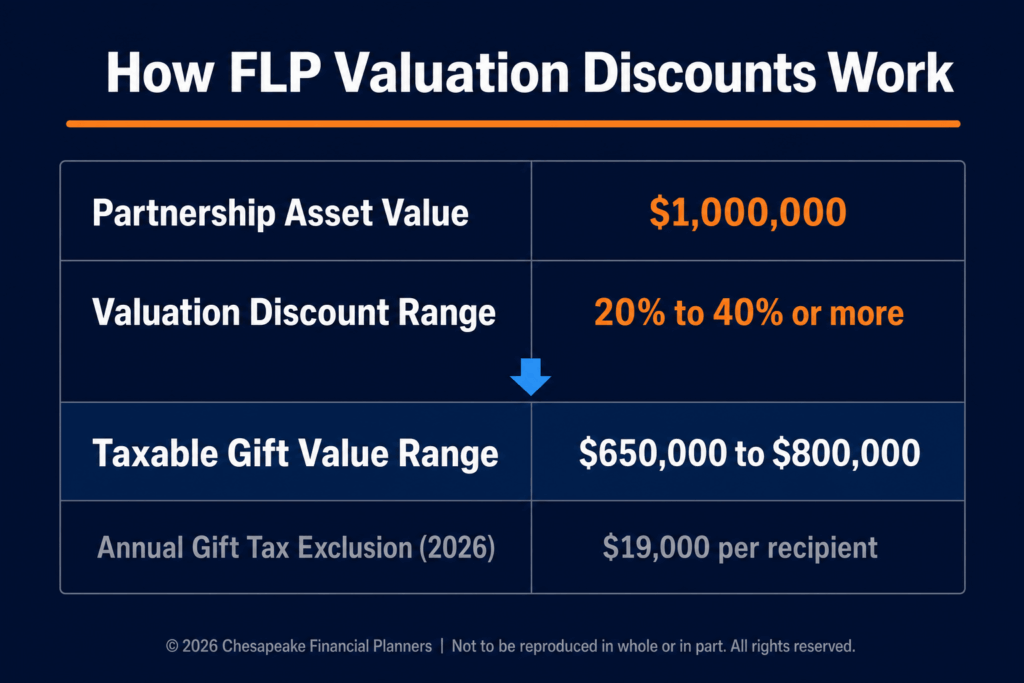
Combined, these discounts commonly range from 20% to 40%, and sometimes more with strong appraisal support. In practice, a limited partnership interest representing $1 million of underlying assets might be valued at $650,000 to $800,000 for gift tax purposes. According to the IRS, valuation must reflect fair market value, which is exactly why a qualified appraisal is non-negotiable. Jeff has watched families lose discounts they assumed were locked in simply because they skipped a defensible appraisal and the IRS revalued the gifts.
| Discount Type | What It Reflects | Typical Range |
|---|---|---|
| Lack of control | Limited partners cannot manage assets or force distributions | 10% to 25% |
| Lack of marketability | No ready buyer; transfer restrictions apply | 15% to 35% |
| Combined effect | Both discounts applied together | 20% to 40%+ |
What Does the IRS Require for a Family Limited Partnership to Hold Up?
The IRS scrutinizes these partnerships closely and has successfully unwound many that existed only to dodge taxes. To survive a challenge, your partnership must look and operate like a genuine business with a legitimate non-tax purpose.
Valid purposes include consolidating family assets for professional management, facilitating business succession, protecting assets from creditors, or pooling smaller holdings to reach better investment opportunities. The partnership also needs real operating hygiene: a formal partnership agreement, documented meetings, separate bank accounts, partnership tax returns, and consistent adherence to formalities.
A few traps reliably draw IRS attention. Transferring your personal residence into the partnership to claim discounts invites a challenge, because a personal-use asset is not a business asset. Deathbed formations raise red flags. And if general partners keep enjoying the full economic benefit of "transferred" assets, the IRS may argue no real transfer happened. This is the Internal Revenue Code Section 2036 retained-interest problem, and it pulls assets back into your taxable estate if you blur the line between you and the partnership.
This is the kind of work where Jeff leans on the R.U.D.D.E.R. Method™, Chesapeake Financial Planners' six-step planning process: Review and Recognize, Uncover and Understand, Design and Develop, Discuss and Decide, Execute and Empower, and Reassess and Refine. The Reassess step matters here, because a partnership that was clean at formation can drift out of compliance if nobody revisits it.
How can I potentially optimize my taxes as my income grows?
How Do Lifetime Gifts Move Wealth Through a Family Limited Partnership?
Once the partnership has an operating history, parents typically begin gifting limited partnership interests to children and grandchildren. The annual gift tax exclusion is one of the cleanest tools available. For 2026, you can gift up to $19,000 per recipient without using any lifetime exemption, and a married couple can combine to gift $38,000 per recipient per year.
Because the gifted interests are discounted, your annual exclusion stretches further. A $19,000 gift of limited partnership interest might represent $25,000 or more of underlying asset value once the discount is applied. Over a decade, across several family members, that compounds into meaningful wealth transfer.
Larger gifts using lifetime exemption can accelerate the strategy, especially when families worry exemption levels could change. The non-negotiable in every case is a qualified appraisal documenting the discount. Skip it, and the whole structure becomes far easier for the IRS to attack.
How do you create a family wealth governance structure for long-term success?
What Other Benefits Does a Family Limited Partnership Provide?
Beyond estate tax reduction, family limited partnerships offer asset protection and centralized management. In most states, a creditor of a limited partner cannot reach partnership assets directly. The creditor's remedy is usually limited to a charging order, which only entitles them to distributions actually made to the debtor partner. That makes a limited partnership interest a far less attractive lawsuit target.
This protection is strongest for limited partners and works best when established well before any legal trouble. Fraudulent transfer rules prohibit moving assets into a partnership to dodge existing creditors, so the structure must be part of long-term planning, not a reaction to a lawsuit. Many families layer an umbrella liability policy on top for additional protection.
Centralized management is the quieter benefit. Rather than each heir managing inherited assets separately, the partnership employs professional advisors and runs coordinated strategies. That protects family wealth from inexperienced decision-making and opens access to investments requiring larger minimums.
How Much Umbrella Insurance Coverage Do I Need?
How can I potentially optimize my taxes as my income grows?
Frequently Asked Questions
What is the difference between a general partner and a limited partner in a family limited partnership?
A general partner controls and manages the partnership, makes investment decisions, and carries liability for partnership obligations. A limited partner owns an economic interest but has no management authority and cannot force distributions. In most family structures, parents act as general partners while children hold limited partnership interests that qualify for valuation discounts.
How much can valuation discounts reduce the value of gifted partnership interests?
Valuation discounts on limited partnership interests typically reduce value by 20% to 40%, and sometimes more with strong appraisal support. The discount combines a lack-of-control component and a lack-of-marketability component. A limited interest representing $1 million in underlying assets might be valued near $650,000 to $800,000 for gift tax purposes, transferring more value per exemption dollar.
Does the IRS allow family limited partnerships for estate planning?
Yes, the IRS allows family limited partnerships, but it scrutinizes them heavily. The partnership must serve a legitimate non-tax business purpose, operate with genuine formalities, and avoid letting general partners retain full economic benefit of transferred assets. Partnerships that exist only to claim discounts, or that hold personal-use property, frequently lose their tax benefits on audit.
Can a family limited partnership protect assets from creditors?
A family limited partnership can protect assets because, in most states, a limited partner's creditor cannot reach partnership assets directly. The creditor's remedy is usually a charging order, which only captures distributions actually paid to that partner. This protection works best when the partnership is established well before any legal dispute, not in reaction to one.
Should I use a family limited partnership or a family LLC?
Both structures use the same valuation discount principles, so the choice depends on liability and flexibility. A family LLC gives every member limited liability and often offers a more flexible management structure under modern state statutes. Many families now prefer LLCs, though family limited partnerships still fit well when an existing partnership or specific state law favors them.
When should I set up a family limited partnership?
You should set up a family limited partnership well before death, ideally years in advance, so it develops a genuine operating history. Deathbed formations and transfers made immediately before death draw IRS challenges and can pull assets back into your taxable estate. Early formation also gives you more years of annual gifting to move wealth efficiently.
If you found this helpful, our estate planning resources at chesapeakefp.com go deeper on wealth transfer strategies, valuation discounts, and how family limited partnerships fit alongside trusts and gifting plans. Download our estate planning guide to see how these pieces work together for your family.
Disclosures
The information provided is for educational purposes only and should not be construed as investment advice. Investment strategies should be tailored to individual circumstances, risk tolerance, and goals. Past performance doesn't guarantee future results. Consult with qualified financial professionals regarding your specific situation.
Advisors associated with Chesapeake Financial Planners may be either (1) LPL Financial Registered Representatives offering securities through LPL Financial, Member FINRA and SIPC, and investment advisor representatives offering investment advice through Great Valley Advisor Group; or (2) solely investment advisor representatives offering investment advice through Great Valley Advisor Group and not affiliated with LPL Financial. Great Valley Advisor Group, and Chesapeake Financial Planners are separate entities from LPL Financial.


