

What Should I Do Immediately After Winning the Lottery?
Last reviewed: July 2026
The first thing to do after winning the lottery is sign the back of the ticket, secure it, and tell no one while you assemble a financial advisor, an estate attorney, and a CPA. The decisions you make in the first 24 hours, before you claim the prize or share the news, determine whether this windfall becomes lasting wealth or a story about how it all disappeared. You have more time than your adrenaline is telling you. Use it.
Key Takeaways
- Sign the ticket immediately and store it securely, because in most states a lottery ticket is a bearer instrument anyone holding it can claim.
- Tell no one until you have a professional team in place and a plan to protect your privacy.
- Federal tax withholding on gambling winnings over $5,000 is 24%, but the top federal rate is 37% on a large jackpot.
- Most prizes give you 180 days to a year to claim, so there is no need to rush to the lottery office.
About the Author: Jeff Judge, CFP®, AEP®, ChFC®, CLU® is Managing Partner of Chesapeake Financial Planners in Forest Hill, Maryland. Jeff has watched windfall recipients lose more to rushed decisions in the first month than to taxes over the next decade. He has been helping families and business owners in Harford County and the Baltimore metro area navigate sudden wealth events and major financial windfalls since earning his CFP® certification in 2013, by using Chesapeake Financial Planners’ signature process, the R.U.D.D.E.R. method™.
Why Are the First 24 Hours After Winning the Lottery So Important?
The first 24 hours matter because nearly every irreversible mistake a lottery winner makes happens in this window, driven by adrenaline rather than strategy. You are not thinking clearly right now, and that is normal. Your brain is flooded with excitement, fear, and the urge to act. That combination produces bad decisions.
Sudden wealth is harder to manage than slow wealth. People who build money over decades develop habits and judgment along the way. A jackpot skips all of that. Jeff Judge often tells clients that the lottery does not hand you wisdom along with the check, and the gap between the money and the judgment to manage it is where fortunes get lost.
The goal in the first day is simple. Protect the ticket, protect your privacy, and protect your future self from your current emotional state. Everything else can wait.
What Is the First Thing to Do With a Winning Lottery Ticket?
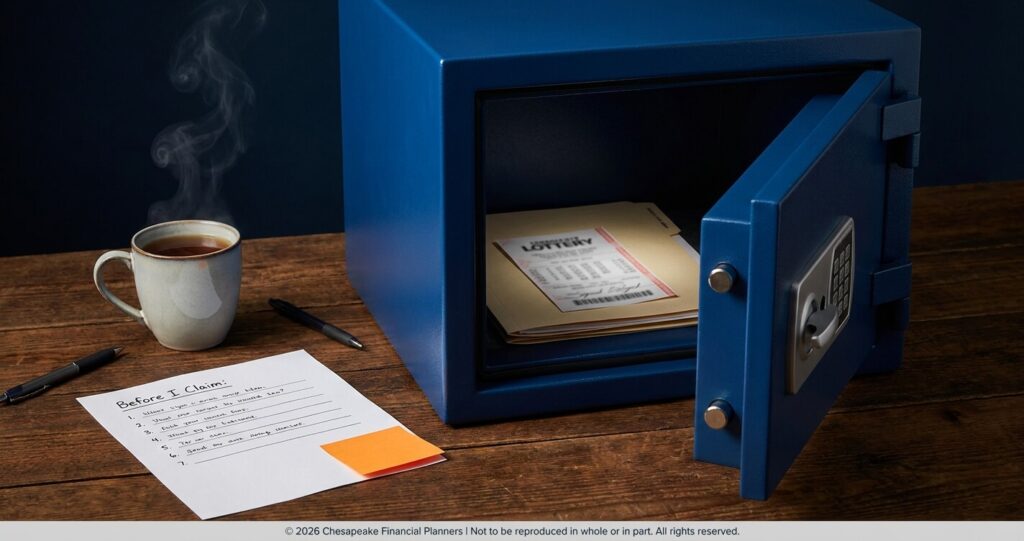
The first thing to do is sign the back of the winning ticket, then store it somewhere secure that only you can access. In most states, a lottery ticket is a bearer instrument, which means whoever physically holds the ticket can claim the prize. If you lose it, the money is gone. If someone takes it, they can cash it.
Signing it establishes ownership. After that, put it somewhere it cannot be lost, burned, or stolen. A fireproof safe or a bank safe deposit box works. A wallet or a kitchen drawer does not.
Take a clear photo of the front and back of the signed ticket and store that image somewhere separate from the physical ticket. Then walk away from it. You do not need to claim the prize today, and rushing to the lottery commission before you have help is one of the most common and most expensive errors winners make.
What professionals does a lottery winner need to hire first?
Should I Tell My Family I Won the Lottery?
Not yet. The moment you tell anyone, even your spouse or your closest friend, the information starts to move beyond your control, and protecting your winnings becomes far harder. People talk. Word spreads. Once it does, your privacy, your security, and your ability to make calm decisions all erode at once.
This is not about distrust. Well-meaning family can still create real problems by pressuring you to share money immediately, telling others without meaning to, or offering emotional advice that costs you a fortune. You will tell the people who matter. You just do not do it on day one, before you have a plan and a team. Jeff Judge notes: "The people who love you most are also the most likely to share the news with someone else before you've signed a single document, and once that information is loose you lose the ability to think clearly and make decisions on your own timeline."
What should you tell family after winning the lottery?
In Jeff's experience, the cleanest path is to decide in advance how and when you will share the news, and with whom, rather than reacting to the excitement in the moment. A plan you set when you are calm holds up far better than a promise you make when your hands are still shaking.
Can I Claim Lottery Winnings Anonymously?
It depends on your state. Some states let lottery winners claim prizes anonymously, often through a trust or LLC, while others require your name, city, and sometimes a photo to be made public. Research your state's specific rules before you do anything that reveals your identity.
If anonymity is available, claiming through a legal entity can keep your name out of headlines and off the radar of strangers, scammers, and long-lost relatives. If your state requires public disclosure, you need a different plan, one built around managing the publicity and hardening your security before the announcement lands. An attorney experienced with windfalls can structure either approach. This is exactly the kind of decision you do not want to make alone in the first hour.
What should you do when you suddenly receive a large sum of money?
Should I Take the Lump Sum or the Annuity?
There is no universal right answer, and the choice depends on your age, discipline, tax situation, and what you plan to do with the money. Most lotteries offer two options, and the difference between them is significant.
| Option | What You Receive | Best Suited For |
|---|---|---|
| Lump Sum | A one-time payment, typically a reduced portion of the advertised jackpot | Disciplined investors who can manage and grow a large sum |
| Annuity | The full advertised amount paid in installments over 20 to 30 years | Those who want guaranteed income and protection from impulse spending |
The lump sum gives you control and the chance to invest, but it also exposes you to your own worst impulses. The annuity enforces discipline and spreads your tax exposure, but it ties up flexibility for decades. Either way, the 24% federal withholding is only a down payment, since a jackpot can push you into the top 37% bracket. Model both paths with your CPA and advisor before you choose. This is the kind of question the R.U.D.D.E.R. Method™ is built to work through, Chesapeake Financial Planners' six-step planning process of Review and Recognize, Uncover and Understand, Design and Develop, Discuss and Decide, Execute and Empower, and Reassess and Refine.
What happens to my finances after a liquidity event?
Frequently Asked Questions
How long do I have to claim a lottery prize?
Most states give lottery winners between 180 days and one year to claim a prize, depending on the state and the game. There is no need to rush to the lottery office the day after you win. Use that time to secure the ticket, assemble your professional team, and build a plan before you claim.
Why should I sign the back of my lottery ticket right away?
You should sign the ticket because in most states a lottery ticket is a bearer instrument, meaning whoever physically holds the signed ticket can claim the prize. Signing it establishes your ownership and protects you if the ticket is lost or stolen before you claim. Photograph both sides and store the ticket securely afterward.
How much tax will I owe on lottery winnings?
Federal law requires 24% withholding on gambling winnings over $5,000, but a large jackpot will likely push you into the top federal bracket of 37%. State taxes may apply on top of that. A CPA should model your full liability before you choose between the lump sum and the annuity.
Should I quit my job after winning the lottery?
Not immediately. Quitting your job in the first days makes you more visible and more vulnerable while you are still running on adrenaline. Maintaining your routine keeps you grounded and protects your anonymity. You can leave your job later, after you have consulted professionals and built a financial plan around your new circumstances.
Who do I need on my financial team after a lottery win?
You need three core professionals: a fee-only financial advisor experienced with sudden wealth, an estate attorney who handles asset protection and trusts, and a CPA who understands large windfalls. Interview multiple candidates, check credentials, and sign engagement agreements before disclosing your win. Avoid anyone a relative casually recommended or who advertises aggressively.
Should I post about my lottery win on social media?
No. Avoid social media and public statements entirely until you have professional guidance and a security plan. A single post can expose your identity, your location, and your wealth to scammers, solicitors, and opportunists. Once the information is public, you cannot take it back, so silence is the safest default in the early weeks.
If you found this helpful, our guide to managing sudden wealth covers the full windfall planning process in depth, from protecting your winnings to building a plan that lasts. Download it at chesapeakefp.com to make your next move with a clear head instead of a racing heart.
Disclosures
The information provided is for educational purposes only and should not be construed as investment advice. Investment strategies should be tailored to individual circumstances, risk tolerance, and goals. Past performance doesn't guarantee future results. Consult with qualified financial professionals regarding your specific situation.
Advisors associated with Chesapeake Financial Planners may be either (1) LPL Financial Registered Representatives offering securities through LPL Financial, Member FINRA and SIPC, and investment advisor representatives offering investment advice through Great Valley Advisor Group; or (2) solely investment advisor representatives offering investment advice through Great Valley Advisor Group and not affiliated with LPL Financial. Great Valley Advisor Group, and Chesapeake Financial Planners are separate entities from LPL Financial.


