

What happens during a comprehensive financial planning review meeting?
Last reviewed: July 2026
A comprehensive financial planning review is a structured meeting where your advisor examines every part of your financial life, measures progress against your goals, and adjusts the plan based on what changed since the last review. It covers investments, taxes, retirement projections, insurance, and estate planning in one coordinated session. It is not a portfolio check. It is a full diagnostic of where you stand and what to do next.
Most people expect their advisor to glance at investment returns and move on. A real financial planning review goes much deeper, and that depth is where the value lives.
Key Takeaways
- A financial planning review covers investments, taxes, retirement projections, insurance, and estate planning, not just portfolio performance.
- Send updated documents before the meeting so review time goes to decisions, not data collection.
- The IRS 401(k) employee contribution limit is $24,500 for 2026, a key figure your advisor checks during the review.
- A good review produces a short list of specific action items with owners and deadlines, not vague advice.
About the Author: Jeff Judge, CFP®, AEP®, ChFC®, CLU® is Managing Partner of Chesapeake Financial Planners in Forest Hill, Maryland. He has been helping families and business owners in Harford County and the Baltimore metro area navigate financial planning reviews since earning his CFP® certification in 2013, by using Chesapeake Financial Planners’ signature process, the R.U.D.D.E.R. method™. Jeff finds that clients consistently undervalue the tax planning portion of the review, which is often where the largest dollar decisions hide.
What Is a Comprehensive Financial Planning Review?
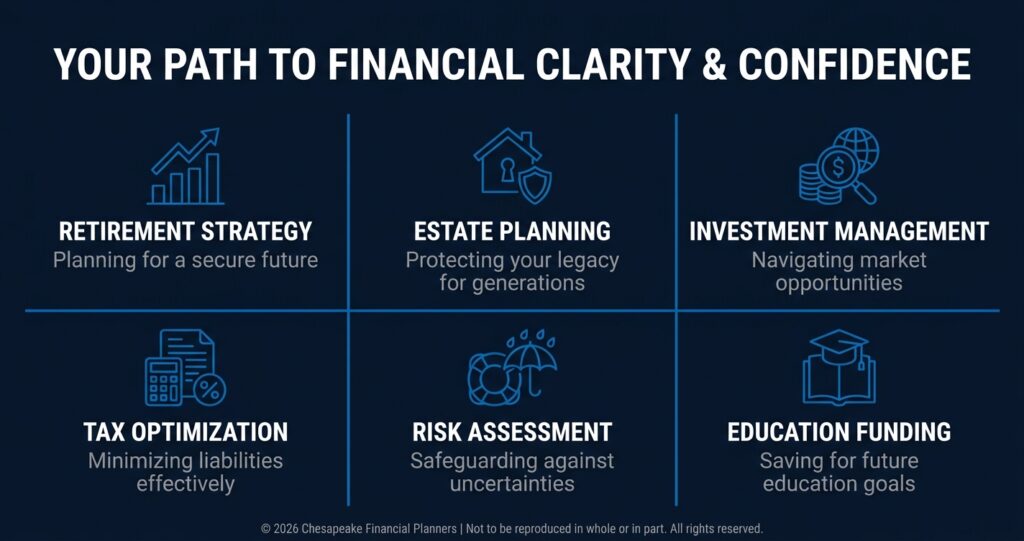
A comprehensive financial planning review is a periodic meeting, usually annual, where an advisor evaluates your complete financial picture and confirms your plan still matches your goals. It differs from a portfolio review, which only looks at investment accounts. A financial planning review examines investments, cash flow, taxes, insurance, retirement timing, and estate documents together, because these pieces interact.
The point is coordination. A Roth conversion changes your tax bill. A market gain shifts your asset allocation. A new grandchild changes your estate plan. Jeff Judge often tells clients that the value of a review is not finding one good idea, it is finding the three or four decisions that only make sense when you look at everything at once. At Chesapeake Financial Planners, this is the core of the R.U.D.D.E.R. Method™, Chesapeake Financial Planners' six-step planning process: Review and Recognize, Uncover and Understand, Design and Develop, Discuss and Decide, Execute and Empower, and Reassess and Refine.
Why Does a Financial Planning Process Matter More Than Investment Selection?
How Should You Prepare Before a Financial Advisor Meeting?
You prepare for a financial advisor meeting by sending updated documents in advance and writing down what changed in your life. This lets the advisor build a meaningful review instead of spending the session collecting data. Preparation directly determines how much you get out of the hour.
Your advisor will typically ask for:
- Recent pay stubs or year-to-date business income
- Year-to-date tax withholding or estimated tax payments
- Updated account statements not already linked
- Changes in expenses, debt, or assets
- Significant life events such as job changes, health issues, or family updates
Behind the scenes, your advisor analyzes your portfolio, checks asset allocation drift, identifies rebalancing or tax-loss harvesting opportunities, and runs updated projections for retirement and other goals before you ever sit down. The more current the inputs, the sharper the output.
What Life Events Should Trigger a Financial Plan Review?
What Gets Covered During the Meeting?
During the meeting, your advisor reviews life changes, investment performance, asset allocation, tax planning, and retirement readiness in a structured sequence. Each topic builds on the last, which is why a financial planning review works better as one coordinated session than as separate conversations spread across the year.
The meeting usually opens with what changed since you last met: career moves, family events, health issues, an inheritance, business developments, or a housing change. These updates shape every recommendation that follows.
Then comes the portfolio performance review. Your advisor presents how each account performed, compares it to appropriate benchmarks, and explains what drove the results. Good advisors put performance in context. A 10% decline sounds alarming until you learn the broad market fell 15%. A 20% gain looks great until you realize how much risk produced it. According to FINRA, understanding the relationship between risk and return is fundamental to evaluating any investment result, which is exactly what this part of the meeting is for.
Asset allocation and rebalancing follow. Over time, your strongest performers grow into an oversized share of your portfolio, which quietly raises your risk. Your advisor discusses whether rebalancing is needed to return to your target, and whether that target should change if your timeline or risk tolerance shifted.
What is the best order to withdraw from my 401k, Roth IRA, and taxable accounts in retirement?
How Does Tax Planning Fit Into the Review?
Tax planning is the part of the review where the largest dollar decisions usually appear, which is why it deserves real time rather than a passing mention. Your advisor looks at the full year ahead, not just the return you already filed. Proactive tax planning is forward-looking by design.
A thorough tax discussion covers:
- Whether you are maximizing tax-advantaged contributions. The IRS set the 2026 401(k) employee contribution limit at $24,500, and the IRA contribution limit at $7,500.
- Whether a Roth conversion makes sense this year given your bracket
- Available tax-loss harvesting opportunities
- How required minimum distributions affect your income
- Whether to accelerate or defer income
- Whether charitable giving strategies fit your situation
For business owners, this section gets more involved and often means coordinating with your CPA on entity structure, deductions, and estimated payments. Jeff Judge has watched clients leave thousands on the table year after year simply because nobody connected the investment side to the tax side. That coordination is the whole point of a comprehensive review.
Should I max out my 401(k) or invest somewhere else?
How Does the Review Measure Retirement Readiness?
The review measures retirement readiness by running updated projections that test whether you can retire when you want and stay funded through a long retirement. Your advisor models multiple scenarios rather than a single straight-line estimate, because real markets and real spending do not move in straight lines.
These projections answer concrete questions: Are you on track for your target retirement date? What is your probability of success across good and bad market sequences? How do Social Security timing, pension income, and withdrawals fit together? The Social Security Administration confirms that delaying benefits past full retirement age increases your monthly benefit, which is one lever your advisor weighs during this section.
A strong review ends with a short, specific action list: contributions to adjust, accounts to rebalance, a conversion to evaluate, a beneficiary form to update. Vague advice is the enemy. You should leave knowing exactly what to do next and who is doing it.
How do I coordinate all my retirement income sources to minimize taxes and maximize income?
Frequently Asked Questions
How often should I have a financial planning review?
Most people benefit from a comprehensive financial planning review once a year, with shorter check-ins if something major changes. Annual cadence keeps your plan current without overreacting to short-term market noise. A job change, inheritance, marriage, divorce, or health event should trigger an off-cycle review regardless of timing.
How long does a financial planning review meeting take?
A comprehensive financial planning review typically runs 60 to 90 minutes, depending on the complexity of your situation. Business owners and households with multiple accounts, equity compensation, or estate considerations often need the longer end. Preparing documents in advance shortens the data-gathering portion and leaves more time for actual decisions.
What is the difference between a portfolio review and a financial planning review?
A portfolio review looks only at your investment accounts and their performance. A comprehensive financial planning review examines your full financial life, including taxes, retirement projections, insurance, cash flow, and estate planning. The financial planning review is broader because those areas interact, and decisions in one affect the others.
What should I bring to a financial advisor meeting?
Bring updated account statements, recent pay stubs or business income, year-to-date tax information, and a written list of any life changes since your last meeting. If you have new insurance policies, estate documents, or large upcoming expenses, bring those too. Complete inputs let your advisor build a sharper, more useful review.
Do I need a financial planning review if I already have investments?
Yes. Having investments does not mean those investments are coordinated with your taxes, retirement timeline, and estate plan. A financial planning review checks whether the pieces work together, identifies gaps, and surfaces tax opportunities that a standalone portfolio rarely captures on its own.
What questions will my advisor ask during the review?
Your advisor will ask what changed in your life, whether your goals shifted, how your spending and income are trending, and how you feel about market risk. These questions shape every recommendation. Honest answers, especially about risk tolerance and upcoming expenses, lead to a plan you will actually follow.
Get the Most From Your Next Review
A comprehensive financial planning review is only as valuable as the preparation and follow-through around it. If you want a clearer picture of what a thorough review should cover before your next meeting, our guide to building a coordinated plan walks through each step in depth. Download it at chesapeakefp.com.
Is financial planning worth it if I already have investments?
Want to go deeper? Our 10 Signs You're Ready for a Certified Financial Planner walks through this step by step.
Disclosures
The information provided is for educational purposes only and should not be construed as investment advice. Investment strategies should be tailored to individual circumstances, risk tolerance, and goals. Past performance doesn't guarantee future results. Consult with qualified financial professionals regarding your specific situation.
Advisors associated with Chesapeake Financial Planners may be either (1) LPL Financial Registered Representatives offering securities through LPL Financial, Member FINRA and SIPC, and investment advisor representatives offering investment advice through Great Valley Advisor Group; or (2) solely investment advisor representatives offering investment advice through Great Valley Advisor Group and not affiliated with LPL Financial. Great Valley Advisor Group, and Chesapeake Financial Planners are separate entities from LPL Financial.


