

Last reviewed: July 2026
Parking a windfall in cash is a costly mistake because a large balance sitting idle quietly loses purchasing power to inflation while missing the growth it could have earned. The windfall cash mistake is not doing something reckless. It is doing nothing on purpose and calling it safe. After a business sale, an inheritance, or a legal settlement, waiting in cash feels responsible. The bank balance never drops, so nothing looks wrong. But every year it sits, that money buys a little less, and the plan it was meant to fund never gets built.
Key Takeaways
- Leaving a windfall in cash is an active decision, not a pause, because idle money either keeps pace with prices or falls behind.
- Inflation is the backdrop: the 2026 Social Security COLA came in at 2.8%, tied to measured consumer prices.
- Two costs stack up: inflation erosion of buying power plus the opportunity cost of growth that never happened.
- FDIC insurance covers only $250,000 per depositor, per bank, per ownership category, so a seven-figure sum sits mostly uninsured too.
About the Author: Jeff Judge, CFP®, AEP®, ChFC®, CLU® is Managing Partner of Chesapeake Financial Planners in Forest Hill, Maryland. He has been helping families and business owners in Harford County and the Baltimore metro area navigate windfalls and sudden money decisions since earning his CFP® certification in 2013, by using Chesapeake's signature process, the R.U.D.D.E.R. Method™. "The people who get hurt after a windfall are almost never the ones who moved too fast," Jeff says. "They are the ones who never moved at all."
Is Leaving a Windfall in Cash Really a Decision?
Yes. Leaving a large sum in cash is an active choice with real consequences, not a neutral pause while you decide. There is no pause button on money. Every dollar you hold is either keeping up with the cost of living or falling behind it, and over any meaningful stretch, cash tends to fall behind.
The reason is inflation. Prices drift up year after year, so the buying power of a fixed pile of cash drifts down. The dollars in the account stay the same. What those dollars can buy shrinks. Put a number on the backdrop: the 2026 Social Security cost-of-living adjustment, which is tied to measured consumer inflation, came in at 2.8%. That figure exists because the government recognizes a fixed dollar amount loses ground to rising prices and has to be bumped up just to hold even. Broader inflation has been running hotter than the adjustment in some categories; the Bureau of Labor Statistics reported the all-items Consumer Price Index rose 4.2% over the 12 months ending May 2026.
Does "doing nothing" actually cost me anything? It does, and that is the trap. A windfall held in cash while prices rise loses purchasing power quietly, every year, with no statement that flags it and no alert that fires. The balance does not move, so nothing feels wrong. People who would never sit through a visible loss will sit through an invisible one for years, because the invisible one never announces itself. This is the same reason a defined process matters. The R.U.D.D.E.R. Method™ is Chesapeake Financial Planners' six-step planning process: Review and Recognize, Uncover and Understand, Design and Develop, Discuss and Decide, Execute and Empower, and Reassess and Refine. Its first step exists precisely to name costs like this one before they run for years unnoticed.
What Are the Two Hidden Costs of Parking a Windfall in Cash?
Two separate forces work against idle money at the same time: inflation erosion and opportunity cost. Neither one ever appears on a bank statement, which is exactly why they get ignored.
The first is erosion. Inflation steadily reduces what the cash can buy. With prices climbing near that 2.8% adjustment, a large balance held for several years gives up a noticeable slice of its real value even though the number on the statement never changes. Hold a big sum for two or three years and the purchasing power you surrender is not a rounding error. It is a meaningful piece of what the windfall was actually worth.
The second is opportunity cost, and it is subtler. Money sitting in cash is money not doing any of the other jobs it could be doing. It is not positioned to any plan. It is not working toward the goals the windfall could fund. Whatever that money might have contributed during those idle years, it simply did not, and you do not get the years back. Opportunity cost does not show up as a loss. It shows up as an absence, the progress that quietly never happened.
Picture a business owner who sells and sets the after-tax proceeds, a sizable seven-figure sum, entirely in a bank account while deciding what to do. The balance is reassuring. It does not move, so it feels handled. Run the tape forward three years with prices rising near that 2.8% pace. The account still shows the same number. But the cost of the life that money was meant to fund, the home, the travel, the help for the kids, the decades of retirement, has climbed the whole time. In real terms the pile that felt untouchable has lost a chunk of its buying power, and the owner felt none of it as a loss because the statement never changed.
"I tell clients the goal in that first stretch after a windfall is not to act fast. It is to keep the money from sitting unmanaged so long that the delay itself becomes the costly decision."
Jeff Judge, CFP®

Why Does the Cash Instinct Feel So Safe After a Windfall?
The cash instinct feels safe because a stable number looks like stable value, even though the two are not the same thing. None of this means people are foolish for wanting to wait. The pull toward cash after a windfall is powerful, and the reasons are human.
There is the fear of a mistake. A windfall often feels like a once-in-a-lifetime amount, and the recipient is terrified of mishandling it. Cash feels like the choice that cannot be wrong, because at least the number is not going down. There is decision paralysis. A large sum opens an overwhelming range of choices, and when every option feels weighty, the brain freezes and defaults to the status quo. And there is the emotional weight of how the money arrived, often the death of a parent, a divorce, an injury, or the sale of a business that was someone's identity. Someone grieving is in no state to make complex financial calls.
Isn't cash safer than the market, though? Cash protects you from a visible drop, but not from the quiet loss to inflation, and it is not even fully protected the way people assume. FDIC insurance covers $250,000 per depositor, per insured bank, per ownership category. Park a seven-figure windfall in one account and most of it sits above that line. That is different from a market drop in a telling way. A falling balance gets attention and often an overreaction. A flat balance losing ground to inflation gets nothing, because there is no moment that feels like a loss. The damage is just as real. Only the visibility differs, and Jeff Judge has watched that visibility fool otherwise careful people for years, because the eye tracks the number and the number holds steady.
How Do You Plan a Windfall Without Rushing In?
You plan a windfall by giving your caution a structure and a timeline instead of leaving it open-ended. Sitting in cash forever is costly. Rushing in headlong is also a risk. The answer is neither extreme. A few principles guide it.
| Principle | What it means | Why it matters |
|---|---|---|
| Separate by job and timeline | Split the money by what each part is for | Near-term needs and taxes can stay in cash; long-horizon dollars should not sit idle |
| Set a defined waiting period | Give the pause an end date | Keeps "a little while" from quietly becoming years |
| Move in measured steps | Deploy gradually, not all at once | Eases the emotional difficulty and the worry about timing |
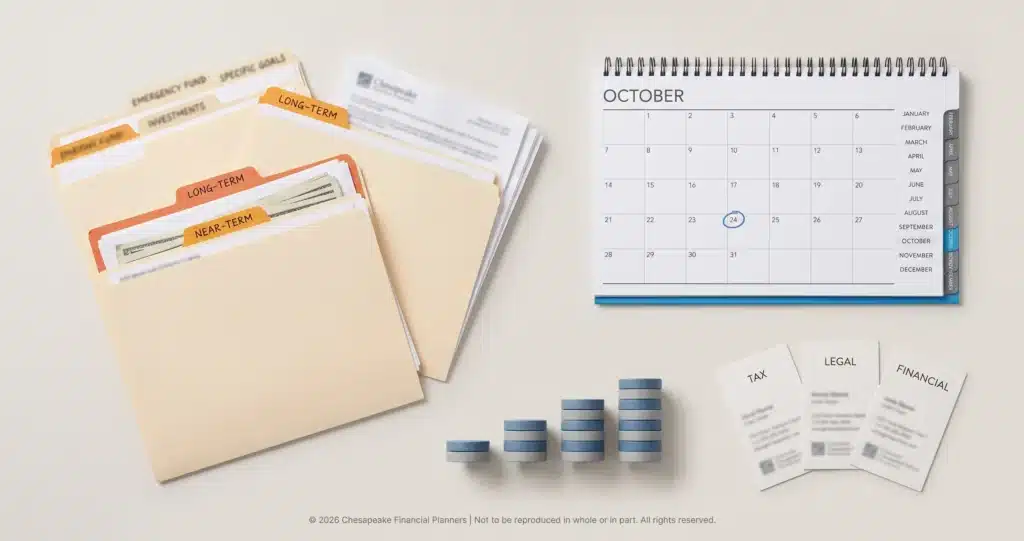
| Get a coordinated view | Look at taxes, investments, estate, and business transition together | First-year structuring choices interact and can be irreversible |
For Harford County business sellers, inheritors, and legal-settlement recipients, that coordinated view is not optional. First-year structuring choices interact directly with Maryland tax and estate rules, and Maryland is the only state that levies both an estate tax and an inheritance tax, so a decision that looks clean in a vacuum can trigger a bill that cannot be undone. That is why we loop in Maryland tax and legal advisors early, before proceeds are moved or retitled, and why our sudden wealth checklist puts the coordinated review ahead of any investment decision. Getting the local advisors in the room in the first ninety days is what keeps a cautious start from turning into a costly drift.
The through-line across all four principles is intent. A short, deliberate cash period is a reasonable place to gather yourself, especially after a hard event. What turns it costly is treating it as permanent. Clients often ask me whether it is smarter to invest a lump sum all at once or ease in over time; the honest answer, as we cover in dollar-cost averaging versus lump-sum investing, is that the phased path buys emotional comfort more than raw return, and comfort is often what actually gets a windfall recipient to move. The mechanics matter less than the decision to stop letting the money sit.
Frequently Asked Questions
Is it a mistake to keep a windfall in cash?
Keeping a windfall entirely in cash indefinitely is usually a costly mistake, because inflation erodes the buying power of idle money and the balance misses the growth a plan could capture. A short, intentional cash period while you get your bearings is reasonable. The error is treating that pause as permanent, since the cost runs quietly year after year with nothing on your statement to flag it.
How much does inflation actually erode cash sitting in the bank?
Inflation erodes cash at roughly the prevailing rate of consumer price increases, which the 2026 Social Security COLA pegged at 2.8% and the broader Consumer Price Index put at 4.2% over the year ending May 2026. On a seven-figure balance held two or three years, that compounds into a meaningful loss of real value, even though the dollar figure on the statement never drops.
Should I invest my windfall all at once or wait until I feel ready?
Neither extreme serves you well; the better move is a defined plan with a timeline rather than an open-ended wait. Rushing in headlong carries real timing risk, but waiting indefinitely guarantees the slow costs of inflation and missed growth. A measured, phased approach, guided by which dollars are needed soon and which are for years out, lets you go slowly without drifting into permanent inaction.
Is my money safe from loss if I just leave it in a bank account?
A bank balance is protected from a visible market drop, but not from inflation, and FDIC insurance only covers $250,000 per depositor, per bank, per ownership category. A large windfall parked in a single account sits mostly above that limit and still loses purchasing power every year. Feeling safe and being safe are not the same thing when the balance holds steady while prices climb.
Who should I talk to first after a business sale or inheritance in Maryland?
Loop in a financial planner alongside your tax and legal advisors early, ideally before proceeds are moved or retitled. Maryland is the only state with both an estate tax and an inheritance tax, so first-year structuring choices can trigger irreversible consequences. A coordinated view across taxes, investments, estate considerations, and any business transition is what keeps a cautious start from becoming an expensive one.
Ready to Put Your Waiting on a Plan?
If your money is sitting in cash because you have not felt ready to decide, that readiness may not arrive on its own, and every month of drift carries the windfall cash mistake a little further. The most useful first step is often a single conversation about how to structure the waiting itself, so the meter stops running while you take the time you need. Jeff Judge and the Chesapeake team serve families and business owners across Harford County and the Baltimore metro. Schedule a free fit call at chesapeakefp.com.
A version of this article was originally published on Chesapeake Financial Planners' LinkedIn.
Want to go deeper? Our First 90 Days After a Windfall walks through this step by step.
Disclosures
The information provided is for educational purposes only and should not be construed as investment advice. Investment strategies should be tailored to individual circumstances, risk tolerance, and goals. Past performance doesn't guarantee future results. Consult with qualified financial professionals regarding your specific situation.
CFP Board owns the marks CFP®, CERTIFIED FINANCIAL PLANNER®, and CFP® (with plaque design) in the U.S.
The ChFC® is the property of The American College of Financial Services, which reserves sole rights to its use, and is used by permission.
The CLU® is the property of The American College of Financial Services, which reserves sole rights to its use, and is used by permission.
Advisors associated with Chesapeake Financial Planners may be either (1) LPL Financial Registered Representatives offering securities through LPL Financial, Member FINRA and SIPC, and investment advisor representatives offering investment advice through Great Valley Advisor Group; or (2) solely investment advisor representatives offering investment advice through Great Valley Advisor Group and not affiliated with LPL Financial. Great Valley Advisor Group, and Chesapeake Financial Planners are separate entities from LPL Financial.
Chesapeake Financial Planners | 2402 Scotlon Ct, Forest Hill, MD 21050 | (410) 652-7868 | www.chesapeakefp.com
© 2026 Chesapeake Financial Planners | Not to be reproduced in whole or in part. All rights reserved.


