

What Is an Expense Ratio, and How Much Is It Costing Me?
Last reviewed: July 2026
An expense ratio is the annual fee a mutual fund or ETF charges you to manage your money, expressed as a percentage of your total investment. If a fund has a 0.50% expense ratio and you have $100,000 invested, you pay $500 a year, automatically deducted from the fund's returns before they ever reach your account. You never see a bill. That's exactly why this fee quietly erodes returns for so many investors who have no idea they're paying it.
Key Takeaways
- An expense ratio is an annual fund fee charged as a percentage of your investment, deducted automatically before returns reach you.
- As of 2026, the average expense ratio for index equity mutual funds was 0.05%, according to the Investment Company Institute.
- A 1% difference in fees can cost a long-term investor hundreds of thousands of dollars over a multi-decade career.
- Lower-cost index funds and ETFs routinely charge a fraction of what actively managed funds charge.
About the Author: Jeff Judge, CFP®, AEP®, ChFC®, CLU® is Managing Partner of Chesapeake Financial Planners in Forest Hill, Maryland. He has been helping families and business owners in Harford County and the Baltimore metro area navigate investment costs since earning his CFP® certification in 2013, by using Chesapeake Financial Planners’ signature process, the R.U.D.D.E.R. method™. Jeff has reviewed hundreds of client portfolios, and the single most common surprise he finds is how much people are paying in fund fees they never knew existed.
What Does an Expense Ratio Actually Pay For?
The expense ratio covers the cost of running the fund. That includes the portfolio manager's salary, the research team, administrative overhead, recordkeeping, and the marketing fees some funds charge (called 12b-1 fees). A fund with a 0.75% expense ratio keeps 0.75% of your invested assets every year to cover all of this, whether the fund makes money or loses it.
Here's the part most people miss: the fee comes out regardless of performance. You pay it in a great year. You pay it in a terrible year. The SEC's investor education office puts it plainly: even small differences in fees can translate into large differences in your account balance over time.
Jeff Judge often tells clients that fees are the one variable in investing you can actually control. You can't control the market. You can't control interest rates. But you can choose a fund that charges 0.05% instead of 0.85%, and that choice compounds in your favor every single year.
How Much Is a High Expense Ratio Really Costing You?
The damage from fees isn't the percentage. It's what that percentage compounds into over decades. A small annual fee feels trivial in any single year, which is exactly why it slips past most investors.
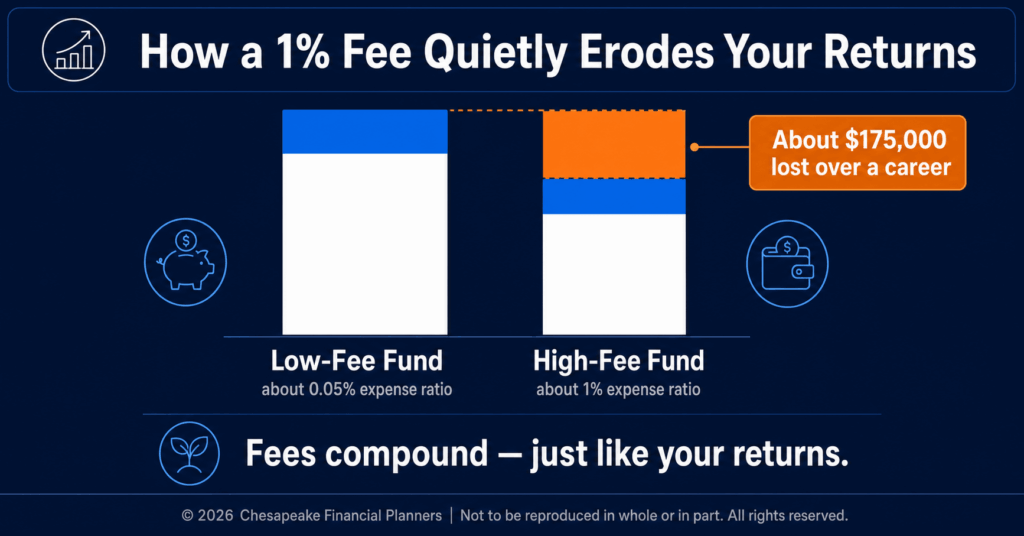
Consider two investors who each put in $100,000 and earn the same 7% gross return for 30 years. One pays a 0.05% expense ratio. The other pays 1.00%. The low-cost investor ends with roughly $750,000. The high-cost investor ends with about $575,000. Same market, same starting amount, same returns. The only difference is fees, and that difference is around $175,000.
According to Morningstar's annual fund fee study, the asset-weighted average fee investors actually pay has fallen steadily for years, but plenty of expensive funds remain on the market. The gap between a cheap fund and an expensive one doing the same job is often the difference between a comfortable retirement and a strained one.
How can I reduce investment fees and keep more returns?

What Is a Good Expense Ratio in 2026?
A good expense ratio depends on the fund type, but the benchmark for broad index funds is now extraordinarily low. The Investment Company Institute reports that the average expense ratio for index equity mutual funds was 0.05% as of 2026, while the average for actively managed equity funds sat far higher.
Here's a simple framework for evaluating what you're paying:
| Fund Type | Reasonable Range | Red Flag Above |
|---|---|---|
| Broad index funds / ETFs | 0.03% to 0.20% | 0.40% |
| Actively managed equity funds | 0.50% to 0.90% | 1.00% |
| Specialty / sector funds | 0.40% to 0.75% | 1.00% |
| Target-date retirement funds | 0.08% to 0.50% | 0.75% |
If you're paying above the red-flag column, the fund needs to justify that cost with something special. Most can't. Jeff has watched clients hold a 1.15% actively managed fund for years, convinced the higher fee bought better performance, only to find the fund trailing a cheap index fund tracking the same market.
How Do Investment Fees Impact My Long-Term Returns?
Expense Ratios Versus Other Investment Costs
The expense ratio is the biggest recurring cost in most portfolios, but it isn't the only one. Trading commissions, bid-ask spreads, account maintenance fees, and advisory fees can all stack on top. The expense ratio is the one baked into the fund itself, which is why it's so easy to overlook on a brokerage statement.
FINRA's fund analyzer tool lets you compare the total cost of two funds side by side over time, including the expense ratio. Running your current funds through it takes ten minutes and often reveals more than any sales pitch ever will.
This is where a real planning process matters. At Chesapeake Financial Planners, fee transparency is part of how we look at every portfolio. We'd rather you understand exactly what you're paying than discover it years later when the compounding damage is already done.
How do I read and understand my investment account statement?
Frequently Asked Questions
What is an expense ratio in simple terms?
An expense ratio is the yearly fee a mutual fund or ETF charges to cover its operating costs, shown as a percentage of your investment. A 0.50% expense ratio on $50,000 means you pay $250 a year, deducted automatically from the fund before any returns reach you.
How do I find out my fund's expense ratio?
You can find a fund's expense ratio in its prospectus, on the fund company's website, or on free research sites like Morningstar by searching the fund's ticker symbol. It's also listed on your brokerage platform under the fund's details, usually labeled "expense ratio" or "net expense ratio."
Is a higher expense ratio ever worth it?
Rarely. A higher expense ratio is only worth it if the fund consistently delivers returns that beat a comparable low-cost fund after fees, which most actively managed funds fail to do over the long run. For the vast majority of investors, a low-cost index fund is the smarter default choice.
Do ETFs have lower expense ratios than mutual funds?
ETFs generally have lower expense ratios than actively managed mutual funds, often by a wide margin, because most ETFs passively track an index rather than employing a team of managers. Some broad-market ETFs charge as little as 0.03%, making them among the cheapest ways to invest in a diversified basket of stocks.
Does the expense ratio come out of my account separately?
No. The expense ratio is never billed to you directly or withdrawn as a separate line item. It is deducted from the fund's assets gradually throughout the year, which lowers the fund's reported return. That invisibility is exactly why so many investors never realize how much they're paying.
If understanding what you pay is a priority, our investor's guide to cutting hidden fund costs breaks down every fee in your portfolio and how to trim it. Download it free at chesapeakefp.com and keep more of what your investments earn.
Disclosures
The information provided is for educational purposes only and should not be construed as investment advice. Investment strategies should be tailored to individual circumstances, risk tolerance, and goals. Past performance doesn't guarantee future results. Consult with qualified financial professionals regarding your specific situation.
Advisors associated with Chesapeake Financial Planners may be either (1) LPL Financial Registered Representatives offering securities through LPL Financial, Member FINRA and SIPC, and investment advisor representatives offering investment advice through Great Valley Advisor Group; or (2) solely investment advisor representatives offering investment advice through Great Valley Advisor Group and not affiliated with LPL Financial. Great Valley Advisor Group, and Chesapeake Financial Planners are separate entities from LPL Financial.


