

What Are REITs, and Do They Belong in Your Portfolio?
Last reviewed: July 2026
A REIT, or real estate investment trust, is a company that owns, operates, or finances income-producing real estate and lets you invest in it the same way you'd buy a stock. You buy shares, and you collect a slice of the rent. REITs belong in many portfolios because they add income and diversification without the headache of being a landlord, but they're not right for everyone, and the tax treatment of their dividends catches people off guard.
Key Takeaways
- A REIT is a company that owns income-producing real estate and trades like a stock, giving you property exposure without buying buildings.
- REITs must pay out at least 90% of taxable income as dividends, per the IRS, which drives their high yields.
- Most REIT dividends are taxed as ordinary income, so they often work best inside a tax-advantaged account like an IRA.
- As of 2026, the U.S. REIT market exceeds $1.4 trillion in equity market capitalization, according to Nareit.
About the Author: Jeff Judge, CFP®, AEP®, ChFC®, CLU® is Managing Partner of Chesapeake Financial Planners in Forest Hill, Maryland. He has been helping families and business owners in Harford County and the Baltimore metro area navigate investment and income decisions since earning his CFP® certification in 2013, by using Chesapeake Financial Planners’ signature process, the R.U.D.D.E.R. method™. Jeff often tells clients that REITs are the simplest way to own real estate without the 2 a.m. phone call about a broken water heater.
What Is a REIT and How Does It Work?
A REIT is a real estate investment trust, a company structured to let everyday investors own a piece of large-scale, income-producing real estate. Think apartment complexes, shopping centers, data centers, cell towers, warehouses, and medical buildings. You buy shares of the REIT, and in return you own a fractional slice of all that property and the rent it generates.
The structure has a specific legal backbone. To qualify as a REIT under the tax code, a company must invest at least 75% of its assets in real estate, derive at least 75% of its gross income from rents or mortgage interest, and pay out at least 90% of its taxable income to shareholders as dividends. That last rule is the whole point. According to the IRS, the 90% payout requirement is what lets a REIT avoid corporate income tax, and it's why REITs are known for fat dividend checks.
Here's the trade-off that comes with that. Because REITs hand out almost everything they earn, they keep very little to reinvest. They grow by raising new capital, not by hoarding profits. That makes the dividend the main event, and the share price growth a secondary story.
What Are the Different Types of REITs?
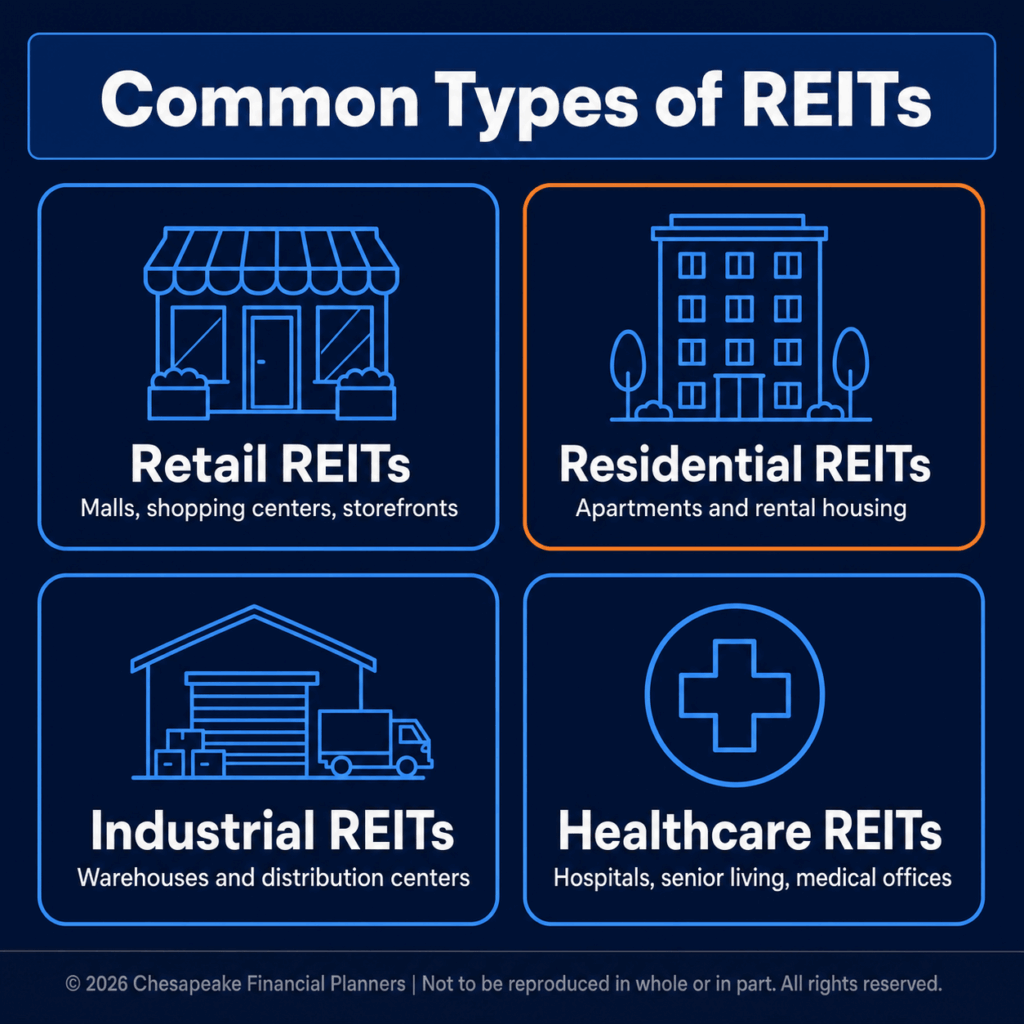
Not all REITs are the same, and the differences matter for your risk and income. There are three broad categories worth knowing before you buy.
Equity REITs own and operate physical property. They collect rent and make up the large majority of the market. When most people say "REIT," this is what they mean.
Mortgage REITs (mREITs) don't own buildings. They lend money to property owners or buy mortgage-backed securities, earning the spread between their borrowing cost and the interest they collect. They tend to carry higher yields and higher risk, especially when interest rates move fast.
Hybrid REITs blend both approaches, owning some property and holding some mortgage debt.
There's also a split by how you buy them. Publicly traded REITs trade on exchanges like any stock and offer daily liquidity. Non-traded REITs and private REITs don't trade on an exchange, often carry steep fees, and can be hard to sell. Jeff has watched clients get talked into non-traded REITs by a salesperson, then discover years later they can't get their money out without a haircut. For most investors, a publicly traded REIT or a low-cost REIT index fund is the cleaner path.

How Are REIT Dividends Taxed?
This is the part that surprises people, so read it twice. Most REIT dividends are taxed as ordinary income, not at the lower qualified dividend rate that applies to most stock dividends. That means a REIT dividend could be taxed at your full marginal rate, which in 2026 reaches as high as 37% at the top federal bracket, per the IRS.
There is a partial offset. The qualified business income deduction lets many investors deduct 20% of their REIT dividend income through 2025 and beyond under current law, which softens the blow. Still, the headline holds: REIT income is taxed less favorably than the dividends from a typical blue-chip stock.
The practical takeaway is about location, not just selection. Jeff Judge often points clients toward holding REITs inside a tax-advantaged account, a traditional IRA, Roth IRA, or 401(k), where the ordinary-income tax drag disappears. Put a REIT in a taxable brokerage account and you hand a chunk of that juicy yield back to the government every April. Put it in a Roth and the income can grow and come out tax-free. Same investment, very different outcome. Understanding the tax picture is one piece of a broader plan; How Do Investment Fees Impact My Long-Term Returns? covers another cost that quietly eats returns.
Do REITs Belong in Your Portfolio?
For many investors, yes, but in moderation and for the right reasons. REITs add two things a stock-and-bond portfolio often lacks: a steady income stream and exposure to an asset class that doesn't always move in lockstep with the broader stock market. That diversification can smooth out the ride.
The case for a modest REIT allocation rests on a few facts. As of 2026, the FTSE Nareit All Equity REITs index has delivered a long-run average annual total return broadly in line with the S&P 500 over multi-decade periods, according to Nareit, while paying a meaningfully higher dividend yield. For an investor who wants income now, that yield is attractive.
The case against overdoing it is just as real. REITs are sensitive to interest rates. When rates rise, REIT share prices often fall, because higher rates make their dividend yields look less competitive against bonds and raise their borrowing costs. We saw exactly that pressure when the Federal Reserve pushed rates up aggressively. A REIT-heavy portfolio can feel a rate shock more sharply than a diversified one.
Most planners suggest keeping REITs to a single-digit slice of a diversified portfolio, often in the 5% to 15% range depending on your income needs and risk tolerance. At Chesapeake Financial Planners, we walk through this allocation question using the R.U.D.D.E.R. Method™, Chesapeake Financial Planners' six-step planning process: Review and Recognize, Uncover and Understand, Design and Develop, Discuss and Decide, Execute and Empower, and Reassess and Refine. The point isn't whether REITs are good or bad in isolation. It's whether they fit your specific plan. If you want to think through the right mix, How should my investment mix change as I get closer to retirement? is a good next read, and Is my portfolio diversified enough to handle market volatility? digs into the diversification question directly. Jeff Judge notes: "REITs can earn a spot in a portfolio for the income and diversification they bring, but I've seen clients pile in at 30 or 40 percent of their holdings and then get hit hard when rates moved — a 5 to 15 percent slice does the job without that kind of concentration risk."
How Do You Invest in a REIT?
You have three main routes, and the right one depends on how hands-on you want to be.
- Buy individual REIT stocks. You can purchase shares of a single publicly traded REIT through any brokerage account, just like buying a share of Apple. This gives you control but concentrates your bet on one company or one property type.
- Buy a REIT index fund or ETF. A low-cost REIT ETF holds dozens or hundreds of REITs in one purchase, spreading your risk across property types and regions. For most people, this is the simplest, cheapest way in.
- Hold REITs through a broader fund. Some target-date funds and total-market funds already include a REIT slice, so you may own some without realizing it.
Before you buy, check the expense ratio on any fund and confirm where you're holding it for tax reasons. Many investors get most of their real estate exposure simply by owning a broad market index fund, so layering on a dedicated REIT position is a deliberate choice, not a default.
Frequently Asked Questions
What is a REIT in simple terms?
A REIT, or real estate investment trust, is a company that owns or finances income-producing real estate and lets you invest by buying shares like a stock. You collect a portion of the rental income as dividends without owning or managing any property yourself, which makes real estate accessible to ordinary investors.
Are REIT dividends qualified or ordinary income?
Most REIT dividends are taxed as ordinary income at your regular marginal tax rate, not the lower qualified dividend rate. A portion may qualify for the 20% qualified business income deduction, which reduces the tax. Because of this treatment, REITs often work best inside a tax-advantaged account like an IRA or 401(k).
How much of my portfolio should be in REITs?
Most financial planners suggest keeping REITs to a single-digit to low-double-digit slice of a diversified portfolio, commonly in the 5% to 15% range. The right figure depends on your income needs, risk tolerance, and whether you already own real estate elsewhere, such as a home or rental property.
Are REITs a good investment for retirement income?
REITs can be a solid source of retirement income because they pay high, regular dividends and add diversification. The catch is their interest-rate sensitivity and ordinary-income tax treatment. Holding them inside a Roth IRA or traditional IRA lets you capture the income without the annual tax drag that a taxable account would create.
What is the difference between a REIT and owning rental property?
A REIT gives you real estate exposure and rental income without buying, financing, or managing a physical property. You get instant liquidity, professional management, and diversification across many buildings. Direct rental property offers more control and potential leverage but demands hands-on work, large upfront capital, and far less liquidity if you need to sell.
Do REITs lose value when interest rates rise?
REIT share prices often fall when interest rates rise, because higher rates make their dividend yields less competitive with bonds and increase their borrowing costs. The effect varies by REIT type, with mortgage REITs typically more sensitive than equity REITs. Over long holding periods, this short-term pressure tends to even out.
REITs are a useful tool, not a magic one. They reward investors who understand the tax treatment, size the position sensibly, and hold them in the right account. If you found this helpful, our guide to building a tax-smart investment mix covers how REITs and other income assets fit together across your accounts. Download it at chesapeakefp.com.
Want to go deeper? Our R.U.D.D.E.R Audit for DIY Investors walks through this step by step.
Disclosures
The information provided is for educational purposes only and should not be construed as investment advice. Investment strategies should be tailored to individual circumstances, risk tolerance, and goals. Past performance doesn't guarantee future results. Consult with qualified financial professionals regarding your specific situation.
Investing in Real Estate Investment Trusts (REIT) involves special risks such as potential illiquidity and may not be suitable for all investors. There is no assurance that the investment objectives of this program will be attained.
Investments in real estate may be subject to a higher degree of market risk because of concentration in a specific industry, sector or geographical sector. Other risks can include, but are not limited to, declines in the value of real estate, potential illiquidity, risks related to general and economic conditions, stage of development, and defaults by borrower.
Dividend payments are not guaranteed and may be reduced or eliminated at any time by the company.
Advisors associated with Chesapeake Financial Planners may be either (1) LPL Financial Registered Representatives offering securities through LPL Financial, Member FINRA and SIPC, and investment advisor representatives offering investment advice through Great Valley Advisor Group; or (2) solely investment advisor representatives offering investment advice through Great Valley Advisor Group and not affiliated with LPL Financial. Great Valley Advisor Group, and Chesapeake Financial Planners are separate entities from LPL Financial.


