
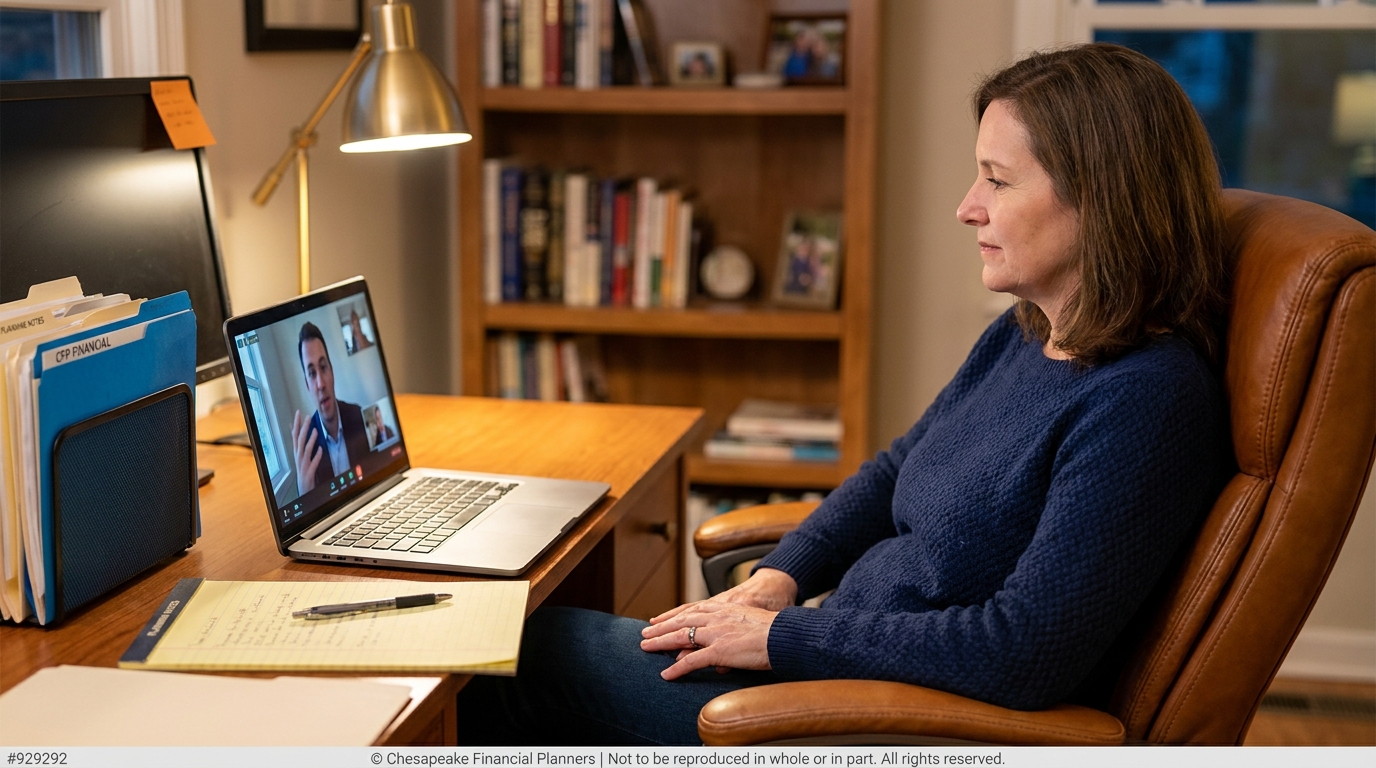
What Is TeleWealth and How Does Virtual Financial Planning Work at Chesapeake Financial Planners?
Last reviewed: July 2026
TeleWealth is the virtual financial planning model at Chesapeake Financial Planners, where a client works directly with a CFP® professional through secure video meetings and digital planning tools instead of in-person visits. It is not a robo-advisor and not an app. For anyone searching for a virtual financial advisor in Maryland, TeleWealth delivers the same comprehensive planning Jeff Judge provides in his Forest Hill office, just without the commute on either end.
On This Page
- Key Takeaways
- Why Did Chesapeake Financial Planners Build TeleWealth?
- What Is TeleWealth and What Is It Not?
- How Does a Virtual Financial Advisor in Maryland Actually Work?
- How Is the R.U.D.D.E.R. Method™ Applied in a Virtual Setting?
- Who Is TeleWealth Built For?
- Is Online Financial Planning in Maryland Secure?
- How Do You Start with TeleWealth?
- Frequently Asked Questions
- Ready to See How TeleWealth Could Work for You?
- Disclosures
Key Takeaways
- TeleWealth is virtual financial planning delivered one-to-one by a CFP® professional, not an automated robo-advisor or a self-serve app.
- A virtual financial advisor in Maryland lets clients in Harford County, Virginia, and beyond work with Jeff Judge without driving anywhere.
- Roughly 63% of advisory firms now meet most clients virtually or in a hybrid model, reflecting a permanent shift in how planning is delivered.
- TeleWealth follows the R.U.D.D.E.R. Method™, the same six-step process used for in-person Chesapeake clients.
- The 2026 401(k) employee contribution limit is $24,500, one of many numbers a virtual plan keeps current for you.
About the Author: Jeff Judge, CFP®, AEP®, ChFC®, CLU® is Managing Partner of Chesapeake Financial Planners in Forest Hill, Maryland. He has been helping families and business owners in Harford County and the Baltimore metro area navigate comprehensive financial planning since earning his CFP® certification in 2013, by using Chesapeake Financial Planners’ signature process, the R.U.D.D.E.R. method™. Jeff built TeleWealth because the clients who most needed structured planning were often the ones whose schedules made an in-person relationship nearly impossible.
Why Did Chesapeake Financial Planners Build TeleWealth?
Chesapeake Financial Planners built TeleWealth because a specific kind of client kept describing the same problem: they knew they needed real financial planning, and the logistics of an in-person advisory relationship had kept them from getting it for years. The barrier was never the value of planning. It was finding time to drive across the county and sit in an office during business hours.
Busy executives. Remote workers managing multi-state tax situations. Pre-retirees within five years of leaving work who had never sat down with a real advisor. High earners in their late 40s and 50s with complex finances and no structured plan. These were the people calling, and most of them had been putting off the conversation far too long.
What problem does virtual planning actually solve?
The problem virtual planning solves is access, not quality. Jeff Judge often tells these clients the same thing: the people who reach out already understand why planning matters, so the job is to build a process that fits their lives instead of demanding they reshape their week around a meeting. TeleWealth is that process.
The shift toward virtual delivery is now industry-wide, not a Chesapeake experiment. Research from the Kitces Report found that roughly 63% of advisory firms now conduct most client meetings virtually or through a hybrid model, a structural change that held even as offices reopened. The meeting format is not what determines plan quality. Advisor quality is.
This matters for a state like Maryland, where commuting realities shape how people live. The U.S. Census Bureau reports that the average one-way commute time in Maryland is around 33 minutes, among the longest in the country. For a working professional, a single in-person planning meeting can consume two hours of windshield time. Multiply that across an ongoing relationship and the in-person model quietly prices itself out of a busy person's calendar.
What Is TeleWealth and What Is It Not?
TeleWealth is comprehensive, relationship-based financial planning delivered by a CFP® professional through video meetings and secure digital tools. Defining it by what it is not removes most of the confusion people bring to the term.
TeleWealth is not a robo-advisor. No algorithm generates your portfolio, and no automated platform does the planning work. The planning is done by Jeff Judge, working directly with you, through a video call instead of an in-person meeting.
TeleWealth is not a one-time consultation. It is an ongoing advisory relationship with regular sessions, proactive communication, and a plan that evolves as your life does.
TeleWealth is not limited to investment management. The planning covers the full picture: retirement income, tax strategy, estate coordination, debt management, insurance review, and ongoing monitoring. Investment management is part of the relationship, not the whole of it.
How is a virtual financial advisor different from a robo-advisor?
A virtual financial advisor is a credentialed human professional who builds and adjusts your plan; a robo-advisor is software that allocates a portfolio based on a questionnaire. The distinction is not cosmetic. A robo-advisor cannot tell you whether to take Social Security at 62 or 70, whether a Roth conversion makes sense in a low-income year, or how to coordinate a business sale with your estate plan.
That difference shows up in cost transparency too. Many investors do not realize how much fee drag affects long-term outcomes. The SEC notes that a 1% annual fee difference can reduce a portfolio's value by tens of thousands of dollars over a few decades. A real advisor relationship should justify its fee through planning that an algorithm structurally cannot deliver. Jeff Judge puts it plainly: a robo-advisor optimizes a portfolio, but it has never once talked a client out of a costly mistake at the worst possible moment.
How Does a Virtual Financial Advisor in Maryland Actually Work?
A virtual financial advisor in Maryland works through scheduled video meetings, screen-shared planning software, secure document exchange, and direct communication between sessions, all without requiring an office visit. The mechanics are simpler than most people expect.
A typical engagement runs through a clear sequence. You start with an introductory video call to confirm fit. You then securely upload statements, tax returns, and benefit documents to an encrypted portal. From there, planning sessions happen over video, with Jeff sharing his screen so you watch the analysis happen in real time rather than receiving a static PDF after the fact.
The collaborative nature of screen-sharing is one reason virtual planning often works better than the in-person version, not worse. When you can see the retirement income model move as assumptions change, the plan stops being abstract. You understand the trade-offs because you watched them get built.
Does virtual planning work for clients outside Maryland?
Yes, virtual planning works for clients in Virginia, the D.C. metro, and other states, which is one of TeleWealth's core advantages. A federal employee retiring from a D.C. job can get state-specific retirement income planning from home. An executive who travels four days a week can schedule sessions around an actual calendar. A client in Northern Virginia can work with Jeff in Forest Hill without anyone driving anywhere.
This geographic reach matters more every year. The number of Americans working remotely at least part of the time remains far above pre-2020 levels, and the Bureau of Labor Statistics reports that roughly 35 million people did some work from home on an average day in recent measurements. A workforce that is no longer tied to a single location needs advice that is not tied to a single zip code either.
What Are the Real Differences Between a Virtual and In-Person Financial Advisor in Maryland?
How Is the R.U.D.D.E.R. Method™ Applied in a Virtual Setting?
The R.U.D.D.E.R. Method™ is Chesapeake Financial Planners' six-step planning process: Review and Recognize, Uncover and Understand, Design and Develop, Discuss and Decide, Execute and Empower, and Reassess and Refine. Every TeleWealth client moves through this same framework, and nothing about the virtual format dilutes it.
R: Review and Recognize
Every engagement starts with a full financial review: income sources, cash flow, assets, liabilities, insurance coverage, investment accounts, benefit elections, tax returns, estate documents, and business ownership details where they apply. Virtually, this is often easier than in person, because documents arrive through a secure portal instead of a folder someone forgot to bring.
The Recognize phase surfaces what the review finds: coverage gaps, duplicate holdings, misaligned strategies, unrecognized risks, and missed opportunities. Most clients are surprised by at least one finding, not because their finances are a mess, but because disconnected decisions look different side by side. Jeff describes the pattern he sees most: someone with solid income and decent savings habits will have a business succession situation that is completely unprotected, or they have been funding a taxable brokerage account for years while their HSA sat at zero. In isolation, neither is a crisis. Together, they are exactly the kind of problem the Review step is built to catch.
U: Uncover and Understand
Numbers do not make decisions. People do. The Uncover step moves the conversation from data to values: priorities, timelines, family considerations, career or business transitions, and what a genuinely good outcome looks like in specific terms.
The Understand piece digs into constraints and trade-offs. What is non-negotiable? Where is there flexibility? Which decisions create the most uncertainty? Jeff spends more time here than on any other step. A technically sound plan can still miss the mark entirely for someone's life, and the U step is where you find out what actually matters. It also surfaces what no spreadsheet shows: a client who needs to retire early to care for a parent, a couple with mismatched risk tolerances, or a business owner who does not actually want to sell and needs a plan that reflects that.
D: Design and Develop
With the review complete and priorities understood, the Design step builds strategies that align resources with goals: retirement income strategy, investment allocation, tax planning, insurance and risk management, estate coordination, and business exit planning. The Develop step turns those strategies into specific, sequenced recommendations with clear responsibilities.
Not everything happens at once. The plan identifies which moves carry the most weight early, which ones depend on something else first, and what can reasonably wait. The output is a working roadmap with priorities, sequence, and accountability, built to be used rather than filed.

D: Discuss and Decide
Recommendations that are not understood will not be followed. The second D is where Chesapeake walks clients through proposed strategies in detail, compares options, pressure-tests assumptions, and confirms the plan fits the life it serves. This is a working conversation, not a presentation. Jeff makes it non-negotiable: if you cannot explain back why you are doing something, the job is not finished. The Discuss step is where the plan becomes yours.
E: Execute and Empower
Decisions made, the work begins. The Execute step covers implementation: account openings, investment changes, beneficiary updates, policy changes, and coordination with CPAs and estate attorneys. Chesapeake handles the implementation, not just the advice. Clients do not get a to-do list and a handshake.
The Empower half is about knowledge. Clients who understand what they own and why are the ones who stay committed when conditions get difficult. An empowered client does not need to call every time the market drops three percent, because they understand that volatility is part of the strategy, not a reason to abandon it.
R: Reassess and Refine
A plan that is not maintained becomes outdated. Life changes, tax law changes, goals shift. The final R reviews each plan on a regular schedule and after major events: career changes, business transitions, shifts in retirement timing, family changes, and relevant updates to tax or estate law. The output is targeted course corrections that keep the plan aligned with where the client is today.
The virtual format strengthens this step rather than weakening it. A quick fifteen-minute video check-in after a job change is far easier to schedule than a drive across the county, which means plans actually get updated when life moves.
Who Is a Virtual Financial Advisor in Maryland Actually Right For?
Who Is TeleWealth Built For?
TeleWealth is built for people who need comprehensive financial planning but whose schedules, locations, or preferences make a traditional in-person relationship impractical. A few client profiles come up repeatedly.
Busy professionals and executives who cannot give up half a day for a meeting. Remote and hybrid workers juggling multi-state tax exposure. Pre-retirees within five to ten years of leaving work who want a real income plan, not guesswork. Federal employees and government contractors in the D.C. corridor coordinating pensions, the TSP, and Social Security. Business owners who need succession and exit planning layered onto personal planning.

Is online financial planning right for someone close to retirement?
Yes, online financial planning is especially well suited to people near retirement, because the years just before retirement carry some of the highest-stakes, most time-sensitive decisions. The window to make tax-efficient moves is often narrow. For 2026, the IRS set the 401(k) employee contribution limit at $24,500, with an additional catch-up of $8,000 for those age 50 and older, and a higher catch-up for those in their early 60s. A virtual advisor keeps you on top of numbers like these and helps you act on them while the window is open.
Healthcare timing matters just as much. The Social Security Administration confirms that the full retirement age for people born in 1960 or later is 67, a threshold that drives Social Security claiming strategy. Coordinating that decision with Medicare enrollment, pension elections, and portfolio withdrawals is exactly the kind of multi-part planning a virtual relationship handles well, because the check-ins can happen frequently and quickly as deadlines approach.
What does a fiduciary financial advisor in Harford County do that a broker doesn't?
Is Online Financial Planning in Maryland Secure?
Online financial planning at Chesapeake Financial Planners is secured through encrypted client portals, secure video platforms, and multi-factor authentication, the same data-protection standards used across the regulated financial industry. Security is the first question most prospective clients ask, and it deserves a direct answer.
Documents are exchanged through an encrypted portal, never over ordinary email. Video sessions run on secure, business-grade platforms rather than consumer chat tools. Account access is protected by the same custodial safeguards that apply to every Chesapeake client, virtual or in-person. The FINRA investor resources outline the cybersecurity protections clients should expect from any firm, and TeleWealth is designed to meet them.
Identity protection is part of this picture. The Federal Trade Commission reported that consumers lost billions of dollars to fraud in recent years, with investment-related scams among the most costly categories. Working with a verified, credentialed fiduciary through secure channels is itself a layer of protection, because you always know who is on the other end of the call.
What technology does a client actually need?
A client needs only a reliable internet connection, a device with a camera, and the willingness to upload documents to a secure portal. No specialized software, no steep learning curve. Jeff often points out that the clients who worried most about the technology are usually the ones most comfortable with it within a single session. The tools are there to get out of the way, not to become the project.
Can You Get Great Financial Advice Without Going to an Office?
How Do You Start with TeleWealth?
You start with TeleWealth by scheduling an introductory video call to confirm that the relationship is a good fit, with no obligation and no cost for that first conversation. From there, the process moves at a pace that suits your situation.
The first meeting is a conversation, not a sales pitch. Jeff learns what brought you in, you learn how the planning process works, and you both decide whether it makes sense to move forward. If it does, you securely share your documents and the R.U.D.D.E.R. Method™ begins with the Review step.
The cost of a virtual relationship is transparent and discussed up front, with no surprises. Understanding what financial planning costs in Maryland, and what you get for it, is part of making a confident decision.
How much does a CFP cost in Maryland?
What questions should I ask when interviewing a fee-only financial advisor in Maryland?
What should I look for in a financial advisor in Maryland?
How do I find a CFP near Forest Hill, MD?

Frequently Asked Questions
What is a virtual financial advisor in Maryland?
A virtual financial advisor in Maryland is a credentialed planning professional, such as a CFP®, who delivers comprehensive financial planning through secure video meetings and digital tools instead of in-person visits. At Chesapeake Financial Planners, this model is called TeleWealth, and it provides the same depth of planning as an office relationship without requiring a commute.
How is TeleWealth different from a robo-advisor?
TeleWealth is different from a robo-advisor because it is a relationship with a human CFP® professional, not software running a questionnaire. A robo-advisor allocates a portfolio automatically and cannot advise on Social Security timing, Roth conversions, estate coordination, or business succession. TeleWealth covers all of those areas through direct planning with Jeff Judge.
Can I use a virtual financial advisor if I live in Virginia or outside Maryland?
Yes, you can use TeleWealth if you live in Virginia, the D.C. metro, or many other states, which is one of its primary benefits. Geographic distance does not limit the relationship, so a Northern Virginia executive or a D.C. federal employee can work with Jeff Judge in Forest Hill, Maryland, entirely through secure video meetings and digital document exchange.
Is online financial planning secure?
Yes, online financial planning at Chesapeake Financial Planners is secured through encrypted client portals, business-grade video platforms, and multi-factor authentication, matching the data-protection standards used across the regulated financial industry. Documents are never sent over ordinary email, and account access is protected by the same custodial safeguards that apply to every client, virtual or in-person.
What does a virtual financial advisor actually help with?
A virtual financial advisor helps with the full scope of financial planning, not just investments. That includes retirement income strategy, tax planning, Social Security and Medicare coordination, estate planning, insurance review, debt management, and business exit planning. At Chesapeake, all of this is organized through the R.U.D.D.E.R. Method™, the firm's six-step planning process.
Do I need special technology to work with a virtual advisor?
No, you do not need special technology to work with a virtual advisor beyond a reliable internet connection and a device with a camera. You upload documents to a secure portal and meet over a secure video platform. Most clients who worry about the technology find themselves comfortable with it within the first session, because the tools are designed to stay out of the way.
Is virtual planning a good fit for people close to retirement?
Yes, virtual planning is an excellent fit for people close to retirement, because the years before retirement carry high-stakes, time-sensitive decisions on contributions, Social Security timing, and Medicare. The 2026 401(k) contribution limit is $24,500 per the IRS, and a virtual advisor helps you act on numbers like these while the window remains open.
Ready to See How TeleWealth Could Work for You?
If this gave you a clearer picture of how a virtual financial advisor in Maryland operates, the next step is simple. Chesapeake Financial Planners has put together a free guide that walks through what to look for when choosing between a virtual and in-person planning relationship, including the questions worth asking before you commit. Download it at chesapeakefp.com and see whether TeleWealth fits the way you actually live and work.
Disclosures
The information provided is for educational purposes only and should not be construed as investment advice. Investment strategies should be tailored to individual circumstances, risk tolerance, and goals. Past performance doesn't guarantee future results. Consult with qualified financial professionals regarding your specific situation.
Advisors associated with Chesapeake Financial Planners may be either (1) LPL Financial Registered Representatives offering securities through LPL Financial, Member FINRA and SIPC, and investment advisor representatives offering investment advice through Great Valley Advisor Group; or (2) solely investment advisor representatives offering investment advice through Great Valley Advisor Group and not affiliated with LPL Financial. Great Valley Advisor Group, and Chesapeake Financial Planners are separate entities from LPL Financial.


