

Last reviewed: September 2026
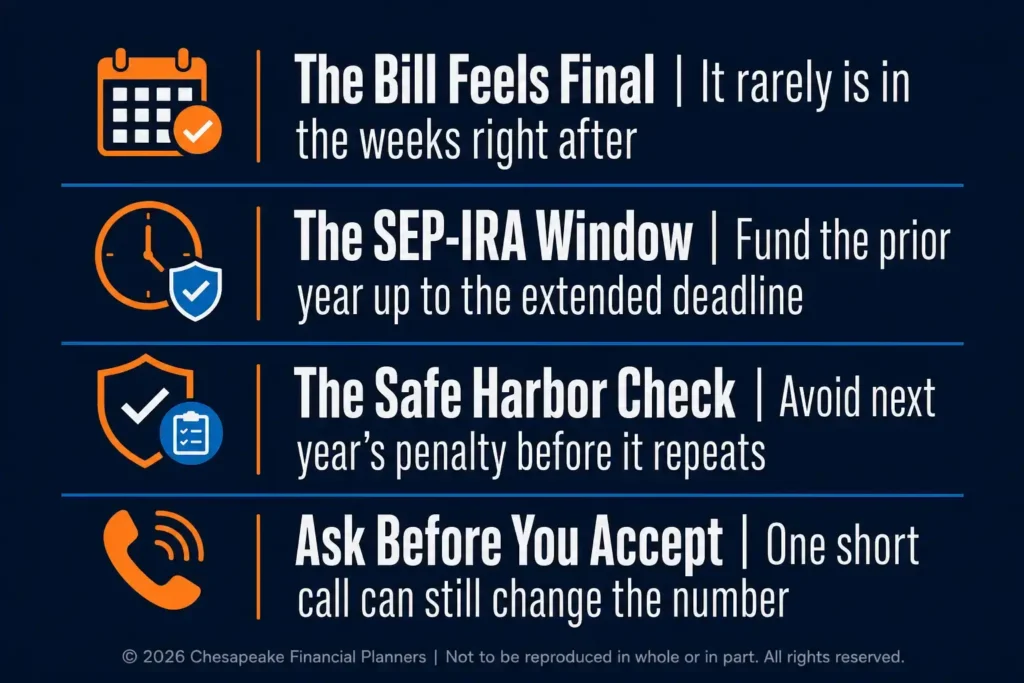
The surprise tax bill business owners get from their CPA each spring is rarely as final as it looks. The tax year is closed, but a few decisions that change what you actually pay are still open for weeks or months afterward: a SEP-IRA contribution up to the extended filing deadline, a profit-sharing deposit into an existing 401(k), an HSA contribution, and a reset of next year's estimated payments. The owners who lose money are usually the ones who pay the number without asking what's still on the table.
Key Takeaways
- A SEP-IRA can be opened and funded for the prior year as late as the business's extended filing deadline.
- For 2026, SEP contributions are capped at 25% of compensation or $72,000, up from $70,000 in 2025.
- HSA contributions close earlier, at the original filing deadline, with 2026 limits of $4,400 self-only and $8,750 family.
- Paying 90% of this year's tax or 110% of last year's for higher earners keeps the underpayment penalty from repeating.
About the Author: Jeff Judge, CFP®, AEP®, ChFC®, CLU® is Managing Partner of Chesapeake Financial Planners in Forest Hill, Maryland. He has been helping families and business owners in Harford County and the Baltimore metro area navigate tax planning and retirement plan decisions since earning his CFP® certification in 2013, by using Chesapeake's signature process, the R.U.D.D.E.R. Method™. "The CPA's number tells you what happened," Jeff says. "The planning conversation tells you what you can still change, and that conversation has an expiration date."
Why Does a Surprise Tax Bill Feel Like the End of the Conversation?
The email usually lands in March or April and says some version of the same thing: you owe more than we projected. For a lot of owners, that sentence reads like a verdict. The figure on the screen looks like a fact of nature instead of the output of choices, some still open.
I see the same sequence almost every time. The owner reads the number twice, calls the CPA to confirm it isn't a mistake, and quietly resigns to writing the check, often blaming themselves for not planning better. What rarely happens in that first call is one more question: given where things stand right now, is there anything left that could change this?
That's not a knock on CPAs. Most will answer that question honestly and specifically if you ask it directly. Their engagement is usually scoped to preparing an accurate return on time, which is backward-looking work. Tax preparation and financial planning need to happen together in these weeks, not one after the other.
What Can Business Owners Still Do About a Surprise Tax Bill?
The most useful lever for many owners is a retirement plan contribution, and the timing surprises people every year. According to the IRS, "You can set up a SEP plan for a year as late as the due date (including extensions) of your business's income tax return for that year." Contributions follow the same extended deadline.
"Jeff has said directly to more than one client in this spot that the worst version of this moment isn't the size of the bill, it's the owner who pays it, feels bad about it, and never asks whether anything was still on the table."
A Solo 401(k) can work for an owner with no employees other than a spouse, but its setup and deferral deadlines follow different rules than a SEP, and those rules have changed in recent years. Check the specifics with your CPA right away. An S-corp owner who already has a company 401(k) may have even more room: a profit-sharing contribution decided after the CPA delivers the number, and funded before the business's extended deadline, can move considerably more than a SEP alone.
A health savings account is the quieter lever. If you were covered by an HSA-eligible high-deductible plan, contributions for the year can be made until the original filing deadline, per IRS Publication 969, a tighter window than the SEP's.
| Lever | Who it fits | Deadline | 2026 limit |
|---|---|---|---|
| SEP-IRA | Owners with self-employment or business income | Business return due date, including extensions | Lesser of 25% of compensation or $72,000 |
| Solo 401(k) | Owner-only businesses (spouse may join) | Setup and deferral rules differ; confirm with CPA | $72,000 total annual additions |
| Profit-sharing into an existing 401(k) | Businesses with a plan already in place | Business return due date, including extensions | $72,000 per participant, all sources |
| HSA | Owners enrolled in an HSA-eligible plan | Original filing deadline, no extensions | $4,400 self-only, $8,750 family |
| Safe harbor estimated payments | Owners with uneven income | Quarterly, going forward | 90% of current-year or 110% of prior-year tax |
How Much Can a Retirement Contribution Move the Number?
Say a CPA delivers a bill $40,000 higher than expected after a strong year. If the owner has self-employment income and hasn't funded a SEP, a contribution sized to the limit can pull tens of thousands of dollars of income off the prior-year return before the extended deadline. For sole proprietors, the 25% is figured on net self-employment earnings after certain adjustments, so the effective percentage is lower, which is one more reason to run the real numbers.
Here's a hypothetical. A $50,000 deductible contribution for an owner in the 32% federal bracket cuts federal income tax by about $16,000. The tax isn't erased; it's deferred into a retirement account the owner needed to be funding anyway. The surprise bill just became the reason the contribution happened this year instead of getting pushed off again.
Does a SEP contribution count if I make it after April 15? Yes, as long as you filed a valid extension and deposit the money before the extended due date. The IRS lets the contribution count for the prior tax year, so the deduction lands on the return your CPA is finishing.
Jeff Judge has seen owners use a surprise bill as the push to finally fund savings they'd postponed for years, which is why he treats the bill as a prompt rather than a verdict. Our comparison of Solo 401(k) vs. SEP-IRA for self-employed owners helps decide which account fits, and this look at why business owners underfund self-employed retirement savings covers the habit behind the gap.
How Does a Surprise Tax Bill Hit Maryland Business Owners Differently?
Maryland builds its return from federal adjusted gross income, so a SEP or profit-sharing deduction that lowers federal AGI generally lowers the Maryland bill too. That matters here because state rates reach 6.5% at the top bracket in 2026, and Harford County adds a 3.06% local income tax.
There's a second Maryland wrinkle. Starting with 2025, the state adds a 2% surtax on net capital gains when federal AGI exceeds $350,000. An owner who sold equipment, real estate held outside the business, or investments during a strong year may be near that line, and a retirement deduction that lowers AGI can matter more than it first appears.
We sit down with owners across Forest Hill, Bel Air, Aberdeen, and the Baltimore suburbs in these exact weeks, often with their CPA on the call. The R.U.D.D.E.R. Method™ is Chesapeake Financial Planners' six-step planning process: Review and Recognize, Uncover and Understand, Design and Develop, Discuss and Decide, Execute and Empower, and Reassess and Refine. After a surprise bill, the Reassess and Refine step is where we reset next year's estimated payments so the same email doesn't arrive twelve months later.

What Can't Be Fixed After the Tax Year Closes?
The window is real, but it isn't unlimited. Elections that had to happen during the year, like an S-corp owner's reasonable compensation figure or an accounting method choice, generally can't be revisited afterward. A SEP or Solo 401(k) only helps if you have self-employment or business income to base it on, and only up to the limit, which won't fully offset a very large surprise.
What if there's nothing left to change? Then the conversation still did its job. An owner who already maxed every contribution, has no HSA-eligible plan, and tracked the safe harbor doesn't have much to move, and confirming that turns a vague, uneasy feeling into a checked-off answer that the surprise was likely a one-time result of a strong year.
The safe harbor deserves attention either way. Paying at least 90% of the current year's tax, or 110% of the prior year's for higher earners, keeps the underpayment penalty off the table. A surprise bill is often the first signal that estimated tax payments have drifted out of that range, and fixing it early in the new year beats discovering it again at the next filing.
The conversation worth having in the next two weeks is short: is there room in a SEP, Solo 401(k), or existing company plan before the extended deadline, and are this year's estimated payments on track? The list of things still in your control gets shorter every week that call doesn't happen.
Frequently Asked Questions
What can business owners do about a surprise tax bill after year-end?
Business owners can often still fund a SEP-IRA or a profit-sharing contribution to an existing 401(k) before the extended filing deadline, make an HSA contribution before the original deadline if eligible, and reset estimated payments for next year. Each option has its own deadline and eligibility rules, so ask your CPA and planner together.
What is the SEP-IRA contribution deadline?
The SEP-IRA contribution deadline is the due date of your federal return, including extensions. The IRS also lets you establish a new SEP as late as that extended due date. That makes a SEP one of the few moves that can still lower the prior year's taxable income after the CPA has run the numbers.
How much can I put in a SEP-IRA for 2026?
For 2026, SEP contributions are limited to the lesser of 25% of compensation or $72,000, up from $70,000 for 2025. Sole proprietors calculate compensation from net self-employment earnings after certain adjustments, so their effective percentage is lower than 25%. Your CPA can calculate the exact maximum from your return.
How do I avoid an underpayment penalty next year?
Pay at least 90% of the current year's tax or 100% of the prior year's tax through withholding and estimated payments, or 110% of the prior year's tax if your adjusted gross income was above $150,000. A surprise bill is often the signal that your quarterly payments need to increase for the coming year.
Does a SEP contribution lower my Maryland taxes too?
Generally, yes. Maryland starts its income tax calculation from federal adjusted gross income, so a deductible SEP contribution that lowers federal AGI usually lowers Maryland taxable income as well. That can reduce both the state tax and your county income tax, such as Harford County's 3.06% local rate for 2026.
Ready to Ask What's Still on the Table?
A surprise tax bill business owners receive in the spring is the start of a conversation, not the end of one. Ready to put a plan around yours? Jeff Judge and the Chesapeake Financial Planners team serve families and business owners across Harford County, Forest Hill, Bel Air, and the Baltimore metro area. Schedule a free fit call and bring your CPA's projection.
A version of this article was originally published on Chesapeake Financial Planners' LinkedIn.
Disclosures
The information provided is for educational purposes only and should not be construed as investment advice. Investment strategies should be tailored to individual circumstances, risk tolerance, and goals. Past performance doesn't guarantee future results. Consult with qualified financial professionals regarding your specific situation.
Contributions to a traditional IRA may be tax deductible in the contribution year, with current income tax due at withdrawal. Withdrawals prior to age 59 ½ may result in a 10% IRS penalty tax in addition to current income tax.
This information is not intended to be a substitute for specific individualized tax, investment or legal advice. We suggest that you discuss your specific situation with a qualified tax, legal or financial advisor.
Advisors associated with Chesapeake Financial Planners may be either (1) LPL Financial Registered Representatives offering securities through LPL Financial, Member FINRA and SIPC, and investment advisor representatives offering investment advice through Great Valley Advisor Group; or (2) solely investment advisor representatives offering investment advice through Great Valley Advisor Group and not affiliated with LPL Financial. Great Valley Advisor Group, and Chesapeake Financial Planners are separate entities from LPL Financial.
Chesapeake Financial Planners | 2402 Scotlon Ct, Forest Hill, MD 21050 | (410) 652-7868 | www.chesapeakefp.com
© 2026 Chesapeake Financial Planners | Not to be reproduced in whole or in part. All rights reserved.


