

Should I Roll Over My Old 401(k) or Leave It Where It Is?
Last reviewed: July 2026
Whether you should roll over your old 401(k) depends on your investment options, your age, and how organized you are. You have four choices when you leave a job: leave the money in your old plan, roll it into your new employer's 401(k), roll it into an IRA, or cash it out. For most people, rolling over to an IRA or a new 401(k) wins on flexibility and simplicity, but leaving it put can make sense if your old plan has unusually good, low-cost funds. Cashing out is almost always the wrong move.
Key Takeaways
- You have four options for an old 401(k): leave it, roll to a new 401(k), roll to an IRA, or cash out.
- Cashing out before age 59½ usually triggers income tax plus a 10% early withdrawal penalty, per the IRS.
- The Rule of 55 lets you take penalty-free withdrawals from a 401(k) if you leave your job at 55 or later.
- Rolling to an IRA expands your investment choices but can complicate backdoor Roth contributions through the pro-rata rule.
- A direct rollover avoids the mandatory 20% withholding the IRS requires on indirect rollovers.
About the Author: Jeff Judge, CFP®, AEP®, ChFC®, CLU® is Managing Partner of Chesapeake Financial Planners in Forest Hill, Maryland. He has been helping families and business owners in Harford County and the Baltimore metro area navigate job transitions and retirement account decisions since earning his CFP® certification in 2013, by using Chesapeake Financial Planners’ signature process, the R.U.D.D.E.R. method™. Jeff has watched more old 401(k)s get forgotten than cashed out, and a forgotten account quietly drifting in stale funds can cost as much as a bad investment choice.
Leaving your old 401(k) where it is feels like the path of least resistance. After a job change, dealing with financial paperwork is the last thing you want. But the default choice is not always the right one, and a decision you make once can follow you for decades. Here are your real options and how to think through each.
What Are My 401(k) Rollover Options After Leaving a Job?
When you leave a job, you have four choices for your old 401(k). Three are reasonable depending on your situation. One should be avoided in nearly every case.
- Leave it in your old employer's plan. Most plans allow this if your balance is above $7,000.
- Roll it into your new employer's 401(k). Consolidate the old account into your current plan.
- Roll it into an IRA. Move it to an Individual Retirement Account for broader investment access and control.
- Cash it out. Take the money now, pay ordinary income tax, and usually a penalty. Almost always a mistake.
The cash-out trap is real. According to the Employee Benefit Research Institute, a meaningful share of workers cash out small balances at job changes, surrendering both the taxes and decades of compounding. If you are under 59½, you typically owe ordinary income tax plus a 10% penalty on the full amount. Jeff Judge often tells clients that a $40,000 cash-out in your thirties is not a $40,000 decision. It is a six-figure decision once you account for what that money would have become by retirement.
What should I do with my 401(k) when I change jobs?
Should I Leave My 401(k) in My Old Employer's Plan?
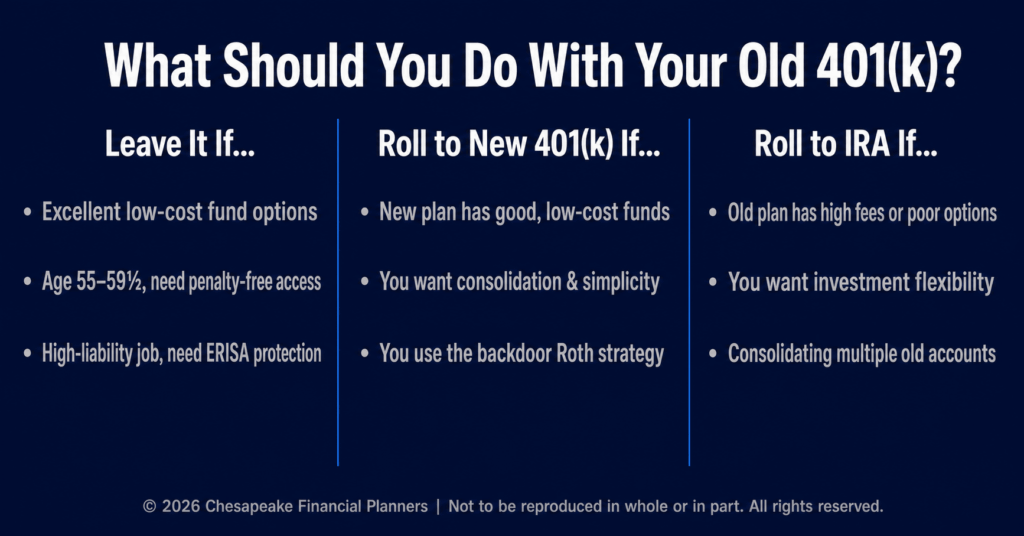
Leaving your 401(k) in your old plan makes sense when the plan is genuinely good. The biggest reasons to stay are strong creditor protection and access to institutional-class funds. Workplace 401(k) plans carry robust federal protection under ERISA, which matters most for doctors, business owners, and others in high-liability roles. Some large plans also offer institutional funds with expense ratios as low as 0.01% to 0.05%, pricing retail investors rarely touch.
There is one age-specific reason to leave it. Under the IRS Rule of 55, if you separate from service in or after the year you turn 55, you can take penalty-free withdrawals from that specific 401(k). Roll that money into an IRA and you lose the Rule of 55. You then wait until 59½ for penalty-free access.
The downsides are real too. You are stuck with whatever menu your old employer offers, you cannot add new contributions, and out-of-sight accounts get forgotten. Some plans also charge maintenance fees to former employees, so read your plan documents before deciding.
Leave it when: your old plan has excellent low-cost funds, you are between 55 and 59½ and may need penalty-free access, you value creditor protection, or you are organized enough not to lose track of it.
| Factor | Old 401(k) | New 401(k) | IRA |
|---|---|---|---|
| Investment choices | Limited menu | Limited menu | Very broad |
| Creditor protection | Strong (ERISA) | Strong (ERISA) | Varies by state |
| Rule of 55 access | Yes | Yes (current plan) | No, wait to 59½ |
| Backdoor Roth friendly | Yes | Yes | Pro-rata risk |
| New contributions | No | Yes | Yes |
Can I roll my old 401(k) into an IRA instead?

Should I Roll It Into My New Employer's 401(k) or an IRA?
Rolling into your new 401(k) wins when that plan has good, low-cost options and you want everything in one place. Consolidation makes your retirement picture easier to manage and simplifies Required Minimum Distributions later. The IRS requires RMDs from most retirement accounts beginning at age 73, and fewer accounts means fewer calculations. Keeping money inside a 401(k) rather than an IRA also helps if you do backdoor Roth contributions, because pre-tax IRA balances trigger the pro-rata rule and can make those contributions partly taxable.
Rolling into an IRA wins on flexibility. You get nearly unlimited investment choices, often lower fund costs than a restricted plan menu, and one place to consolidate multiple old accounts. The tradeoff is the pro-rata complication for backdoor Roth and, in some states, weaker creditor protection than ERISA plans.
However you move the money, use a direct rollover. With a direct rollover, the funds go straight from one custodian to the other and nothing is withheld. With an indirect rollover, the plan must withhold 20% for taxes, and you have only 60 days to redeposit the full amount, including the withheld portion, or it counts as a taxable distribution.
This is exactly the kind of fork in the road the R.U.D.D.E.R. Method™ is built for. The R.U.D.D.E.R. Method™ is Chesapeake Financial Planners' six-step planning process: Review and Recognize, Uncover and Understand, Design and Develop, Discuss and Decide, Execute and Empower, and Reassess and Refine. The point is that a rollover is not a paperwork task. It is a decision that touches your taxes, your investment costs, and your access to the money for years.
Should I Choose a Roth 401k or Traditional 401k?
How do I coordinate all my retirement income sources to minimize taxes and maximize income?
Frequently Asked Questions
Should I roll over my old 401(k) or leave it where it is?
Roll it over if you want more investment choices, lower fees, or simpler account management, and leave it if your old plan has excellent low-cost funds or you need Rule of 55 access. The right answer depends on your plan quality, your age, and how organized you are with scattered accounts. For most people, consolidating into an IRA or a new 401(k) reduces clutter and improves control.
How long do I have to roll over my 401(k) after leaving a job?
You generally have no deadline to roll over a 401(k) if you leave it in the old plan and your balance is above $7,000. But if you take an indirect rollover where the check comes to you, the IRS gives you only 60 days to deposit the full amount into another retirement account before it becomes a taxable distribution. A direct rollover avoids this clock entirely.
Will I pay taxes if I roll over my 401(k)?
No, you will not pay taxes on a direct rollover from a traditional 401(k) to a traditional IRA or another 401(k), because the money stays tax-deferred. Taxes only apply if you cash out, miss the 60-day window on an indirect rollover, or convert pre-tax money to a Roth account. With a Roth conversion, you owe ordinary income tax on the converted amount that year.
What is the pro-rata rule and how does it affect my rollover?
The pro-rata rule means the IRS treats all your traditional, SEP, and SIMPLE IRA balances as one pool when you do a backdoor Roth conversion. If you roll pre-tax 401(k) money into an IRA, it can make future backdoor Roth contributions partly taxable. Keeping that money inside a 401(k) instead of an IRA avoids the problem entirely for high earners using the backdoor strategy.
Can I roll over my 401(k) if I'm still employed?
Usually no, because most 401(k) plans only allow rollovers after you leave the employer, though some plans permit in-service rollovers or distributions after a certain age. Check your specific plan rules with your plan administrator. If your current plan blocks in-service rollovers, you typically wait until you separate from service to move that money elsewhere.
Your Next Step
An old 401(k) is one of those decisions that feels small in the moment and compounds over decades. Whether you roll it over or leave it depends on details only a look at your actual plan and your full financial picture can answer. At Chesapeake Financial Planners, Jeff Judge and the team help families and business owners across Harford County and the Baltimore metro make this call every week. Schedule a free fit call at chesapeakefp.com to roll over 401k decisions with confidence.
Want to go deeper? Our 401(k) vs. IRA Rollover Guide walks through this step by step.
Disclosures
The information provided is for educational purposes only and should not be construed as investment advice. Investment strategies should be tailored to individual circumstances, risk tolerance, and goals. Past performance doesn't guarantee future results. Consult with qualified financial professionals regarding your specific situation.
Contributions to a traditional IRA may be tax deductible in the contribution year, with current income tax due at withdrawal. Withdrawals prior to age 59 ½ may result in a 10% IRS penalty tax in addition to current income tax.
This information is not intended to be a substitute for specific individualized tax, investment or legal advice. We suggest that you discuss your specific situation with a qualified tax, legal or financial advisor.
Advisors associated with Chesapeake Financial Planners may be either (1) LPL Financial Registered Representatives offering securities through LPL Financial, Member FINRA and SIPC, and investment advisor representatives offering investment advice through Great Valley Advisor Group; or (2) solely investment advisor representatives offering investment advice through Great Valley Advisor Group and not affiliated with LPL Financial. Great Valley Advisor Group, and Chesapeake Financial Planners are separate entities from LPL Financial.


