

Last reviewed: October 2026
Selling a business when you own the building means you are making two decisions, not one: what the company sells for, and what happens to the real estate underneath it. A buyer can purchase the property, lease it from you, or move out and leave you holding an empty building. Each path produces a different tax bill and a different retirement income, even when the business price is identical.
Key Takeaways
- The IRS taxes unrecaptured section 1250 gain, the depreciation you claimed on a building, at a maximum 25% rate when you sell the property.
- A building sale or later rent can draw the 3.8% net investment income tax above $250,000 for joint filers, depending on how you hold it.
- Maryland adds its own layer: a top state rate of 6.5% for 2026, plus county income tax.
- A lease turns the building into retirement income that depends on a company you no longer run, so lease terms matter as much as price.
About the Author: Jeff Judge, CFP®, AEP®, ChFC®, CLU® is Managing Partner of Chesapeake Financial Planners in Forest Hill, Maryland. He has been helping families and business owners in Harford County and the Baltimore metro area navigate business exits, and the real estate that often comes with them, since earning his CFP® certification in 2013, by using Chesapeake's signature process, the R.U.D.D.E.R. Method™. "The building deserves its own decision, made early enough that you are choosing instead of reacting."
Why Does Selling a Business When You Own the Building Create a Second Decision?
Because a buyer purchases the operating company, and the building is a separate asset with its own value, its own tax picture, and its own buyer questions.
We see this pattern with owners across industries. The property was bought decades ago, often for a fraction of today's value, and sits in a separate LLC on the advice of an attorney or CPA, which was a sensible call. Because the operating company pays the rent, the building feels like part of the business rather than a separate investment.
One manufacturing owner we worked with had a clear exit number in his head. Then we asked about the building. He owned it personally through a separate entity, and his company had paid him rent for 18 years. It had not appeared anywhere in his exit math. In his mind it was simply where the business lived. In reality it was a second asset that had to be priced, taxed, and fitted into his retirement.
Will the buyer buy the building, lease it, or leave? What happens to your income if the new owners struggle after you step away? Those questions are much easier to answer before a buyer is at the table than after a letter of intent arrives.
What Are the Three Paths for the Building: Buy, Lease, or Vacate?
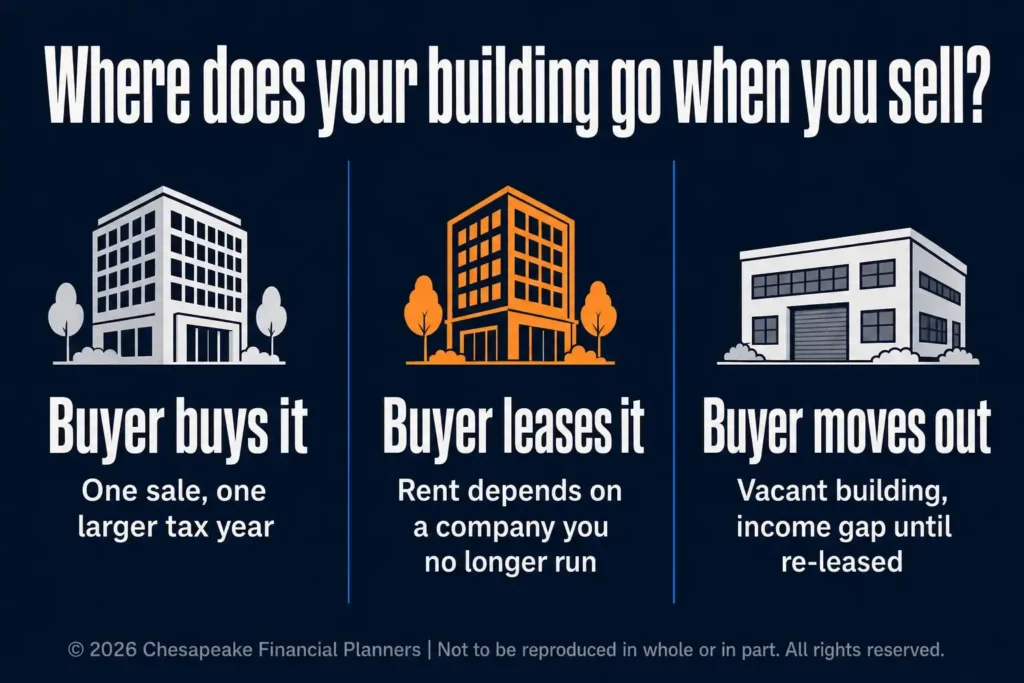
When you own the building and sell the business, the property usually follows one of three paths, and each one changes your retirement differently.
| Path | What you receive | Main tax effect | Main risk |
|---|---|---|---|
| Buyer buys the building | A lump sum alongside the business proceeds | Gain, including depreciation recapture, lands in the same tax year as the sale | Larger one-year tax bill |
| Buyer leases the building | Rent over the lease term | Smaller event now, rent taxed as it arrives | Income depends on the tenant's health |
| Buyer moves out | An empty building | Depends on whether you re-lease or sell | Vacancy and an income gap |
What happens if the buyer buys the building?
You receive a lump sum for the real estate and realize any gain on it in the same year as the business sale. For a building held a long time, that gain may include depreciation recapture, and the IRS states that "the portion of any unrecaptured section 1250 gain from selling section 1250 real property is taxed at a maximum" rate of 25%. The upside is a clean exit: no tenant, no roof, no property tax bills.
What happens if the buyer leases the building from you?
You keep the property and become a landlord to the company you just sold. This is common with private equity buyers and strategic acquirers that prefer to keep real estate off their balance sheet. Monthly rent can feel like a paycheck, but your income now rides on decisions made by owners you do not control. These lease terms deserve the most attention:
- Length of the term and the renewal options
- Annual rent increases
- Who pays for maintenance, insurance, and property taxes
- What happens if the tenant is sold again, including rules on assignment and subleasing
- Whether a parent company or the new owners co-sign the lease
Private equity buyers often resell within several years, so a lease that looked sturdy with the first owner can look different with the third.
What happens if the buyer moves out?
Sometimes the buyer plans to consolidate operations elsewhere. You then own a building adapted to one business, with no tenant, and the market for specialized commercial property can be thin. This outcome catches owners off guard because they assumed the building was part of the company's value. To the buyer, it was not.
Jeff Judge often tells owners that the building is where their exit plan quietly becomes a real estate plan, whether they meant for it to or not.
How Does the Building Change Your After-Tax Exit Number?
It adds a second set of proceeds and a second tax calculation, and the timing of each depends on which of the three paths you choose.
Here is a hypothetical example with round numbers and no specific tax rates. Say the business sells for $6 million and the building is worth $2 million. If the buyer purchases both, you have one large taxable year and two sets of proceeds to invest. If the buyer leases the building, you have a smaller taxable event now and rental income later, taxed as it arrives. If the buyer moves out, you have a building to reposition and an income gap until it is leased or sold.
Several tax layers can sit on top of the building gain. Long-term gain on the property is generally taxed at 0%, 15%, or 20% depending on your income, and for 2026 the 15% bracket tops out at $613,700 of taxable income for joint filers and $545,500 for single filers. The depreciation portion can be taxed at up to 25%, as noted above. The 3.8% net investment income tax may apply too, and the IRS thresholds are $250,000 for joint filers and $200,000 for single filers. Whether it reaches your building depends on how you hold and use the property, which is a question for your CPA.
The business price might be identical in every case. Your retirement is not.
How Much of Your Net Worth Should Sit in One Building After the Sale?
Treat it like any other large single position: decide the share of your total assets it should represent before you accept a lease, not after.
Before the sale, most of your net worth sat in one business. After the sale, if you keep the building and lease it back, a meaningful share may sit in one property, with one tenant, in one location. That is a smaller concentration than before, but it is still concentration, and the tenant is the company you just sold. Jeff Judge treats a building the way he treats any large position in a plan: what share of total assets does it represent, and would a year of missed rent be an inconvenience or a crisis? For a wider look at this risk, see our post on business owner portfolio concentration risk.
The manufacturing owner from our opening negotiated a lease with a longer term, annual rent increases, and a parent company co-signing the lease, terms he would not have thought to ask for without the conversation. He also set aside part of his sale proceeds as a reserve in case the tenant ever left. We encourage owners to put the building on the table as its own decision, early enough to make it on their terms.
Some owners deal with the real estate on its own schedule instead, selling the building to an investor with a long lease back to the operating company before the business goes to market. The trade-offs are real: it creates a taxable event on the building earlier, it binds the eventual buyer to a lease some buyers will not want, and it takes time to do well.
At Chesapeake Financial Planners, we use the R.U.D.D.E.R. Method™, our six-step planning process: Review and Recognize, Uncover and Understand, Design and Develop, Discuss and Decide, Execute and Empower, and Reassess and Refine. The building shows up in the Uncover and Understand step, because it is exactly the kind of asset that stays invisible until someone asks.

What Should You Settle Before the Letter of Intent, and What Changes in Maryland?
Settle the building's value, its rent, your retirement goals, the tax timing, and its place in your estate plan before a buyer is at the table.
- Get the value. Order a current appraisal of the real estate as a separate asset. Owners are often surprised in both directions, because a specialized facility can be worth less than assumed when few businesses could use it as is.
- Check the rent. If your company pays below-market rent, a buyer may happily lease at that rate and lock you into it. If it pays above market, a buyer may push back or lower the business price. Moving rent toward fair market value a year or two before a sale can make the negotiation cleaner.
- Decide what retirement looks like. Some owners want to be finished with real estate. Others like rental income and accept the risk. Either answer can work if it comes from your plan rather than from whatever the buyer proposes.
- Coordinate the tax side early. The timing of a building sale relative to the business sale, how recapture is taxed, and whether spreading transactions across tax years makes sense are questions for your CPA and planner together. If you are open to swapping into other property, the IRS explains that like-kind exchanges apply to real property used in business or held for investment, and our post on 1031 exchanges for real estate investors covers the mechanics.
- Plan the estate angle. A leased building with a financially strong tenant can be a meaningful asset to pass to your family. A vacant specialty building can be a burden. How it is titled, and whether your estate plan addresses it, matters.
For Harford County owners, the Maryland layer matters too. Maryland taxes residents' gains as income, with a top state rate of 6.5% for 2026 and a county income tax that starts at 2.25%. If you run a small manufacturing, contracting, or distribution business around Forest Hill or Bel Air, the building may well be your largest asset outside the company, and our firm is virtual by default with in-person meetings available. For the state-level picture of a full sale, read our guide to selling a business in Maryland, and for the full process see Selling a Business: The Complete Financial Planning Guide.
Frequently Asked Questions
Do I have to sell my building when I sell my business?
No, the building is a separate asset, so you can sell it with the business, lease it to the buyer, or keep it. The right choice depends on the buyer's plans, your tax picture, and how much retirement income you want tied to one property. Decide your preference before the letter of intent arrives.
Can I keep the building and lease it to the buyer?
Yes, and many owners do, especially with private equity or strategic buyers who prefer not to own real estate. The lease then becomes part of your retirement income, so its length, rent increases, maintenance responsibilities, assignment rules, and any parent-company co-signer deserve as much attention as the sale price.
What taxes apply when I sell a building I used for my business?
A sale can trigger federal tax on the gain, including a maximum 25% rate on depreciation you claimed, possibly the 3.8% net investment income tax, and Maryland income tax for residents. The mix depends on how you hold the property and your income that year, so your CPA should model it before closing.
Can a 1031 exchange defer tax on the building?
It may, if you exchange the building for other real property held for business or investment, according to the IRS. The exchange has strict timing and structure rules and does not apply to the sale of the business itself. Talk with your CPA and a qualified intermediary well before closing.
How does below-market rent affect my business sale?
Below-market rent raises the company's reported profit, which can lift what a buyer will pay for the business, while a buyer who leases at that rate leaves you earning less as landlord. The value shifts between your two assets, so compare the total outcome with an appraisal and your CPA before agreeing to terms.
When should I get the building appraised?
Order the appraisal before you talk with buyers, ideally a year or more before a planned sale. A current value tells you what share of your net worth the building represents and gives you a baseline for rent, sale price, and tax planning. Waiting until the letter of intent leaves little time to react.
If you are selling a business when you own the building, ask yourself one question this week: which of the three paths is the building on? Ready to put a plan around the answer? Jeff Judge and the Chesapeake team serve families and business owners across Harford County and the Baltimore metro. Schedule a free fit call at chesapeakefp.com.
A version of this article was originally published on Chesapeake Financial Planners' LinkedIn.
Disclosures
The information provided is for educational purposes only and should not be construed as investment advice. Investment strategies should be tailored to individual circumstances, risk tolerance, and goals. Past performance doesn't guarantee future results. Consult with qualified financial professionals regarding your specific situation.
Investments in real estate may be subject to a higher degree of market risk because of concentration in a specific industry, sector or geographical sector. Other risks can include, but are not limited to, declines in the value of real estate, potential illiquidity, risks related to general and economic conditions, stage of development, and defaults by borrower.
Certified Financial Planner Board of Standards Center for Financial Planning, Inc. owns and licenses the certification marks CFP®, CERTIFIED FINANCIAL PLANNER®, and CFP® (with plaque design) in the United States to Certified Financial Planner Board of Standards, Inc., which authorizes individuals who successfully complete the organization’s initial and ongoing certification requirements to use the certification marks.
The ChFC® is the property of The American College of Financial Services, which reserves sole rights to its use, and is used by permission.
The CLU® is the property of The American College of Financial Services, which reserves sole rights to its use, and is used by permission.
This information is not intended to be a substitute for specific individualized tax, investment or legal advice. We suggest that you discuss your specific situation with a qualified tax, legal or financial advisor.
Advisors associated with Chesapeake Financial Planners may be either (1) LPL Financial Registered Representatives offering securities through LPL Financial, Member FINRA and SIPC, and investment advisor representatives offering investment advice through Great Valley Advisor Group; or (2) solely investment advisor representatives offering investment advice through Great Valley Advisor Group and not affiliated with LPL Financial. Great Valley Advisor Group, and Chesapeake Financial Planners are separate entities from LPL Financial.
Chesapeake Financial Planners | 2402 Scotlon Ct, Forest Hill, MD 21050 | (410) 652-7868 | www.chesapeakefp.com
© 2026 Chesapeake Financial Planners | Not to be reproduced in whole or in part. All rights reserved.


