
What Happens in the Uncover and Understand Step of the R.U.D.D.E.R. Method™?
Last reviewed: July 2026
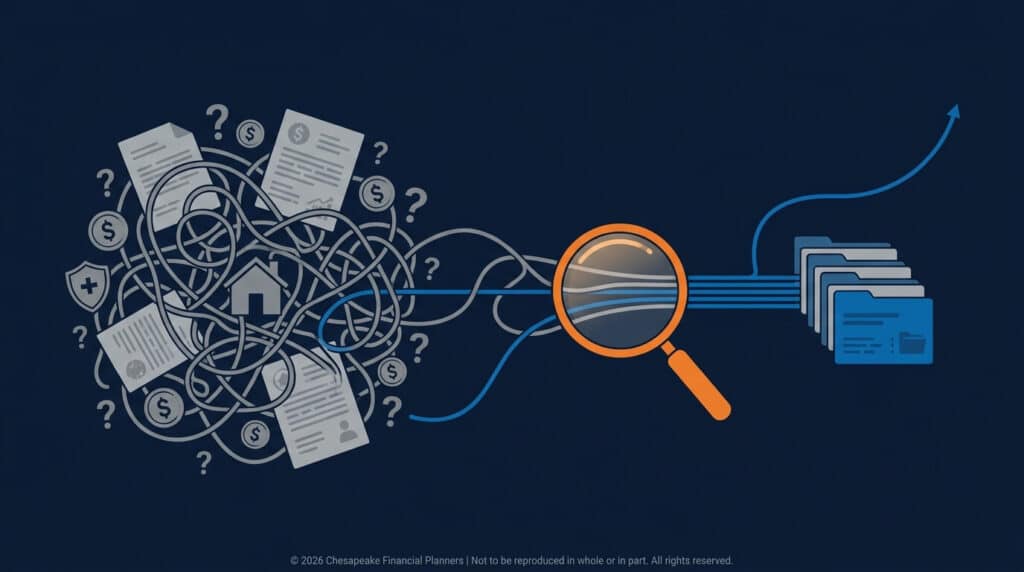
The Uncover and Understand step is the second stage of the R.U.D.D.E.R. Method™, where your financial planner digs past the surface numbers to find what your money is actually for. It is the fact-finding and discovery phase: gathering every account, every goal, every worry, and every assumption so the plan that follows is built on reality instead of guesswork. This is the step where a planner stops listening for what you say you want and starts understanding what you actually need.
Key Takeaways
- Uncover and Understand is step two of the R.U.D.D.E.R. Method™, focused on deep discovery of your full financial picture and personal goals.
- This step gathers hard data and soft data: account balances, cash flow, and the values and fears behind your decisions.
- The average U.S. household carries $105,056 in debt, making an honest liability inventory essential.
- Skipping discovery is the most common reason financial plans fail, because the plan solves the wrong problem.
About the Author: Jeff Judge, CFP®, AEP®, ChFC®, CLU® is Managing Partner of Chesapeake Financial Planners in Forest Hill, Maryland. He has been helping families and business owners in Harford County and the Baltimore metro area navigate financial planning conversations since earning his CFP® certification in 2013, by using Chesapeake Financial Planners’ signature process, the R.U.D.D.E.R. method™. Jeff has watched more plans fail from skipped discovery than from poor investment picks, which is exactly why this step gets the most time.
What Is the Uncover and Understand Step?
Uncover and Understand is the discovery phase of the R.U.D.D.E.R. Method™, Chesapeake Financial Planners' six-step planning process: Review and Recognize, Uncover and Understand, Design and Develop, Discuss and Decide, Execute and Empower, and Reassess and Refine. In this second step, the planner collects a complete inventory of your financial life and the human context around it.
That means two kinds of information. Hard data: income, account balances, debt, insurance coverage, tax returns, employer benefits, and projected Social Security. Soft data: what keeps you up at night, what you want your money to do, how you feel about risk, and the family dynamics nobody puts on a balance sheet. Both matter. A plan built only on the spreadsheet misses why you wanted the plan in the first place.
Jeff Judge often tells clients that this is the step where the real planning happens, long before anyone recommends a single product. Get the discovery right, and the rest of the process almost writes itself.
What is the R.U.D.D.E.R. Method™ in financial planning?

What Information Does This Step Gather?
This step gathers a full picture of both your numbers and your priorities so nothing important gets missed. A thorough discovery pulls together everything that touches your money.
On the hard-data side, a planner typically collects:
- All account balances: checking, savings, brokerage, 401(k), IRA, HSA, and pensions
- Current debts and interest rates, from mortgages to credit cards
- Insurance policies: life, disability, long-term care, and property
- Recent tax returns and current-year withholding
- Employer benefits, including match formulas and stock plans
- Estimated Social Security benefits from your SSA statement
The numbers tell only half the story. The Federal Reserve reports the average American household carries $105,056 in total debt, and an honest liability inventory is often the most revealing part of discovery. People know what they own. Fewer track what they owe with the same precision.
Why Does Discovery Matter So Much?
Discovery matters because a plan built on incomplete information solves the wrong problem, and that mistake compounds for years. When a planner skips deep discovery, the recommendations end up generic, addressing an average client instead of the actual person sitting across the table.
Retirement readiness shows why this is more than theory. The Federal Reserve's 2023 survey found that only 34% of non-retired adults felt their retirement savings were on track. The gap between feeling on track and being on track usually traces back to assumptions that were never tested in a real discovery conversation.
Jeff has watched clients walk in convinced their biggest problem was investment returns, when the actual issue was a tax bill they were quietly handing back to the IRS every year. You cannot find that without asking. Discovery is how you find the problem worth solving instead of the one that is easiest to talk about.
What happens in the Review and Recognize step of the R.U.D.D.E.R. Method™?
How Does This Step Connect to the Rest of the Plan?
This step feeds directly into Design and Develop, the next stage, where the actual strategy gets built. Everything uncovered here becomes the raw material for the recommendations that follow. Skip it, and the design phase has nothing solid to stand on.
Think of it as the difference between a tailor measuring you and a tailor guessing your size. The measurements are not the suit, but you will never get a suit that fits without them. According to the Bureau of Labor Statistics, the average household spends a significant share of income on housing and transportation alone, and understanding those cash-flow realities shapes every recommendation that comes next.
What happens in the Design and Develop step of the R.U.D.D.E.R. Method™?
Frequently Asked Questions
What is the Uncover and Understand step in the R.U.D.D.E.R. Method™?
The Uncover and Understand step is the second stage of the R.U.D.D.E.R. Method™, focused on discovery. Your planner gathers a complete inventory of your financial accounts, debts, insurance, and tax situation, along with your goals, values, and concerns. This deep fact-finding ensures the plan that follows addresses your real situation rather than assumptions.
How long does the discovery step take?
The discovery step usually spans one or two meetings plus time to gather documents, often taking a few weeks from start to finish. The timeline depends on how complex your finances are and how quickly you can pull together statements, tax returns, and benefit details. Rushing it tends to create gaps that surface later as plan problems.
What documents should I bring to a discovery meeting?
Bring recent statements for every account, your most recent tax return, current insurance policies, employer benefit summaries, and a Social Security estimate. Also bring any debt details, including balances and interest rates. The more complete your documentation, the more accurate the discovery, and the fewer follow-up requests you will field afterward as the planner builds your strategy.
Why does my planner ask about my goals and feelings, not just my money?
Your planner asks about goals and feelings because the numbers alone cannot tell them what your money is for. Two clients with identical balances may need completely different plans based on their risk tolerance, family obligations, and what they want retirement to look like. Soft data shapes the plan as much as the hard data does.
What happens if discovery is rushed or skipped?
If discovery is rushed or skipped, the plan ends up solving the wrong problem, because it is built on assumptions instead of facts. Generic recommendations often miss tax inefficiencies, coverage gaps, or cash-flow issues that proper discovery would catch. This is one of the most common reasons financial plans fail to deliver the results clients expect.
If you found this helpful, our overview of the full R.U.D.D.E.R. Method™ walks through all six steps in depth, including how discovery feeds the strategy that follows. Download it at chesapeakefp.com to see how the framework can put structure around your own financial decisions.
What happens in the Discuss and Decide step of the R.U.D.D.E.R. Method™?
Want to go deeper? Our R.U.D.D.E.R. Method guide walks through this step by step.
Disclosures
The information provided is for educational purposes only and should not be construed as investment advice. Investment strategies should be tailored to individual circumstances, risk tolerance, and goals. Past performance doesn't guarantee future results. Consult with qualified financial professionals regarding your specific situation.
Advisors associated with Chesapeake Financial Planners may be either (1) LPL Financial Registered Representatives offering securities through LPL Financial, Member FINRA and SIPC, and investment advisor representatives offering investment advice through Great Valley Advisor Group; or (2) solely investment advisor representatives offering investment advice through Great Valley Advisor Group and not affiliated with LPL Financial. Great Valley Advisor Group, and Chesapeake Financial Planners are separate entities from LPL Financial.


