

What Happens in the Review and Recognize Step of the R.U.D.D.E.R. Method™?
Last reviewed: July 2026
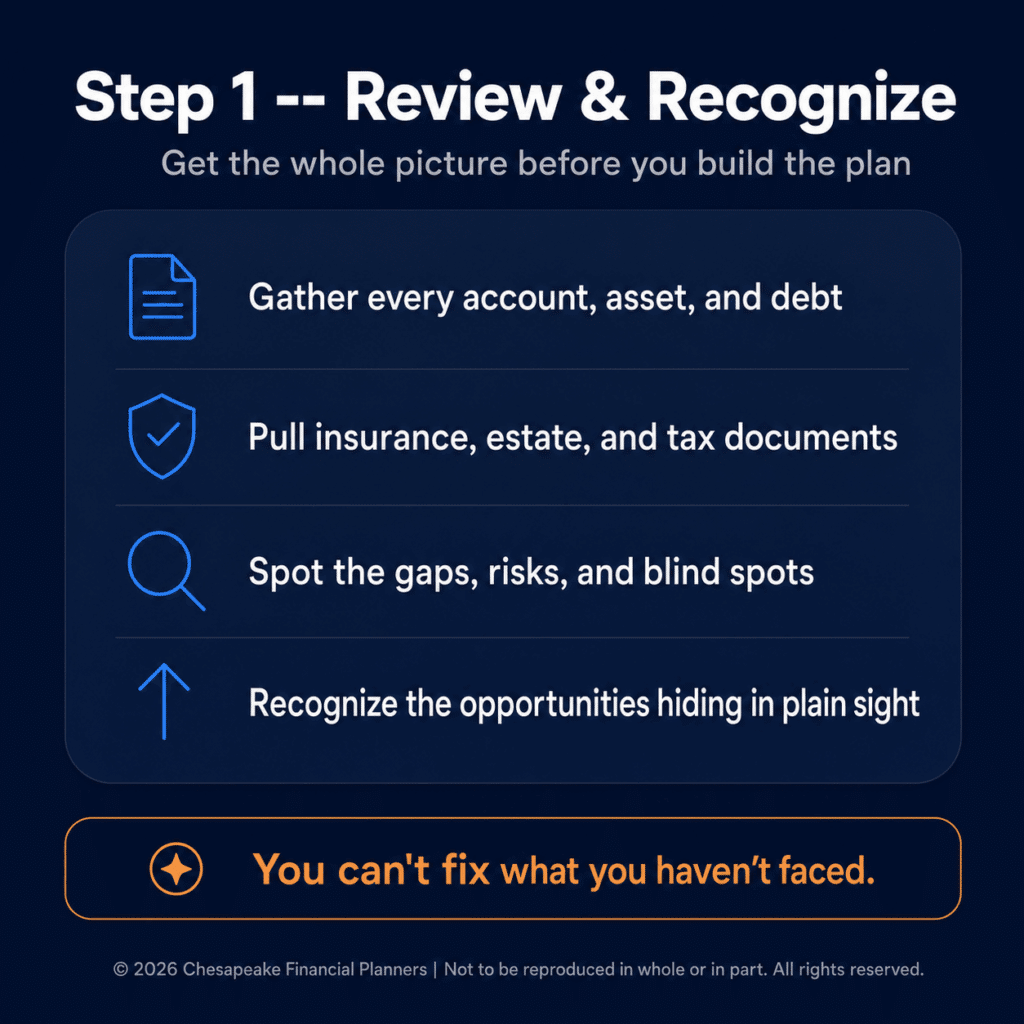
The Review and Recognize step is the first stage of the R.U.D.D.E.R. Method™, and it means taking an honest inventory of where your money stands today before making any plan for tomorrow. In this step, your advisor reviews your full financial picture (income, assets, debts, insurance, and goals) and helps you recognize the gaps, risks, and opportunities hiding inside it. No strategy gets built until this groundwork is done, because a plan built on a fuzzy starting point fails the moment real life touches it.
Key Takeaways
- Review and Recognize is the first step of the R.U.D.D.E.R. Method™, focused on documenting your complete financial picture before any planning begins.
- The step gathers income, assets, debts, insurance, tax returns, and goals into one clear baseline.
- Roughly 36% of U.S. households carry credit card debt that a thorough review surfaces early.
- Recognizing gaps and risks at the start prevents expensive surprises later in the planning process.
About the Author: Jeff Judge, CFP®, AEP®, ChFC®, CLU® is Managing Partner of Chesapeake Financial Planners in Forest Hill, Maryland. He has been helping families and business owners in Harford County and the Baltimore metro area navigate financial planning since earning his CFP® certification in 2013, by using Chesapeake Financial Planners’ signature process, the R.U.D.D.E.R. method™. Jeff often says the Review and Recognize step is where most people first see their whole financial life laid out on one page, and the reaction is usually relief, not panic.
The R.U.D.D.E.R. Method™ is Chesapeake Financial Planners' six-step planning process: Review and Recognize, Uncover and Understand, Design and Develop, Discuss and Decide, Execute and Empower, and Reassess and Refine. Step 1 sets the foundation for everything that follows. Skip it, or rush it, and the rest of the process inherits the blind spots.
What Does "Review and Recognize" Actually Mean?
Review and Recognize is two jobs in one phrase. Review is the data-gathering half: pulling together every relevant financial document and account so nothing is guessed at. Recognize is the interpretation half: spotting what those numbers are telling you, including the things you'd rather not see.
Most people walk in thinking they already know their financial situation. Then they add up the real numbers and find a forgotten old 401(k), an insurance policy that no longer fits, or a savings rate that won't get them where they want to go. Jeff Judge has watched this moment play out hundreds of times. The recognition part is what separates a plan that sticks from a wish list.
This step is deliberately backward-looking and present-focused. It is not the place for projections or product recommendations. Those come later. Here, the only goal is an accurate, complete starting line.
What Information Gets Reviewed in This First Step?
A thorough review covers your entire financial life, not just your investment accounts. The point is to leave nothing in the dark.
- Income sources: salary, business income, rental income, and expected Social Security. The Social Security Administration sets the maximum taxable earnings base at $184,500 for 2026, which matters for high earners mapping their benefit.
- Assets: retirement accounts, brokerage accounts, real estate, business equity, and cash reserves.
- Debts: mortgages, student loans, credit cards, and business obligations.
- Insurance: life, disability, health, and long-term care coverage.
- Tax returns: the last two years, which reveal bracket, deductions, and planning opportunities.
- Goals: retirement timing, education funding, legacy wishes, and major purchases.
That last item surprises people. Goals are data too. A plan with no clearly recognized destination is just a spreadsheet. According to the Federal Reserve, only 34% of non-retired adults felt their retirement savings were on track in 2024, a gap that a proper review brings into focus.
Why Does the RUDDER Method Review Recognize Financial Planning Step Come First?
Sequencing is not an accident here. The Review and Recognize step comes first because every later decision depends on the accuracy of this baseline. You cannot design a tax strategy without seeing the tax returns. You cannot size an emergency fund without knowing the real monthly spending.
In Jeff's experience, the most expensive financial mistakes start with a wrong assumption that nobody checked. Someone believes they're contributing enough to their 401(k) when they're leaving an employer match on the table. The IRS set the 2026 employee 401(k) contribution limit at $24,500, with an additional $8,000 catch-up for those 50 and older. A review catches the gap between what you assume and what's actually happening.
This step also builds trust. When you and your advisor look at the full picture together, the relationship starts on honesty rather than a sales pitch. That tone carries through every step that follows. From here, the process moves naturally into the What happens in the Uncover and Understand step of the R.U.D.D.E.R. Method™? phase, where the conversation shifts from what you have to what you actually want.
How Long Does the Review and Recognize Step Take?
For most households, gathering documents takes a week or two of light effort on your end, followed by a working session with your advisor to recognize the patterns. Complex situations (business owners, multiple properties, blended families) take longer because there is more to assemble. The reward for doing it carefully is a plan that holds up. To see how this fits the larger framework, the What is the R.U.D.D.E.R. Method™ in financial planning? post walks through all six steps.
Frequently Asked Questions
What is the Review and Recognize step in the R.U.D.D.E.R. Method™?
The Review and Recognize step is the first stage of the R.U.D.D.E.R. Method™, where your advisor gathers your complete financial picture and helps you recognize the gaps, risks, and opportunities inside it. It documents income, assets, debts, insurance, and goals to create an accurate baseline before any planning strategy is designed.
What documents do I need for the Review and Recognize step?
You'll want recent pay stubs, retirement and brokerage account statements, mortgage and loan balances, insurance policies, and the last two years of tax returns. Bringing a list of your financial goals also helps. The more complete your documents, the more accurate the baseline your advisor builds in this first step.
Why is reviewing your finances the first step in financial planning?
Reviewing your finances comes first because every later decision depends on an accurate starting point. You cannot design a tax strategy, size an emergency fund, or set a retirement target without knowing your real numbers. Skipping this step builds the entire plan on assumptions that often turn out to be wrong.
Can I do the Review and Recognize step myself?
You can gather and review your own financial documents, and doing so is a useful exercise. The harder part is the Recognize half, where an experienced advisor spots gaps, tax opportunities, and risks that are easy to miss on your own. A second set of trained eyes usually surfaces things most people overlook.
What happens after the Review and Recognize step?
After Review and Recognize, the R.U.D.D.E.R. Method™ moves into Uncover and Understand, where your advisor digs into your priorities, values, and concerns. The accurate baseline from step one feeds directly into that conversation. Each subsequent step builds on the foundation laid by this first review, which is why getting it right matters.
If you want to see where you actually stand before building a plan, our R.U.D.D.E.R. Method™ overview guide breaks down all six steps in plain language. Read it at chesapeakefp.com, then decide whether a structured review is the next right move for you.
Want to go deeper? Our R.U.D.D.E.R. Method guide walks through this step by step.
Disclosures
The information provided is for educational purposes only and should not be construed as investment advice. Investment strategies should be tailored to individual circumstances, risk tolerance, and goals. Past performance doesn't guarantee future results. Consult with qualified financial professionals regarding your specific situation.
Advisors associated with Chesapeake Financial Planners may be either (1) LPL Financial Registered Representatives offering securities through LPL Financial, Member FINRA and SIPC, and investment advisor representatives offering investment advice through Great Valley Advisor Group; or (2) solely investment advisor representatives offering investment advice through Great Valley Advisor Group and not affiliated with LPL Financial. Great Valley Advisor Group, and Chesapeake Financial Planners are separate entities from LPL Financial.


