

How Does a Roth Conversion Ladder Work for Retirement Planning?
Last reviewed: July 2026
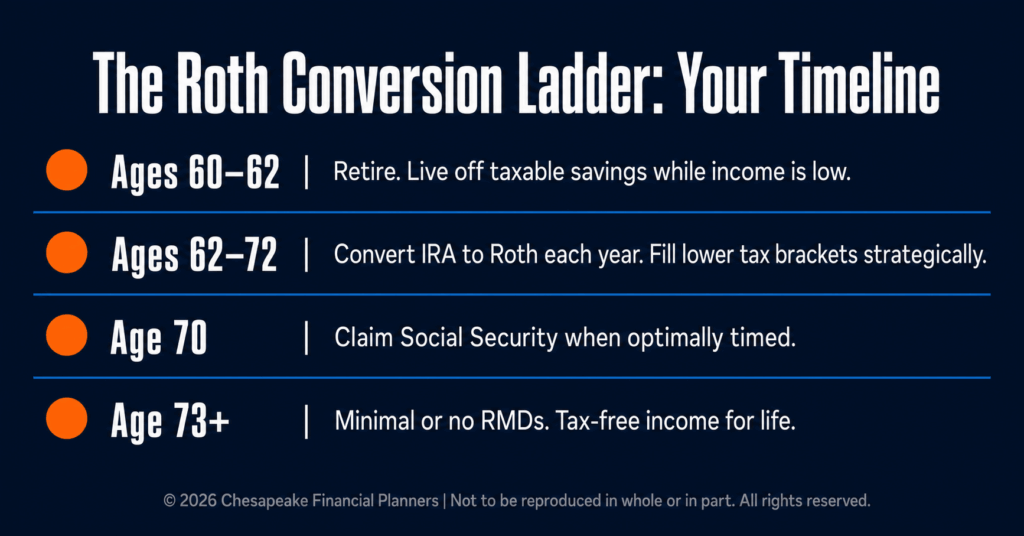
A Roth conversion ladder is a multi-year strategy where you convert portions of your traditional IRA or 401(k) into a Roth IRA over several years, paying income tax on each converted amount at today's rates instead of facing larger tax bills later. The strategy works best in the low-income window between retirement and the start of Required Minimum Distributions, when you can fill up lower tax brackets on purpose. Done well, a Roth conversion ladder shrinks future RMDs, lowers lifetime taxes, and reduces Medicare surcharges down the road.
Key Takeaways
- A Roth conversion ladder converts pre-tax retirement money to Roth over multiple years to control your tax bracket.
- The IRS requires RMDs to begin at age 73 under current law, which a ladder helps reduce.
- Converting during low-income years can prevent up to 85% of Social Security benefits from becoming taxable later.
- High earners use ladders to manage IRMAA Medicare surcharges that kick in at higher income levels.
About the Author: Jeff Judge, CFP®, AEP®, ChFC®, CLU® is Managing Partner of Chesapeake Financial Planners in Forest Hill, Maryland. He has been helping families and business owners in Harford County and the Baltimore metro area navigate retirement tax decisions since earning his CFP® certification in 2013, by using Chesapeake Financial Planners’ signature process, the R.U.D.D.E.R. method™. Jeff often reminds clients that the years between retiring and turning 73 are the cheapest tax years they will ever have, and most people waste them.
What Is a Roth Conversion Ladder?
A Roth conversion ladder is a sequence of partial Roth conversions, one per year, designed to move pre-tax retirement savings into a tax-free Roth account gradually. Instead of converting a $2 million IRA in a single year and triggering a brutal tax bill, you convert a manageable slice annually. Each conversion is a "rung" on the ladder, and each rung eventually delivers tax-free income for the rest of your life.
The point is bracket control. You decide how much to convert each year, filling lower tax brackets without spilling into higher ones. Money converted to a Roth grows tax-free, comes out tax-free in retirement, and is not subject to Required Minimum Distributions during your lifetime.
Jeff Judge has watched clients delay this decision for three years, then realize they gave up three of their best low-tax years for nothing. It rarely gets cheaper to wait. Once Social Security and RMDs start stacking on top of each other, your bracket fills up fast and the room to convert disappears.
Should I Do Roth Conversions Before I Retire?
Why a Roth Conversion Ladder Matters Before RMDs Hit
Traditional IRAs and 401(k)s create a future tax problem most people underestimate. The accounts grow tax-deferred for decades, and then the IRS comes to collect. A Roth conversion ladder defuses several of these issues at once.
Required Minimum Distributions force taxable income whether you need the money or not. Under current law, RMDs begin at age 73 according to the IRS. A large pre-tax balance can generate six figures of forced income each year, pushing a retiree from a comfortable bracket into a much higher one.
Those distributions ripple outward. They can make up to 85% of your Social Security benefits taxable, and they can trigger Income-Related Monthly Adjustment Amounts, the surcharges that raise Medicare Part B and Part D premiums for higher earners. A well-run ladder keeps income lower in the RMD years, which is exactly when those surcharges bite hardest.
There is also an inheritance angle. Under the SECURE Act, most non-spouse heirs must empty an inherited IRA within 10 years per IRS guidance, often during their own peak earning years. A Roth left to heirs comes out tax-free, removing that tax bomb entirely.
How do Roth conversions affect IRMAA and Medicare Part B premiums?
How to Build a Roth Conversion Ladder Step by Step
A Roth conversion ladder is simple in concept and detailed in execution. The sequence below is the framework Jeff uses with clients, and it mirrors the Discuss and Decide and Execute and Empower stages of the firm's planning process. The R.U.D.D.E.R. Method™ is Chesapeake Financial Planners' six-step planning process: Review and Recognize, Uncover and Understand, Design and Develop, Discuss and Decide, Execute and Empower, and Reassess and Refine.
Step 1: Calculate your conversion capacity. Figure out how much you can convert without spilling into a higher bracket. For example, suppose you are married filing jointly in 2026 with $50,000 of other taxable income. The 2026 federal tax brackets from the IRS set the top of the 22% bracket at $211,400 for joint filers. That leaves room to convert roughly $161,400 while staying inside the 22% bracket, far cheaper than letting RMDs push you into 32% or higher later.
Step 2: Identify how you will pay the tax. Conversions create an immediate tax bill, and you should pay it from outside the IRA. Use taxable brokerage funds, cash reserves, or part-time income. Never pull from the IRA itself to pay the tax, because that shrinks the balance you are trying to grow tax-free.
Step 3: Execute the conversion late in the year. Convert in November or December once you have clarity on your annual income. This avoids accidentally overshooting your target bracket because of a surprise capital gain or bonus earlier in the year.
Step 4: Pay quarterly estimated taxes. A conversion raises your tax liability, so coordinate with your CPA on estimated payments to avoid underpayment penalties.
Step 5: Let the converted money grow. Once inside the Roth, the balance compounds tax-free and stays out of your lifetime RMD calculation.
Step 6: Repeat and reassess annually. Each year you reevaluate your income, your bracket, and how much runway remains before RMDs. This is the Reassess and Refine step in action.
What Should You Prioritize Financially in the 5 Years Before Retirement?
Frequently Asked Questions
What is a Roth conversion ladder in simple terms?
A Roth conversion ladder is converting part of your traditional IRA or 401(k) to a Roth IRA each year over several years, paying tax on each piece at lower rates now. The goal is to reduce future Required Minimum Distributions and create tax-free retirement income one annual rung at a time.
When is the best time to do a Roth conversion ladder?
The best window is usually between retirement and the start of Required Minimum Distributions, often the years in your sixties when your income dips. During this gap your taxable income tends to be lower, giving you room to convert and fill lower tax brackets before Social Security and age 73 RMDs raise your baseline income.
How much should I convert each year?
Convert enough to fill your target tax bracket without spilling into the next one. Many retirees aim to fill the 22% or 24% bracket using the 2026 IRS brackets as guardrails. The right amount depends on your other income, your future RMD projection, and whether the conversion would trigger IRMAA Medicare surcharges in two years.
Does a Roth conversion affect my Medicare premiums?
Yes, a conversion increases your modified adjusted gross income, which can push you over an IRMAA threshold and raise your Medicare Part B and Part D premiums about two years later. The Centers for Medicare and Medicaid Services base these surcharges on a two-year lookback, so timing your conversions carefully matters for premium planning.
Can a Roth conversion ladder reduce taxes for my heirs?
Yes. Most non-spouse heirs must empty an inherited traditional IRA within ten years, often during their highest-earning years, and pay ordinary income tax on every dollar. A Roth IRA passes to heirs tax-free, so converting now can remove a significant future tax burden from the next generation while still respecting the ten-year rule.
Do I have to pay the conversion tax all at once?
No, you pay tax only on the amount you convert in a given year, which is exactly why the ladder spreads conversions across multiple years. You should pay the resulting tax from non-retirement funds such as a taxable brokerage account or cash, and coordinate quarterly estimated payments with your CPA to avoid penalties.
If you want to see how a multi-year conversion plan would look for your own accounts, our retirement tax planning guide walks through the math and the trade-offs in plain language. Download it at chesapeakefp.com to start mapping your own Roth conversion ladder.
Want to go deeper? Our Roth Conversion Window walks through this step by step.
Disclosures
The information provided is for educational purposes only and should not be construed as investment advice. Investment strategies should be tailored to individual circumstances, risk tolerance, and goals. Past performance doesn't guarantee future results. Consult with qualified financial professionals regarding your specific situation.
Contributions to a traditional IRA may be tax deductible in the contribution year, with current income tax due at withdrawal. Withdrawals prior to age 59 ½ may result in a 10% IRS penalty tax in addition to current income tax.
Traditional IRA account owners have considerations to make before performing a Roth IRA conversion. These primarily include income tax consequences on the converted amount in the year of conversion, withdrawal limitations from a Roth IRA, and income limitations for future contributions to a Roth IRA. In addition, if you are required to take a required minimum distribution (RMD) in the year you convert, you must do so before converting to a Roth IRA.
A Roth IRA offers tax deferral on any earnings in the account. Qualified withdrawals of earnings from the account are tax-free. Withdrawals of earnings prior to age 59 ½ or prior to the account being opened for 5 years, whichever is later, may result in a 10% IRS penalty tax. Limitations and restrictions may apply.
Advisors associated with Chesapeake Financial Planners may be either (1) LPL Financial Registered Representatives offering securities through LPL Financial, Member FINRA and SIPC, and investment advisor representatives offering investment advice through Great Valley Advisor Group; or (2) solely investment advisor representatives offering investment advice through Great Valley Advisor Group and not affiliated with LPL Financial. Great Valley Advisor Group, and Chesapeake Financial Planners are separate entities from LPL Financial.


