
Last reviewed: July 2026
The retirement lifestyle upgrades worth the money are the ones that buy back time, comfort, connection, and experiences you will actually use, not the ones that simply cost more. Many of the retirees I meet in Harford County saved carefully for decades, then freeze at the idea of spending on themselves. The research backs up what I see across the desk: retirees tend to underspend the money they worked hard to build. According to the Employee Benefit Research Institute, retirees with the largest savings drew down less than 11% of their assets over the first 18 years of retirement.
Key Takeaways
- Retirees with the largest savings spent down under 11% of their assets across 18 years, a sign of chronic underspending.
- Treat many upgrades as reallocation, not splurge: move dollars from low-value habits toward experiences, comfort, connection, and convenience.
- Social isolation carries real health cost; the NIH links it to roughly a 50% higher dementia risk for older adults.
- Weigh any upgrade by cost per hour of joy, its physical and emotional toll, opportunity cost, and a 60 to 90 day trial.
About the Author: Jeff Judge, CFP®, AEP®, ChFC®, CLU® is Managing Partner of Chesapeake Financial Planners in Forest Hill, Maryland. He has been helping families and business owners in Harford County and the Baltimore metro area turn savings into a life well lived since earning his CFP® certification in 2013, using Chesapeake's signature process, the R.U.D.D.E.R. Method™. "The clients I worry about are not the overspenders," Jeff says. "They are the ones who denied themselves for forty years and cannot give themselves permission to enjoy what they built."
Why do so many retirees underspend the retirement they saved for?
Retirement spending anxiety is the habit of delaying wanted upgrades because they feel like a threat to long-term security. The instinct is understandable. You spent a career saving, and the muscle that got you here does not switch off on the day you retire. But the data shows the fear is often overblown. That same EBRI research found that about a third of retirees had more assets 18 years in than when they started. People routinely overestimate what a lifestyle change costs and underestimate how much happiness it delivers.
The reframe I use with clients is simple: many of these choices are reallocation, not a splurge. You are not stacking a new expense on top of a tight budget. You are moving dollars away from low-value habits, the forgotten subscriptions, the second car you rarely drive, toward experiences, comfort, connection, and convenience. That shift is the heart of intentional retirement spending. For more on striking that balance, see our take on how to balance saving and enjoying life now.
Are retirees really underspending, or just being careful? Both can be true, but careful becomes counterproductive when it costs you years of good health you could have enjoyed. Jeff Judge often tells clients that money left unspent at 72 does not buy back the trip you could have taken at 68. The goal is not to spend recklessly. It is to spend on purpose.
Which five retirement lifestyle upgrades give an outsize return on quality of life?
Five upgrades tend to deliver an outsize return on retirement quality of life without an outsize budget. Here they are, in the order I usually suggest testing them:
- Take longer trips in the off-season. Shoulder-season travel often trims total trip costs while thinning the crowds, think Europe in April or October instead of July, or the Caribbean in May. A two-week trip that runs a peak-season premium might cost far less in late spring or early fall, which can turn one big trip into two. Fly midweek, pick one city plus day trips instead of hopping hotels, and live more like a local.
- Create a small home office or creative space. A dedicated spot for a passion project (writing, woodworking, music, family history, volunteering) anchors your identity and replaces the structure work used to provide. A spare-bedroom refresh with a desk, lighting, storage, and basic equipment might run, as an example, $1,000 to $3,000. Start small. If you still use it nearly every day after a few months, invest a little more.
- Outsource the tasks you dislike. Lawn care, housecleaning, handyman work, meal prep, tax prep. Compare the annual cost to the hours you reclaim: lawn care at, say, $900 a year that saves 150 hours is buying back time at $6 an hour. Factor the hidden costs too, the physical wear, the injury risk, the mental load. Low-risk test: hire help for one season, and outsource only the part you hate.
- Use a membership as social infrastructure. When work ends, the built-in social system goes with it, and isolation is a quiet retirement risk. A standing routine (a yoga class, a coffee shop where you are a regular, a community workshop, a continuing-education course) gives you structure and social scaffolding. Consistency matters more than cost; go often enough to be recognized.
- Make targeted technology upgrades. Solve one or two specific frictions rather than modernizing everything: a tablet that makes video calls with grandkids easy, a video doorbell or smart thermostat for safety and convenience, medication reminders and simple health tracking for organization. Buy for simplicity. The right device is the one you will actually use.
That fourth upgrade deserves a number, because the stakes are not only social. The National Institute on Aging reports that social isolation is associated with roughly a 50% increased risk of dementia and a higher risk of heart disease and stroke among older adults. A $1,000-a-year membership that keeps you connected is not a luxury line item; it is preventive care.

When does off-season travel actually cost less? The shoulder seasons, the weeks just before and after peak, usually offer lower prices and thinner crowds. Traveling in late April or early October rather than mid-summer can meaningfully cut lodging and airfare, and the savings often stretch one planned trip into two. That is the rare upgrade that spends less while delivering more.
How do you decide if a retirement upgrade is actually worth it?
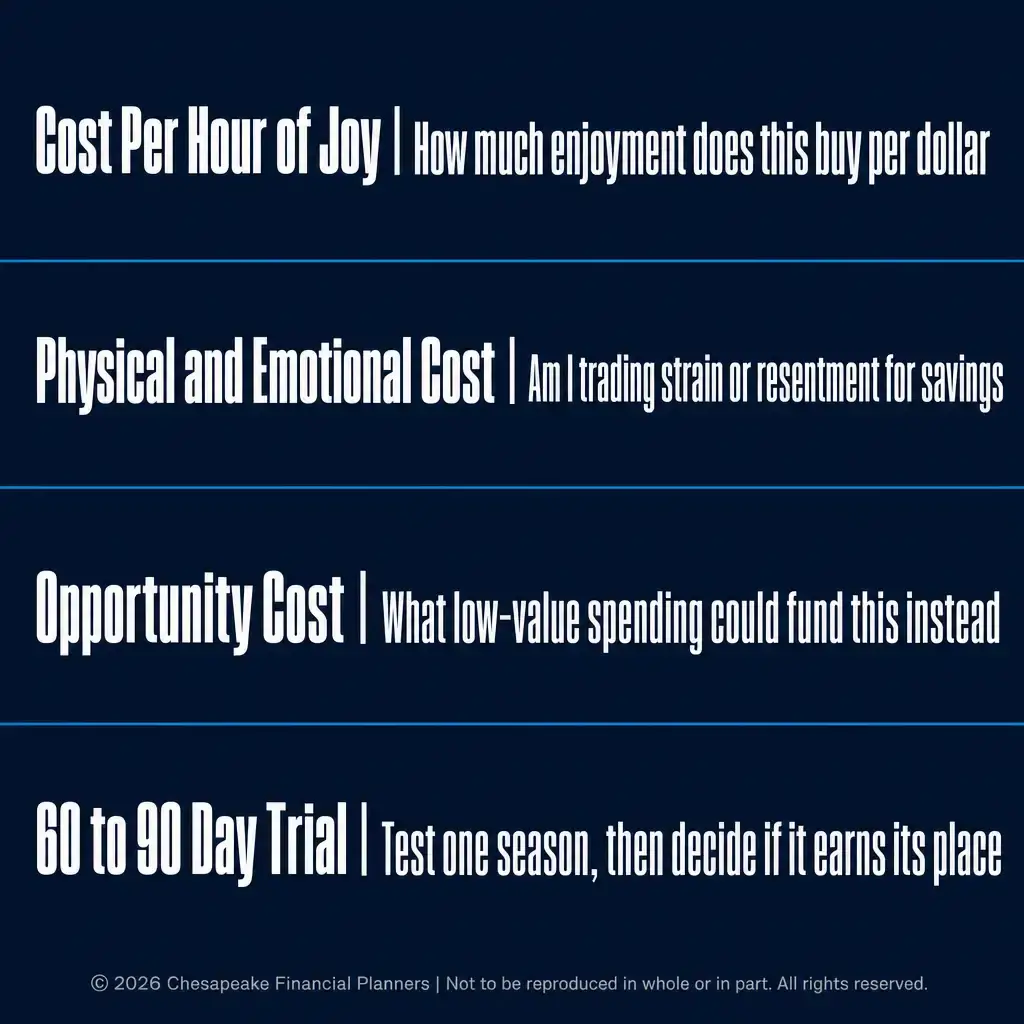
Weigh every upgrade as an investment in the quality of your time, not just another purchase. I give clients four questions to run before they spend:
| Decision test | Question to ask | What it reveals |
|---|---|---|
| Cost per hour of joy | How many hours of enjoyment or relief does this buy per dollar? | Whether the price is small next to the payoff |
| Physical and emotional cost | Am I "saving" money by taking on strain, risk, or resentment? | Hidden costs a budget does not show |
| Opportunity cost | What low-value spending could I redirect to fund this? | Turns a splurge into a reallocation |
| 60 to 90 day trial | If I test this for a season, do I still value it? | Separates a real upgrade from an impulse |
The trial period is the piece people skip. Hire the lawn service for one summer. Set up the creative space with modest equipment. Join the class for a quarter. If it still earns its place after 60 to 90 days, keep it; if not, you have lost very little. Using money on purpose to support the retirement you envisioned is the entire point.
How does intentional spending fit into a Maryland retirement income plan?
Intentional spending only works when it sits inside a plan that shows what you can actually afford. This is where the reallocation mindset meets the math. At Chesapeake Financial Planners in Forest Hill, we work with retirees across Harford County and the Baltimore metro who face the same underspending psychology, plenty saved, yet frozen by the fear of running short. A plan answers the question their gut cannot: is this upgrade affordable, given your income sources, taxes, and time horizon?
That is the job of the R.U.D.D.E.R. Method™, Chesapeake Financial Planners' six-step planning process: Review and Recognize, Uncover and Understand, Design and Develop, Discuss and Decide, Execute and Empower, and Reassess and Refine. It turns a vague worry about spending into a set of numbers you can act on.
When a client sees, in black and white, that a $5,000-a-year travel budget still leaves them on track at 90, the permission to spend takes care of itself. Jeff Judge has watched that single shift change how people live in retirement, from rationing to enjoying, without derailing the plan. A retirement income plan and a sensible retirement spending strategy do more for quality of life than any single gadget, because they tell you which upgrades you have already earned. Finding purpose in retirement is often what these upgrades are really about.
Frequently Asked Questions
Is it financially safe to spend more in early retirement?
Spending more in early retirement can fit your plan when your withdrawal rate stays sustainable and your income sources cover the essentials. The research shows retirees err toward underspending far more often than overspending. The way to know your own limit is a written plan that models your spending against longevity, taxes, and market ups and downs, rather than gut feel.
What is the difference between a reallocation and a splurge?
A reallocation moves dollars you already spend from low-value habits toward things that raise your quality of life, while a splurge adds a brand-new cost on top of your budget. Reframing an upgrade as a reallocation, funding a travel budget by cutting unused subscriptions, for example, removes much of the guilt that stops retirees from spending intentionally.
How much should I budget for a home office or creative space in retirement?
A modest home office or creative space often costs, as an example, $1,000 to $3,000 for a desk, lighting, storage, and basic equipment. Start small and spend more only if you still use the space nearly every day after a few months. The value is not the furniture; it is the structure and identity the space restores when work ends.
Is outsourcing tasks in retirement worth the cost?
Outsourcing tasks in retirement is worth it when the hours and physical strain you reclaim outweigh the price. Compare the annual cost to the time saved, then add the hidden costs of injury risk and mental load. A low-risk approach is to hire help for one season and outsource only the chore you least enjoy.
Why does social connection matter so much for retirement spending?
Social connection matters because isolation is one of retirement's hidden health risks, and spending to stay connected can pay off in wellbeing. The National Institute on Aging links social isolation to a higher risk of dementia and heart disease among older adults. A modest membership that builds a weekly routine is one of the higher-return upgrades you can make.
Ready to spend on the retirement you envisioned?
The retirement lifestyle upgrades worth the money are the ones a solid plan tells you that you can afford, and the ones you will still value 90 days from now. Jeff Judge and the Chesapeake team serve families and business owners across Harford County and the Baltimore metro. Schedule a free fit callt here to put a plan around the life you want.
A version of this article originally appeared in Kiplinger.
Disclosures
The information provided is for educational purposes only and should not be construed as investment advice. Investment strategies should be tailored to individual circumstances, risk tolerance, and goals. Past performance doesn't guarantee future results. Consult with qualified financial professionals regarding your specific situation.
Advisors associated with Chesapeake Financial Planners may be either (1) LPL Financial Registered Representatives offering securities through LPL Financial, Member FINRA and SIPC, and investment advisor representatives offering investment advice through Great Valley Advisor Group; or (2) solely investment advisor representatives offering investment advice through Great Valley Advisor Group and not affiliated with LPL Financial. Great Valley Advisor Group, and Chesapeake Financial Planners are separate entities from LPL Financial.
Chesapeake Financial Planners | 2402 Scotlon Ct, Forest Hill, MD 21050 | (410) 652-7868 | www.chesapeakefp.com
© 2026 Chesapeake Financial Planners | Not to be reproduced in whole or in part. All rights reserved.


