
How Do You Read Financial Statements for Investment Decisions?
Last reviewed: July 2026
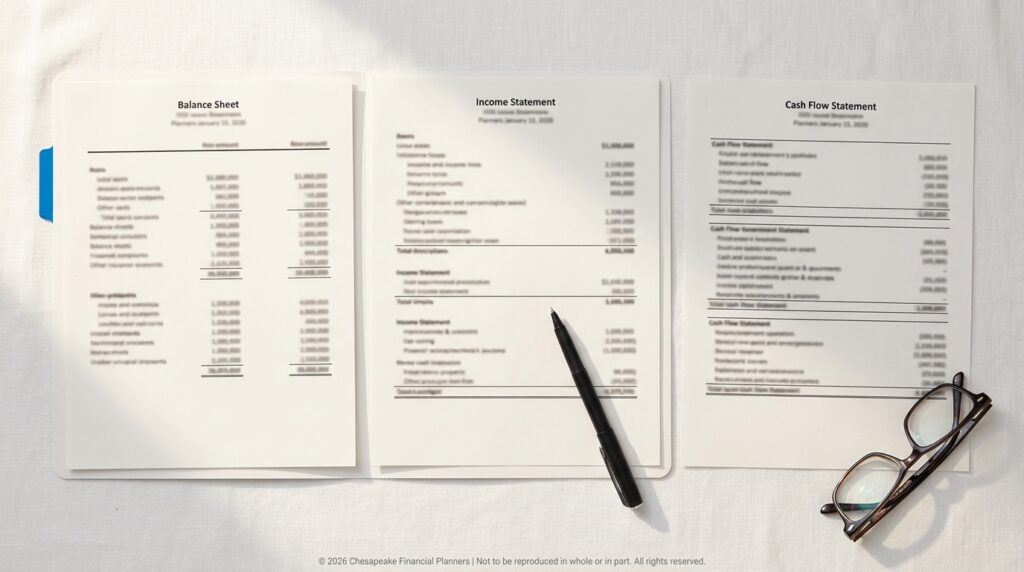
To read financial statements for investment decisions, you start with three documents: the balance sheet (what a company owns and owes), the income statement (whether it made money), and the cash flow statement (whether cash actually moved). Read together, they tell you if a business is profitable, solvent, and generating real cash. Most people learn to read financial statements right after a major money event, when the stakes are highest and the learning curve feels steepest.
Key Takeaways
- The three core financial statements are the balance sheet, the income statement, and the cash flow statement, and each answers a different question.
- The balance sheet always follows one equation: Assets equal Liabilities plus Equity.
- Public companies file these statements with the SEC, where over 2 million filings are submitted annually as of 2026.
- A company can show profit on its income statement while running out of cash, which is why the cash flow statement matters most.
- Financial ratios turn raw numbers into comparisons you can act on.
About the Author: Jeff Judge, CFP®, AEP®, ChFC®, CLU® is Managing Partner of Chesapeake Financial Planners in Forest Hill, Maryland. He has been helping families and business owners in Harford County and the Baltimore metro area read financial statements and evaluate investment opportunities since earning his CFP® certification in 2013, by using Chesapeake Financial Planners’ signature process, the R.U.D.D.E.R. method™. Jeff often sees clients who just sold a business or inherited a portfolio assume the numbers are someone else's job. They are not. The people who learn to read these three statements make better decisions and get talked into fewer bad ones.
Whether you just sold your business, received an inheritance, or are weighing an investment during a career transition, the ability to read financial statements protects your wealth. Financial statements look intimidating. Unfamiliar terms, dense formatting, columns of numbers. But like a nutrition label, once you know what each line means, they tell a clear story.
What Are the Three Core Financial Statements?
Every business produces three fundamental financial statements. Together they give you a complete picture of financial position and performance. According to the SEC's beginner's guide, these statements let you "find out about the financial condition of a company in which you might want to invest."
Here is what each one answers:
| Statement | Question it answers | Time frame |
|---|---|---|
| Balance Sheet | What does the company own and owe? | A single point in time |
| Income Statement | Did the company make money? | A period (quarter or year) |
| Cash Flow Statement | Where did the cash actually go? | A period (quarter or year) |
The mistake I see most often is reading just one of these in isolation. A glowing income statement means little if the cash flow statement shows the business is bleeding cash. You need all three to see the truth.
How Do You Read a Balance Sheet?
The balance sheet shows what a company owns (assets), what it owes (liabilities), and the difference between them (equity) at a specific date. Think of it as a financial photograph taken on one day.
One equation always holds true: Assets = Liabilities + Equity. If those two sides do not balance, something is wrong with the statement.
Assets are resources the company controls, split into current assets (convertible to cash within a year) and long-term assets:
- Cash and cash equivalents
- Accounts receivable (money customers owe)
- Inventory
- Property, plant, and equipment
- Intangible assets like patents and goodwill
Liabilities are obligations the company owes, also split into current (due within a year) and long-term:
- Accounts payable (money owed to suppliers)
- Short-term debt
- Accrued expenses like wages and taxes owed
- Long-term debt such as bonds and mortgages
Equity is the owners' stake: what would remain if every asset were sold and every debt paid. It includes common stock, retained earnings (cumulative profits kept in the business), and additional paid-in capital. When you read a balance sheet for an investment decision, the first thing to check is whether current assets comfortably exceed current liabilities. If they do not, the company may struggle to pay near-term bills. Jeff Judge notes: "Before I look at anything else on a balance sheet, I want to know whether current assets cover current liabilities, because a company with great long-term assets can still run out of cash to pay next month's bills."
How Do You Read an Income Statement?
The income statement, also called the profit and loss statement, shows financial performance over a period, usually a quarter or year. It answers one question: did the company make money or lose it? Income statement analysis follows a top-to-bottom logic that strips costs away from revenue until you reach the bottom line.
Here is the structure:
- Revenue: money earned from selling products or services
- Minus Cost of Goods Sold: the direct cost to produce what was sold
- Equals Gross Profit
- Minus Operating Expenses: salaries, rent, marketing, research
- Equals Operating Income: profit from core operations
- Plus or Minus Other Income and Expenses: interest, investment gains or losses
- Minus Income Taxes
- Equals Net Income: the bottom-line profit or loss
Net income reveals profitability and whether revenue is growing or shrinking. But profit on paper does not always mean cash in the bank. A company can book a large sale, report the profit, and still wait months to collect the cash. That gap is exactly why the third statement exists.
How Do You Read a Cash Flow Statement?
The cash flow statement reconciles net income with the actual cash that moved during the period. It shows where cash came from and how it was spent, split into three categories:
- Operating activities: cash generated by the core business
- Investing activities: cash spent on or earned from assets like equipment or acquisitions
- Financing activities: cash from borrowing, repaying debt, issuing stock, or paying dividends
This is the reality check. A profitable-looking business with consistently negative operating cash flow is a warning sign. The Financial Industry Regulatory Authority (FINRA) reminds investors that understanding a company's financials is a basic part of evaluating any stock. When I walk a client through a potential business purchase, the cash flow statement is the one I read first, because it is the hardest to dress up.
This kind of step-by-step diagnosis mirrors how we work through a client's full financial picture using the R.U.D.D.E.R. Method™, Chesapeake Financial Planners' six-step planning process: Review and Recognize, Uncover and Understand, Design and Develop, Discuss and Decide, Execute and Empower, and Reassess and Refine.
What Financial Ratios Should You Calculate?
Raw numbers mean little until you compare them. Financial ratios turn the three statements into signals you can act on:
- Current ratio (current assets divided by current liabilities): measures short-term solvency. Above 1.0 generally means the company can cover near-term bills.
- Debt-to-equity ratio (total liabilities divided by equity): shows how much the company relies on borrowing.
- Gross margin (gross profit divided by revenue): shows pricing power and production efficiency.
- Net profit margin (net income divided by revenue): shows how much of each dollar of sales becomes profit.
Compare these ratios against the company's own prior years and against competitors. A single ratio in isolation tells you almost nothing. The trend tells you the story.
If you are doing this analysis because of an inheritance, a buyout, or a business sale, the numbers are only part of the decision. Building a strong What are the fundamentals of personal financial planning? gives you the context to know what these statements mean for your own situation. And before you commit inherited funds, it helps to understand the What behavioral biases most commonly hurt investment decisions and how do you fix them?, because the biggest risk is often the decision, not the spreadsheet.
Frequently Asked Questions
What are the three main financial statements?
The three main financial statements are the balance sheet, the income statement, and the cash flow statement. The balance sheet shows what a company owns and owes at a point in time, the income statement shows profit or loss over a period, and the cash flow statement shows the actual cash that moved during that period.
Which financial statement is most important for investors?
No single statement is most important, because each answers a different question, but the cash flow statement is often the hardest to manipulate. A company can report strong profits on its income statement while running short on cash. Reading all three together gives you the complete and honest picture of a company's health.
How do you tell if a company is financially healthy?
A financially healthy company generally has current assets that exceed current liabilities, positive and growing operating cash flow, manageable debt relative to equity, and stable or rising profit margins. Check these signals across several years rather than a single period, since one strong quarter can mask a deteriorating trend underneath.
Can a profitable company still run out of cash?
Yes, a profitable company can absolutely run out of cash. Profit is recorded when a sale is made, but cash may not arrive for months if customers pay slowly or inventory ties up funds. This is why the cash flow statement exists and why reviewing it is essential before any investment or business purchase decision.
Do I need an accounting background to read financial statements?
No, you do not need an accounting background to read financial statements at a useful level. Learning the purpose of each statement, the basic structure, and a handful of ratios gives most investors enough to evaluate opportunities and ask sharper questions. Financial literacy is a learnable skill, not a credential reserved for accountants.
Where can I find a public company's financial statements?
You can find a public company's financial statements for free on the SEC's EDGAR database, where companies file annual reports (Form 10-K) and quarterly reports (Form 10-Q). These filings include audited statements and management discussion, giving you the same source data professional analysts use.
A plain-English foundation puts your next investment decision on firmer ground. Start with the statements companies are required to file, and build from there.
Disclosures
The information provided is for educational purposes only and should not be construed as investment advice. Investment strategies should be tailored to individual circumstances, risk tolerance, and goals. Past performance doesn't guarantee future results. Consult with qualified financial professionals regarding your specific situation.
Advisors associated with Chesapeake Financial Planners may be either (1) LPL Financial Registered Representatives offering securities through LPL Financial, Member FINRA and SIPC, and investment advisor representatives offering investment advice through Great Valley Advisor Group; or (2) solely investment advisor representatives offering investment advice through Great Valley Advisor Group and not affiliated with LPL Financial. Great Valley Advisor Group, and Chesapeake Financial Planners are separate entities from LPL Financial.


