

What Is the Difference Between Qualified and Ordinary Dividends?
Last reviewed: July 2026
Qualified dividends are taxed at the lower long-term capital gains rates (0%, 15%, or 20%), while ordinary dividends are taxed at your regular income tax rate, which can run as high as 37%. The difference comes down to who paid the dividend and how long you held the stock. For a high earner, that distinction can mean paying 15% instead of 35% on the same dollar of dividend income, and the gap on a sizable taxable portfolio adds up fast. Understanding qualified dividends vs ordinary dividends is one of the simplest ways to keep more of what your investments pay you.
Key Takeaways
- Qualified dividends are taxed at long-term capital gains rates of 0%, 15%, or 20% depending on your taxable income.
- Ordinary dividends are taxed at your regular income rate, which tops out at 37% in 2026 per the IRS.
- To qualify, you must hold the stock more than 60 days during a specific 121-day window around the ex-dividend date.
- REITs, MLPs, and money market funds almost always pay ordinary dividends, never qualified ones.
- High earners may also owe the 3.8% Net Investment Income Tax on dividend income on top of the base rate.
About the Author: Jeff Judge, CFP®, AEP®, ChFC®, CLU® is Managing Partner of Chesapeake Financial Planners in Forest Hill, Maryland. He has been helping families and business owners in Harford County and the Baltimore metro area navigate investment tax decisions since earning his CFP® certification in 2013, by using Chesapeake Financial Planners’ signature process, the R.U.D.D.E.R. method™. Jeff sees the same thing every spring: investors who built a portfolio for yield without ever checking whether that yield would be taxed at 15% or 35%, and the surprise costs them real money.
What Is a Dividend and Why Does Its Tax Status Matter?
A dividend is a payment a company makes to its shareholders, usually out of profits. You own a slice of the business, the business makes money, and it sends some of that cash back to you. Mature, profitable companies like Coca-Cola, Johnson & Johnson, and ExxonMobil pay dividends every quarter. Many fast-growing companies pay nothing and reinvest instead.
Here's the part most people miss. You owe tax on dividends in the year you receive them, even if you automatically reinvest every dollar back into more shares. The IRS does not care that you never touched the cash. The dividend hit your account, so it counts as income.
What makes the tax status matter is the size of the spread. The same $10,000 in dividends can cost you $1,500 or $3,700 in federal tax depending on one classification. That is not a rounding error. On a $1 million taxable portfolio yielding 3%, the difference between qualified and ordinary treatment can swing your tax bill by several thousand dollars a year.
How Should I Place Investments Across Taxable and Retirement Accounts?
How Are Qualified Dividends Taxed in 2026?
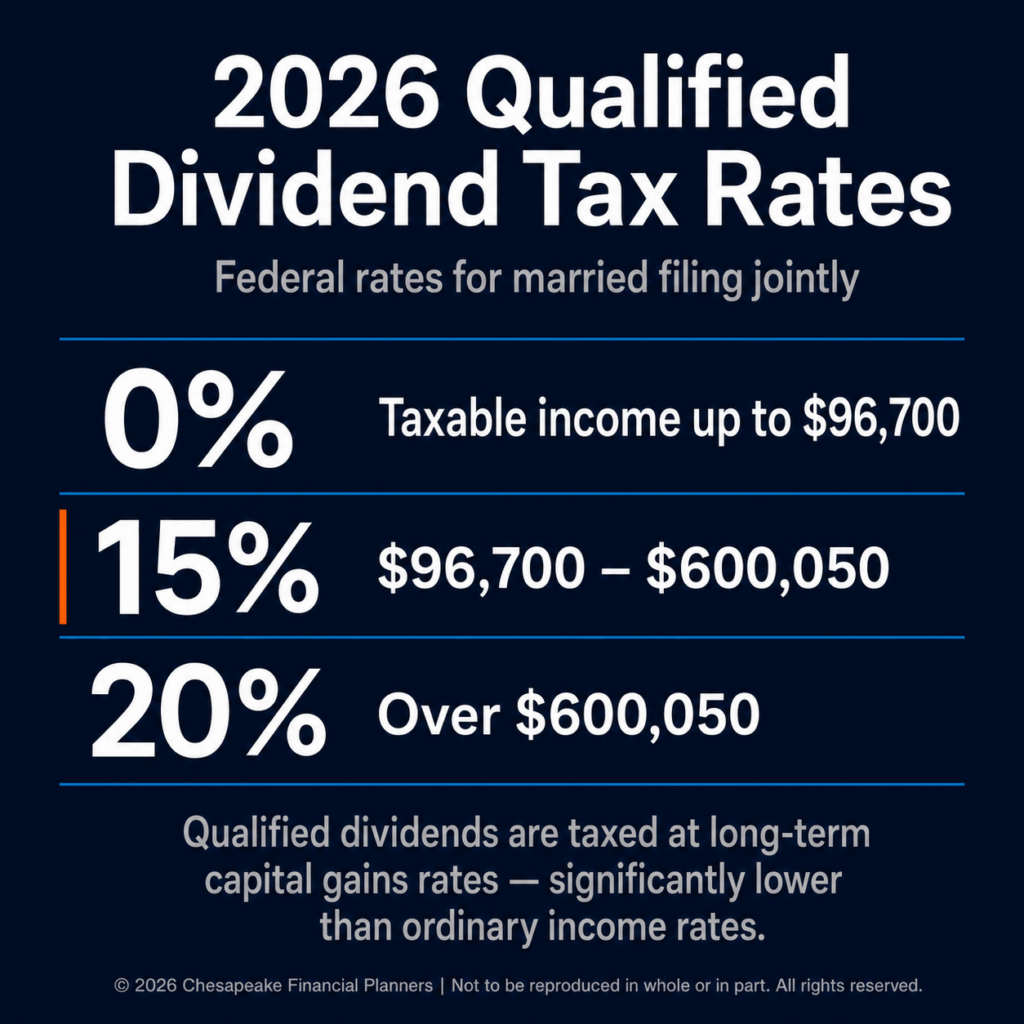
Qualified dividends get the favorable long-term capital gains treatment. According to the IRS, the 2026 rates break down into three tiers based on your taxable income:
| Rate | Married Filing Jointly | Single Filer |
|---|---|---|
| 0% | Taxable income up to ~$98,900 | Taxable income up to ~$49,450 |
| 15% | Roughly $98,901 to $613,700 | Roughly $49,451 to $545,500 |
| 20% | Taxable income above $613,700 | Taxable income above $545,500 |
For most investors, qualified dividends land at the 15% rate. Compare that to ordinary income rates, which run 22%, 24%, 32%, 35%, or 37% for middle- and high-income earners, and the appeal is obvious.
A quick example. You receive $10,000 in qualified dividends and your marginal ordinary rate is 32%. At the 15% qualified rate you owe $1,500. If those same dollars were ordinary dividends, you would owe $3,200. That is a $1,700 difference on one line of your tax return, every single year you hold the position.
Jeff Judge often tells clients that the qualified dividend rate is one of the best deals left in the tax code for people who invest in regular stocks. You do not have to do anything fancy to get it. You just have to know the rules and not trip over them.
How Are Ordinary Dividends Taxed?
Ordinary dividends, sometimes called non-qualified dividends, are taxed exactly like your salary, your bonus, or your freelance income. There is no preferential rate. Whatever your marginal tax bracket is, that is what your ordinary dividends cost you.
If you sit in the 32% bracket, ordinary dividends cost 32% in federal tax. Add a state income tax and, for high earners, the 3.8% Net Investment Income Tax, and the effective rate on that income can climb past 40%. The IRS applies the NIIT once your modified adjusted gross income crosses $250,000 for married filing jointly or $200,000 for single filers.
Take the same $10,000 in dividends from the earlier example, but this time they are ordinary. At a 32% rate you owe $3,200 in federal tax, more than double the $1,500 you would pay on qualified dividends. That gap is the entire reason this classification deserves your attention.
What Is the Difference Between Marginal and Effective Tax Rate?
What Makes a Dividend Qualified?
A dividend earns qualified status only if it clears two separate hurdles. Miss either one and the dividend is taxed as ordinary income, full stop.
Hurdle one: the paying company must be eligible. The dividend has to come from a U.S. corporation, or from a foreign corporation that either trades on a major U.S. exchange or is based in a country with a tax treaty with the United States. Most dividends from large U.S. and developed-market international stocks clear this bar without any effort on your part.
Some payers can never produce qualified dividends. The IRS lists the common exceptions, and these almost always pay ordinary dividends:
- Real Estate Investment Trusts (REITs)
- Master Limited Partnerships (MLPs)
- Money market funds
- Certain preferred stocks
- Dividends paid by tax-exempt organizations
This is why REIT-heavy portfolios often carry a higher tax drag than investors expect. The yield looks attractive on paper, but a big chunk of it gets taxed at ordinary rates.
Hurdle two: you must satisfy the holding period. You have to hold the stock for more than 60 days during the 121-day window that starts 60 days before the ex-dividend date. The ex-dividend date is the cutoff by which you must own the shares to receive that dividend.
The rule exists to stop dividend stripping, where someone buys a stock right before the ex-dividend date, grabs the payout, and dumps it the next day expecting the low rate. The IRS says no. You have to actually own the position for a meaningful stretch.
In Jeff's experience, the holding period trips up active traders far more than buy-and-hold investors. If you are rebalancing aggressively or trading around earnings, check your holding periods before you assume your dividends are qualified.
How Can I Reduce Capital Gains Taxes on My Investments?
How Do You Know Which Dividends You Received?
Your brokerage reports it all on Form 1099-DIV. Box 1a shows your total ordinary dividends, and Box 1b shows the portion of that total which is qualified. Box 1b is a subset of Box 1a, not a separate amount, so do not add them together.
When you file, the qualified amount in Box 1b flows to the preferential rate calculation, while everything else in Box 1a that is not qualified gets taxed as ordinary income. Most tax software handles the split automatically, but it pays to glance at the form. If you hold REITs or recently bought into a dividend payer, the qualified portion may be smaller than you assumed.
Jeff has watched clients build an entire retirement income plan around a dividend yield number without ever opening the 1099-DIV to see how much of that yield survives taxes. The after-tax yield is the number that actually matters.
How can I potentially optimize my taxes as my income grows?
Frequently Asked Questions
Are REIT dividends qualified or ordinary?
REIT dividends are almost always ordinary dividends, taxed at your regular income rate rather than the lower capital gains rate. This is because REITs pass income through to shareholders without paying corporate tax first. A portion may qualify for the 20% pass-through deduction, but the base dividend itself is ordinary income.
What is the holding period for qualified dividends?
You must hold the stock for more than 60 days during the 121-day period that begins 60 days before the ex-dividend date. For preferred stock paying dividends tied to periods over 366 days, the requirement extends to more than 90 days within a 181-day window. Selling too soon converts an otherwise qualified dividend into an ordinary one.
Do I pay tax on dividends I reinvest?
Yes, you owe tax on dividends in the year you receive them even if you automatically reinvest every dollar. The IRS treats a reinvested dividend the same as cash you took out. Your brokerage still reports it on Form 1099-DIV, and you still owe the appropriate qualified or ordinary tax on the full amount.
What is the tax rate on qualified dividends in 2026?
Qualified dividends are taxed at 0%, 15%, or 20% in 2026 depending on your taxable income, matching the long-term capital gains brackets per the IRS. Most investors pay 15%. High earners may also owe the 3.8% Net Investment Income Tax on top, pushing the effective federal rate to roughly 23.8%.
How are ordinary and qualified dividends reported on the 1099-DIV?
Form 1099-DIV reports total ordinary dividends in Box 1a and the qualified subset in Box 1b. Box 1b is part of Box 1a, not a separate figure, so you never add them together. The qualified portion receives the lower capital gains rate, while the remaining ordinary portion is taxed at your regular income rate.
Putting This to Work in Your Portfolio
The qualified versus ordinary distinction is not just trivia for tax season. It shapes where you should hold which investments, how aggressively you can trade without losing the low rate, and how much of your stated yield you actually keep. If you want a clearer picture of how dividend taxation fits into your full plan, our guide on tax-efficient investing walks through the strategies high earners use to cut their drag. Download it at chesapeakefp.com.
Want to go deeper? Our Tax Strategy Readiness Quiz walks through this step by step.
Disclosures
The information provided is for educational purposes only and should not be construed as investment advice. Investment strategies should be tailored to individual circumstances, risk tolerance, and goals. Past performance doesn't guarantee future results. Consult with qualified financial professionals regarding your specific situation.
Dividend payments are not guaranteed and may be reduced or eliminated at any time by the company.
This information is not intended to be a substitute for specific individualized tax, investment or legal advice. We suggest that you discuss your specific situation with a qualified tax, legal or financial advisor.
Advisors associated with Chesapeake Financial Planners may be either (1) LPL Financial Registered Representatives offering securities through LPL Financial, Member FINRA and SIPC, and investment advisor representatives offering investment advice through Great Valley Advisor Group; or (2) solely investment advisor representatives offering investment advice through Great Valley Advisor Group and not affiliated with LPL Financial. Great Valley Advisor Group, and Chesapeake Financial Planners are separate entities from LPL Financial.


