

How Are NQSOs Taxed in an Exercise-and-Hold Strategy?
Last reviewed: July 2026
In an NQSO exercise and hold strategy, the tax is set the day you exercise, not the day you sell. The moment you exercise a non-qualified stock option, the spread between your strike price and the stock's fair market value becomes ordinary compensation income, taxed at your regular rate whether or not you sell a single share. Holding afterward starts a long-term capital gains clock on future appreciation, but it does nothing to change the bill you already triggered. That is the trap: if the stock falls, you can owe tax on a paper gain that no longer exists.
Key Takeaways
- With an NQSO, the bargain element is taxed as ordinary income at exercise, reaching the top 37% federal rate before state tax.
- High earners also face the 3.8% Net Investment Income Tax on investment gains once income clears the threshold.
- Employers usually withhold at the 22% supplemental wage rate, often 10 to 15 points below a top earner's real marginal rate.
- Exercise-and-sell recognizes the same income but converts it to cash, funds the tax, and ends the single-stock concentration.
About the Author: Jeff Judge, CFP®, AEP®, ChFC®, CLU® is Managing Partner of Chesapeake Financial Planners in Forest Hill, Maryland. He has helped families and business owners across Harford County and the Baltimore metro area work through equity compensation decisions since earning his CFP® certification in 2013, using Chesapeake's signature process, the R.U.D.D.E.R. Method™. "The mistake I see most is treating an NQSO like a share you already own," Jeff says. "It is not. It is a tax event with a stock attached, and the tax comes due whether the stock cooperates or not."
What actually gets taxed when you exercise an NQSO?
When you exercise a non-qualified stock option, the difference between your strike price and the fair market value that day is the bargain element, and it is taxed as ordinary compensation income. Not capital gains. The same bucket as your salary, climbing to the top federal ordinary-income rate of 37% for the highest earners before state tax and the 3.8% Net Investment Income Tax enter the picture.
That income is recognized at exercise, full stop. Your employer reports it on your W-2 and withholds something against it, usually not enough. This is the part that catches people who assume an option behaves like an ISO, where the regular-tax event can wait until sale. An NQSO gives you no such grace.
Does exercising an NQSO create taxable income even if you never sell? Yes. The taxable event is the exercise itself, not the eventual sale. The bargain element lands on your W-2 for the year you exercise, so you owe ordinary-income tax on it that April even if every share is still sitting in your brokerage account untouched.
Why does exercise-and-hold lock in a tax bill that can vanish?
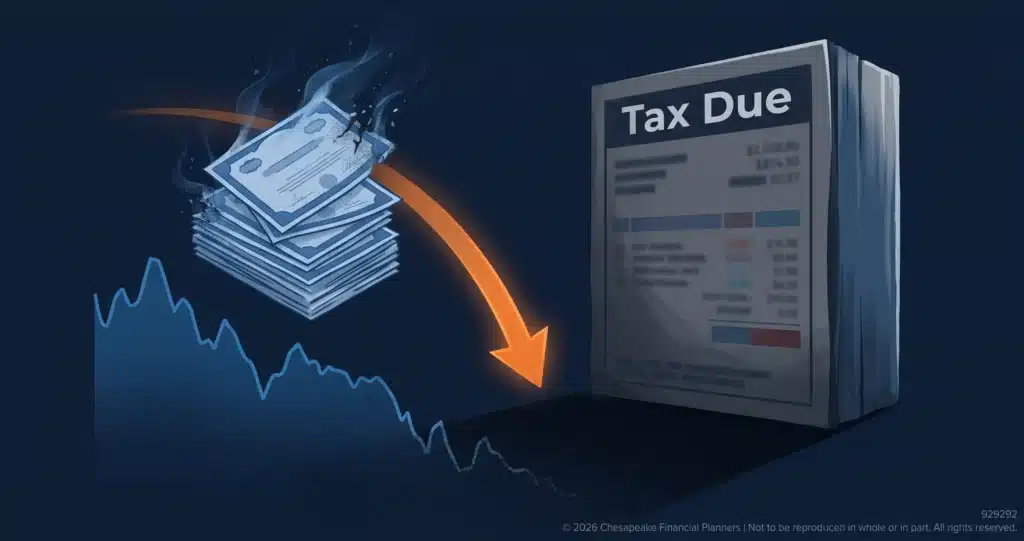
Because the tax is fixed at exercise while the stock keeps moving. Say you exercise 10,000 options with a $5 strike when the stock trades at $50. You have just created $450,000 of ordinary income, owed for the year you exercised. Now the stock slides to $25. You are holding shares worth $250,000 and you owe tax as if you made $450,000. The gain the IRS is billing you for evaporated, but the bill did not.
People hold after exercising for one reason: to start the clock on long-term capital gains treatment, which applies only to appreciation above the exercise-date value, and only after more than a year. That can pay off if the stock holds or rises. But it stacks two risks at once. You have paid ordinary-income tax in cash, and you have kept a large position concentrated in one company while you wait to see whether the bet works.
As Jeff Judge, CFP® frames it for clients weighing the hold:
"In my experience, the whole decision comes down to whether you can stomach being wrong about the stock while the IRS bills you for a number that no longer exists."

How does exercise-and-sell compare to exercise-and-hold?
For a lot of people, the cleaner path is exercise-and-sell, sometimes on the same day. You recognize the ordinary income either way, because it is baked in at exercise. Selling immediately converts the shares to cash at a known price, funds the tax, and takes the single-stock position off the table. What you give up is the chance at long-term treatment on future appreciation. That is the entire trade.
Here is the same $450,000 exercise run both ways, assuming the stock later drops 30%:
| Factor | Exercise-and-Sell | Exercise-and-Hold |
|---|---|---|
| Ordinary income recognized | ~$450,000 | ~$450,000 (identical) |
| Federal tax to set aside | ~$166,500 at 37%, plus MD state and NIIT | Only 22% withheld, about $99,000 |
| Cash to fund the tax | Sale proceeds cover it | None, unless you sell shares |
| Single-stock position | Sold off at exercise | Full concentration retained |
| If the stock drops 30% | Already in cash, unaffected | Shares worth ~$315,000, still owe on $450,000 |
| Shortfall at filing | None | ~$67,500 federal, before state |
| Trade-off | Gives up LTCG on future gains | Bets the stock rises enough to cover both risks |
The comparison is not close for most households. Exercise-and-hold only wins if the stock rises enough to cover both the concentration risk and the rate difference. When Chesapeake works through this with a client under the R.U.D.D.E.R. Method™, the diversification question and the tax question get separated on purpose, because collapsing them into one gut decision is how people end up holding a falling stock they never would have bought with cash.
Where does the 22% withholding gap come from, and why does Maryland make it worse?
When the bargain element hits your W-2, most companies withhold federal tax at the flat 22% supplemental wage rate on supplemental income up to $1 million, above which a mandatory 37% rate kicks in. If your real marginal rate is 32%, 35%, or 37%, the company just under-withheld by 10 to 15 points on a very large number. On a $450,000 bargain element, the gap between 22% withheld and a 37% real rate is roughly $67,500 of federal tax that nobody set aside, before state tax touches it. If you exercised and held, you may not even have cash from a sale to cover it.
Maryland residents feel this harder. The state's top marginal income-tax rate of 6.5% for 2026 stacks on top of the federal ordinary-income hit, and county income tax piles on above that. None of it is covered by the flat 22% federal withholding, so a Harford County engineer exercising a big block of options can face a five-figure state shortfall on top of the federal one.
Does a cashless exercise fix the withholding gap? No. In a cashless or net exercise, the broker sells just enough shares to cover the strike and the default withholding, and you keep the rest. It solves funding, not the tax rate. The broker still withholds at the supplemental rate, usually well below your real bracket, so you can owe a large balance at filing. The fix is to sell extra shares beyond the default withholding or make an estimated tax payment for the shortfall in the same quarter. Jeff Judge has watched clients treat the 22% line on their pay stub as the whole tax bill, then get a spring surprise that a single estimated payment would have prevented.
When does an NQSO exercise and hold strategy actually make sense?
Holding after exercise defends itself in two situations. The first is a private company you genuinely believe in with a low strike price exercised early, when the spread between strike and fair market value is small, so the ordinary-income hit is small too. The second is when the concentrated position is a small slice of an already-diversified net worth and you can write the tax check without selling anything. What separates these from the version that burns people is the size of the bet relative to your whole balance sheet.
Before you exercise, run four checks. Know your real marginal rate for the year, since a big exercise can push you into a higher bracket. Decide how the tax gets funded first, not after. Separate the diversification decision from the tax decision, because if you would not buy this much employer stock with cash today, holding it after exercise is the same bet with extra steps. And if you also hold incentive stock options, map the AMT and ISO interaction before you layer an NQSO exercise on top, because the two can collide in the same tax year.
This decision shows up constantly in the Baltimore metro corridor we serve. Engineers and program staff around Aberdeen Proving Ground, biotech and life-sciences employees tied to the Johns Hopkins ecosystem, and SaaS professionals across Harford County all tend to hold equity compensation that dwarfs the rest of their savings. For them the NQSO exercise and hold question is rarely about the tax rules in the abstract. It is about whether a single employer's stock should carry that much of their future, a form of concentration risk that outlasts any one exercise. Sorting the NSO versus ISO versus RSU mechanics is step one; sizing the bet against everything else is the real work.
Frequently Asked Questions
Are NQSOs taxed at exercise or at sale?
Non-qualified stock options are taxed at exercise. The bargain element, meaning fair market value minus your strike price, becomes ordinary compensation income the day you exercise and lands on that year's W-2. A later sale only triggers capital gains or losses on movement after the exercise date, not a second tax on the original spread.
What is the bargain element on an NQSO?
The bargain element is the difference between the stock's fair market value on the exercise date and the strike price you pay, multiplied by the number of options exercised. It is taxed as ordinary income, not capital gains. On 10,000 options with a $5 strike exercised at a $50 price, the bargain element is $450,000 of ordinary income.
Why is 22% withholding not enough on a large NQSO exercise?
The 22% flat supplemental wage rate is often 10 to 15 points below a high earner's real marginal rate of 32% to 37%. On a $450,000 bargain element, that gap is roughly $67,500 of unfunded federal tax before any state tax. Selling extra shares or making an estimated payment closes it before filing season.
Is exercise-and-hold ever better than exercise-and-sell?
Exercise-and-hold can win when the exercise-date spread is small, such as an early exercise at a private company, or when the shares are a minor slice of an already diversified net worth you can pay the tax on without selling. Otherwise, exercise-and-sell ends the single-stock concentration and funds the tax at a known price.
Do Maryland residents owe extra tax when they exercise NQSOs?
Yes. Maryland's top state income-tax rate of 6.5% for 2026, plus county income tax, stacks on top of the federal ordinary-income tax at exercise. The flat 22% federal withholding covers none of it, so Harford County and Baltimore-area residents should plan for a state shortfall alongside the federal one when they exercise a large block.
How do ISOs change an NQSO exercise decision?
If you hold incentive stock options alongside NQSOs, the alternative minimum tax can be triggered by ISO exercises in the same year you recognize NQSO ordinary income, compounding your bill. Model both together before exercising either, so a large NQSO exercise does not accidentally push your ISO strategy into an expensive AMT position.
Ready to put a plan around your equity?
An NQSO exercise and hold decision is really two decisions wearing one costume: a tax decision and a diversification decision. Jeff Judge and the Chesapeake team work through both with tech, biotech, and executive families across Harford County and the Baltimore metro every week. Schedule a complimentary fit call at Chesapeake Financial Planners and fund the exercise on purpose, not by accident.
A version of this article was originally published on Jeff Judge's LinkedIn.
Disclosures
The information provided is for educational purposes only and should not be construed as investment advice. Investment strategies should be tailored to individual circumstances, risk tolerance, and goals. Past performance doesn't guarantee future results. Consult with qualified financial professionals regarding your specific situation.
Stock investing includes risks, including fluctuating prices and loss of principal.
The ChFC® is the property of The American College of Financial Services, which reserves sole rights to its use, and is used by permission.
CFP Board owns the marks CFP®, CERTIFIED FINANCIAL PLANNER®, and CFP® (with plaque design) in the U.S.
The CLU® is the property of The American College of Financial Services, which reserves sole rights to its use, and is used by permission.
Advisors associated with Chesapeake Financial Planners may be either (1) LPL Financial Registered Representatives offering securities through LPL Financial, Member FINRA and SIPC, and investment advisor representatives offering investment advice through Great Valley Advisor Group; or (2) solely investment advisor representatives offering investment advice through Great Valley Advisor Group and not affiliated with LPL Financial. Great Valley Advisor Group, and Chesapeake Financial Planners are separate entities from LPL Financial.
Chesapeake Financial Planners | 2402 Scotlon Ct, Forest Hill, MD 21050 | (410) 652-7868 | www.chesapeakefp.com
© 2026 Chesapeake Financial Planners | Not to be reproduced in whole or in part. All rights reserved.


