

What Is on the Financial Checklist for a New Baby?
Last reviewed: July 2026
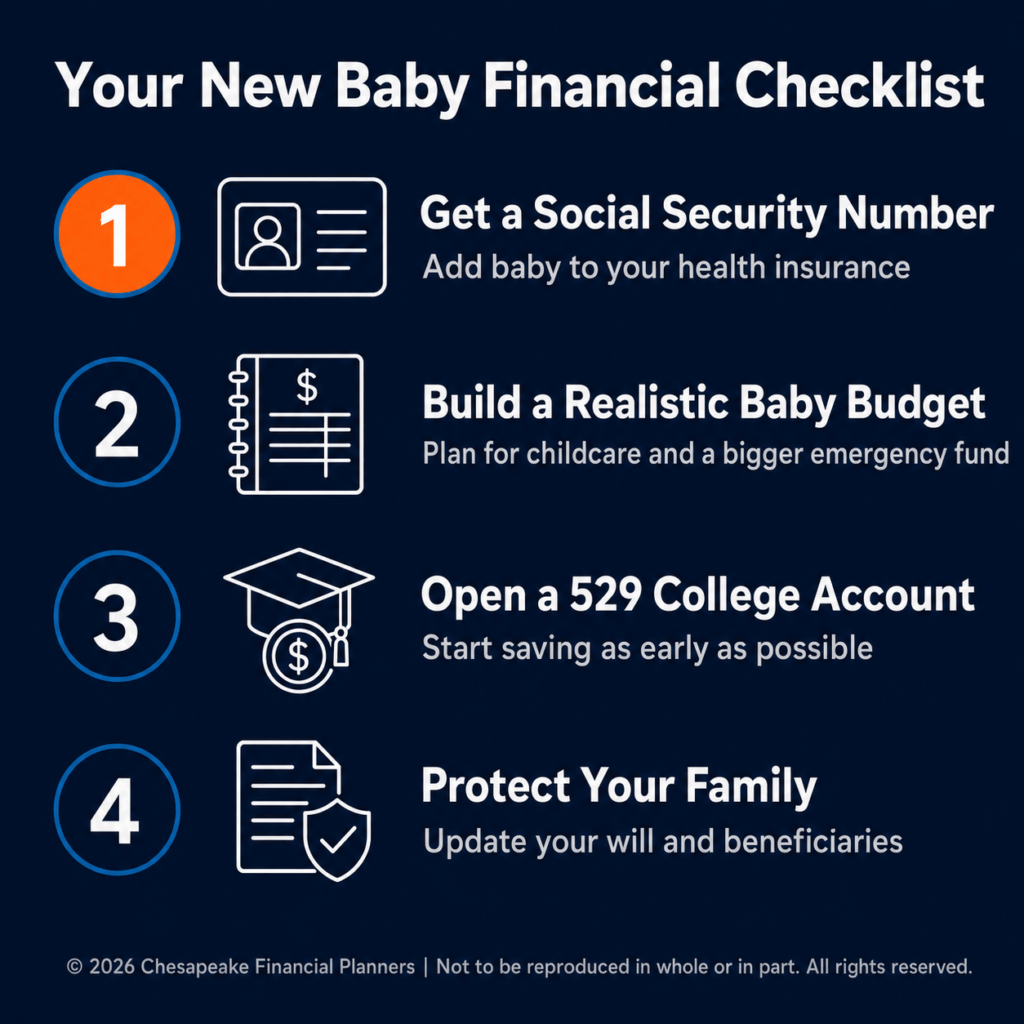
The financial checklist for a new baby starts with five moves: get a Social Security number, add the child to your health insurance within 30 days, build a baby budget, open a 529 college savings account, and update your will and beneficiaries. Do these in the first 90 days and you avoid the most expensive new-parent mistakes. Everything else can wait a few months.
A new baby financial checklist isn't about doing everything at once. It's about doing the right things in the right order, while you're running on four hours of sleep.
Key Takeaways
- The USDA estimates raising a child to age 17 costs roughly $310,605, so early planning matters.
- You can add a newborn to health insurance within 30 days of birth as a qualifying life event.
- A 529 for newborn accounts can grow tax-free for nearly two decades before college.
- The 2026 Child Tax Credit is worth up to $2,200 per qualifying child.
- The 2026 gift tax annual exclusion lets each grandparent give $19,000 per year, tax-free.
About the Author: Jeff Judge, CFP®, AEP®, ChFC®, CLU® is Managing Partner of Chesapeake Financial Planners in Forest Hill, Maryland. He has been helping families and business owners in Harford County and the Baltimore metro area navigate the financial side of growing families since earning his CFP® certification in 2013, by using Chesapeake Financial Planners’ signature process, the R.U.D.D.E.R. method™. Jeff tells new parents the same thing every time: the goal in year one isn't perfection, it's protection.
Step 1: Get a Social Security Number and Update Your Insurance
Your first financial planning new baby task happens before you leave the hospital. Most hospitals let you apply for your baby's Social Security number through the birth registration paperwork. You'll need that number for tax deductions, the Child Tax Credit, and to open any account in the child's name.
Next, call your health insurer. Adding a newborn counts as a qualifying life event, which gives you a window (usually 30 days from birth) to enroll the baby without waiting for open enrollment. Miss that window and you could be paying out of pocket for pediatric visits and well-baby checkups. According to the Social Security Administration, you can request the SSN card right at birth registration, which is the path I recommend over applying separately later.
Jeff Judge has watched parents forget the insurance deadline more than any other item on this list. It's a 10-minute phone call that prevents thousands in surprise bills.
Step 2: Build a Realistic Baby Budget
A baby budget is the second step, and it's where most new parents underestimate. The USDA puts the cost of raising a child to age 17 at roughly $310,605, and that figure doesn't include college. Diapers, formula, childcare, and bigger living space add up fast in the first two years.
Start with the three categories that move the most money: childcare, healthcare, and the loss of income if one parent reduces hours. Childcare alone can rival a mortgage payment in many parts of the country. Build those numbers into your monthly cash flow before the baby arrives, not after.
Then adjust your emergency fund. A family with a newborn should carry three to six months of expenses in cash, and that target just got bigger because your expenses did. If you need a structured way to think through this, How Do I Pay for College Without Ruining My Retirement? covers how to fund big goals without sacrificing your own future.
Step 3: Open a 529 College Savings Account
Opening a 529 for newborn savings is the highest-leverage move on this checklist, because time is the variable that matters most. A dollar invested at birth has roughly 18 years to compound before tuition is due. That's the entire reason to start now instead of "when things settle down."
There is no federal annual contribution limit on a 529, though contributions count as gifts for tax purposes. The 2026 gift tax annual exclusion is $19,000 per person, and 529 plans allow superfunding: you can front-load five years of gifts at once, up to $95,000 from a single contributor in 2026, using the five-year election. Grandparents love this feature.
If you live in Maryland, your state offers a tax deduction for contributions. How do you use a Maryland 529 plan to save on state income taxes? explains exactly how that works. For the mechanics of how these accounts grow and what they cover, see How does a 529 plan work and what are the rules for contributions and withdrawals?. The flexibility has improved, too, because leftover funds can now move to a Roth IRA under new rules, covered in How does the new 529-to-Roth rollover work?. Jeff Judge notes: "Maryland's state deduction makes a 529 even more attractive for local families, and the new Roth rollover option means leftover college savings don't have to sit stranded if your child takes a different path."
This is where the R.U.D.D.E.R. Method™ comes in. The R.U.D.D.E.R. Method™ is Chesapeake Financial Planners' six-step planning process: Review and Recognize, Uncover and Understand, Design and Develop, Discuss and Decide, Execute and Empower, and Reassess and Refine. For new parents, the Design and Develop step is where we decide how much to fund college without shortchanging retirement.
Step 4: Update Your Will, Beneficiaries, and Insurance
This is the step new parents skip, and it's the one that protects the child most. A will names a guardian for your baby. Without one, a court decides who raises your child if something happens to both parents. That decision should be yours, not a judge's.
Update beneficiary designations on your 401(k), IRA, and life insurance to reflect your new family structure. Those forms override your will, so an outdated beneficiary can send money to the wrong place. Then look hard at life insurance. A young family with a single earner often needs far more coverage than the small policy offered through work.
The 2026 Child Tax Credit is worth up to $2,200 per qualifying child, which helps your cash flow but does nothing to protect your family if income disappears. Term life insurance does. As Jeff puts it, life insurance for a new parent isn't an investment, it's a promise that the plan keeps going even if you don't.
Frequently Asked Questions
How much does it cost to raise a child?
Raising a child to age 17 costs roughly $310,605 according to USDA estimates, and that figure excludes college tuition. The largest early expenses are childcare, healthcare, and housing. Most new parents underestimate childcare, which can rival a mortgage payment in high-cost areas. Build these numbers into your monthly budget before the baby arrives.
When should I open a 529 plan for my baby?
Open a 529 plan as soon as your baby has a Social Security number, ideally within the first few months. Time is the most powerful variable in college saving, because money invested at birth has roughly 18 years to grow tax-free. Starting early lets compounding do most of the work for you.
Do I need life insurance after having a baby?
Yes, most new parents need life insurance, especially single-earner households or families with a mortgage. Term life insurance replaces lost income so your family can maintain its lifestyle and fund future goals if a parent dies. Workplace coverage is rarely enough on its own, so review your total coverage need after the birth.
What is the gift tax limit for grandparents contributing to a 529?
For 2026, each grandparent can give up to $19,000 per year per grandchild without filing a gift tax return, under the IRS annual exclusion. A 529 plan also allows superfunding, letting a single contributor front-load up to $95,000 at once using a five-year election. This is a popular way to jump-start a newborn's college fund.
Should I update my will after having a baby?
Yes, update your will right away to name a legal guardian for your child. Without a will, a court decides who raises your child if both parents die. Also update beneficiary designations on retirement accounts and life insurance, since those forms override your will and can send assets to the wrong person.
If your checklist is in order, the next question is usually how to fund college without sacrificing your own retirement. Our free college planning guide walks through the tradeoffs step by step, with the same framework we use with clients. Download it at chesapeakefp.com.
Want to go deeper? Our College Funding Playbook walks through this step by step.
Prefer a different starting point? Our Estate Document Locator is worth a look.
Disclosures
The information provided is for educational purposes only and should not be construed as investment advice. Investment strategies should be tailored to individual circumstances, risk tolerance, and goals. Past performance doesn't guarantee future results. Consult with qualified financial professionals regarding your specific situation.
Prior to investing in a 529 Plan, investors should consider whether the investor's or designated beneficiary's home state offers any state tax or other state benefits such as financial aid, scholarship funds, and protection from creditors that are only available for investments in such state's qualified tuition program. Withdrawals used for qualified expenses are federally tax free. Tax treatment at the state level may vary. Please consult with your tax advisor before investing.
Advisors associated with Chesapeake Financial Planners may be either (1) LPL Financial Registered Representatives offering securities through LPL Financial, Member FINRA and SIPC, and investment advisor representatives offering investment advice through Great Valley Advisor Group; or (2) solely investment advisor representatives offering investment advice through Great Valley Advisor Group and not affiliated with LPL Financial. Great Valley Advisor Group, and Chesapeake Financial Planners are separate entities from LPL Financial.


