

How Do I Maximize My Employer Benefits Package?
Last reviewed: July 2026
To maximize your employer benefits, capture the full 401(k) match first, fund a health savings account if you have a qualifying high-deductible plan, take any discounted stock purchase offer, and right-size your flexible spending account before the enrollment deadline. Most people skim the packet and check a few boxes. That habit leaves real money behind every single year, often several thousand dollars in matched contributions and tax savings you never claimed.
Key Takeaways
- Contributing enough to capture your full 401(k) match is the closest thing to guaranteed free money in personal finance.
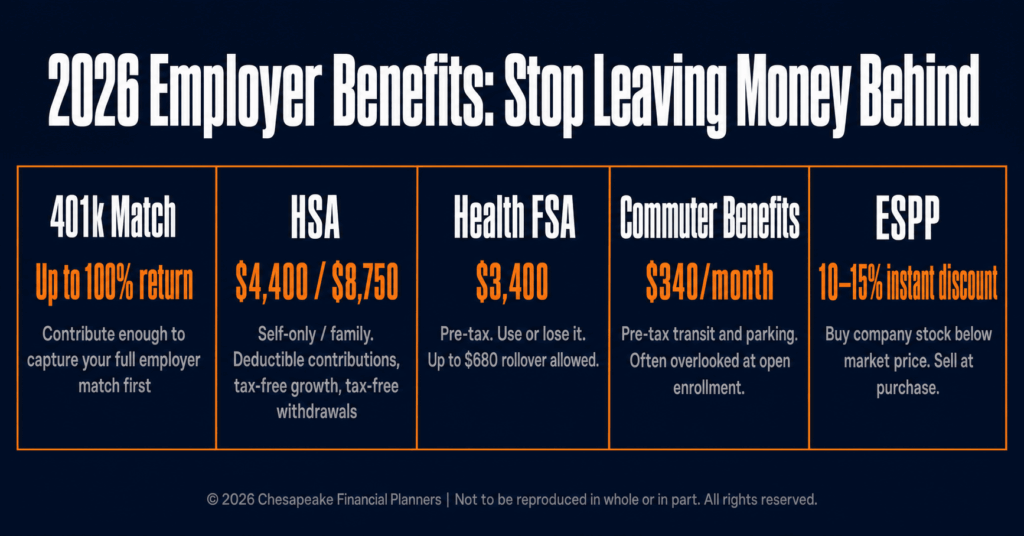
- The 2026 HSA contribution limit is $4,400 for individual coverage and $8,750 for family coverage.
- Employee stock purchase plans often offer a 10% to 15% discount, creating an immediate gain at purchase.
- Flexible spending accounts use pre-tax dollars but carry a use-it-or-lose-it risk, so estimate expenses conservatively.
About the Author: Jeff Judge, CFP®, AEP®, ChFC®, CLU® is Managing Partner of Chesapeake Financial Planners in Forest Hill, Maryland. He has been helping families and business owners in Harford County and the Baltimore metro area navigate employer benefits decisions since earning his CFP® certification in 2013, by using Chesapeake Financial Planners’ signature process, the R.U.D.D.E.R. method™. Jeff often sees high earners obsess over their investment picks while ignoring an unclaimed 401(k) match worth more than any fund could deliver in a year.
A strong benefits package is one of the most overlooked levers in personal finance. The optimization here isn't complicated, but it does require reading the fine print and making a few deliberate choices. Below is how to work through the pieces that matter most.
What Should I Do First With My Employer Benefits?
Start with the 401(k) match, because it is the highest-return decision you will make all year. A typical employer match is 50% on the first 6% of salary, or 100% on the first 3%. That means if you earn $150,000 and your plan matches 50% on the first 6%, contributing $9,000 earns you roughly $4,500 in employer money. Contribute nothing, and you get nothing.
There is no investment that reliably beats an instant 50% to 100% return. According to Fidelity, the average employer match across plans it administers runs close to 4.6% of pay, money that is yours only if you contribute enough to unlock it.
Jeff Judge has watched clients delay capturing their match for years while they paid extra on a 4% car loan. The math almost never favors that trade. At minimum, contribute enough to get the full match before you direct cash anywhere else, including low-interest debt.
What are the fundamentals of personal financial planning?
How Does a Health Savings Account Help Me?
A health savings account is the most tax-efficient account most workers will ever touch, but only if your employer offers a qualifying high-deductible health plan. The HSA carries a triple tax advantage: contributions reduce your taxable income, the balance grows tax-free, and withdrawals for qualified medical expenses are tax-free. No 401(k) or Roth IRA offers all three.
The 2026 HSA contribution limits set by the IRS are $4,400 for individual coverage and $8,750 for family coverage, with an extra $1,000 catch-up contribution available at age 55 and older.
Here is where most people leave value on the table. They contribute to the HSA, then let the cash sit idle earning almost nothing. Instead, invest the balance and pay current medical bills out of pocket if you can. Save your receipts. You can reimburse yourself tax-free years or even decades later. Treated this way, an HSA becomes a stealth retirement account wearing a health insurance disguise.
Are Employee Stock Purchase Plans Worth It?
Yes, an employee stock purchase plan is usually worth enrolling in, because it lets you buy company stock at a discount to market price, typically 10% to 15%. That discount is a built-in gain the moment you buy.
Consider a stock trading at $100 with a 15% discount. You pay $85 per share, an immediate gain of roughly 17.6% on the shares you purchase through payroll deduction. The structure varies by employer, and some plans add a lookback feature that prices your purchase off the lower of two dates, which sweetens the deal further.
The discipline that matters most is what you do after the purchase. Concentration in a single stock, especially your employer's, is a real risk to your financial stability. If your paycheck and your portfolio both depend on the same company, a downturn hits you twice. For most people, the cleaner move is to enroll, contribute toward the maximum, and sell the shares shortly after purchase to lock in the discount. An immediate sale typically triggers ordinary income tax on the discount portion, which trims the gain but rarely eliminates it.
What behavioral biases most commonly hurt investment decisions and how do you fix them?
How Do Flexible Spending Accounts Work?
A flexible spending account lets you set aside pre-tax dollars for medical or dependent care expenses, lowering your taxable income for the year. The 2026 healthcare FSA contribution limit announced by the IRS is $3,400, and the dependent care FSA limit is $7,500 for most filers.
The catch is the use-it-or-lose-it rule. Funds you do not spend by year-end are generally forfeited, though many plans allow a limited carryover or a short grace period into the next year. Because of that risk, estimate your spending conservatively. It is better to slightly under-contribute than to surrender money you never used.
Qualifying expenses are broader than people expect: glasses, contacts, copays, dental work, orthodontics, and daycare all count. If you wear contacts and your kids are in braces, an FSA can shave real dollars off your tax bill with almost no risk of forfeiture.
What About Life and Disability Insurance Through Work?
Employer-provided life and disability insurance is a useful baseline, but it rarely covers a family fully. Group term life coverage often defaults to one or two times salary, which falls short of what most households with dependents actually need. Group long-term disability coverage typically replaces around 60% of income, and benefits paid from employer-funded coverage are usually taxable, leaving you with less than the headline number suggests.
The bigger trap is portability. Most group coverage ends when your job does. Jeff Judge regularly meets clients who assumed their work policy traveled with them, only to discover after a layoff or career change that they were uninsured at the worst possible moment. Treat employer coverage as a foundation, then evaluate whether a separate individual policy belongs on top of it.
How Much Should I Have in My Emergency Fund?
Frequently Asked Questions
How much should I contribute to my 401(k) to get the full employer match?
Contribute at least the percentage your employer matches in full. A common formula is 50% on the first 6% of salary, so contributing 6% captures every available matching dollar. Contributing less leaves guaranteed employer money on the table, which is effectively turning down a raise you already earned.
Is an HSA better than a 401(k) for retirement savings?
An HSA offers a triple tax advantage that no 401(k) can match, making it exceptionally powerful for qualified medical costs in retirement. That said, capture your full 401(k) match first, since the match is free money. After the match, many savers prioritize maxing the HSA before returning to additional 401(k) contributions.
Should I sell my ESPP stock right away?
For most people, selling employee stock purchase plan shares shortly after purchase is the disciplined choice. It locks in the 10% to 15% discount and avoids concentration risk from holding too much of your employer's stock. An immediate sale triggers ordinary income tax on the discount, but the gain usually still comes out ahead.
What happens to my FSA money if I don't use it?
Most flexible spending account funds you fail to spend by year-end are forfeited under the use-it-or-lose-it rule. Some plans allow a limited carryover or a short grace period into the following year. To avoid losing money, estimate your annual medical or dependent care spending conservatively before you enroll.
Does my employer life insurance cover my family fully?
Employer group life insurance rarely covers a family fully, since coverage often defaults to one or two times salary. Households with dependents typically need more. Group coverage also usually ends when your job does, so many families add an individual policy to close the gap and keep protection portable.
If you found this helpful, our free guide to building a complete benefits and savings plan walks through these decisions step by step. Download it at chesapeakefp.com and put a real strategy behind your next enrollment season.
Disclosures
The information provided is for educational purposes only and should not be construed as investment advice. Investment strategies should be tailored to individual circumstances, risk tolerance, and goals. Past performance doesn't guarantee future results. Consult with qualified financial professionals regarding your specific situation.
Advisors associated with Chesapeake Financial Planners may be either (1) LPL Financial Registered Representatives offering securities through LPL Financial, Member FINRA and SIPC, and investment advisor representatives offering investment advice through Great Valley Advisor Group; or (2) solely investment advisor representatives offering investment advice through Great Valley Advisor Group and not affiliated with LPL Financial. Great Valley Advisor Group, and Chesapeake Financial Planners are separate entities from LPL Financial.


