
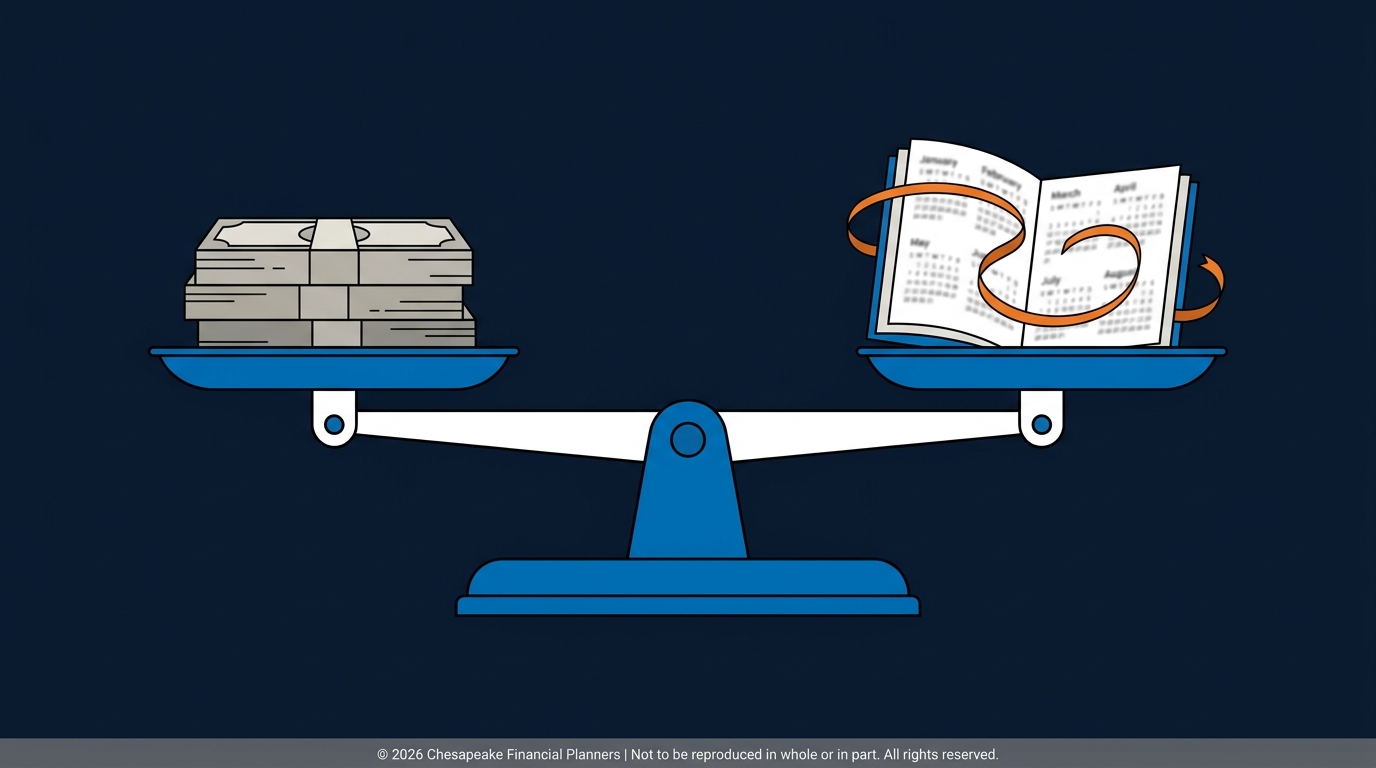
Should I Take a Lump Sum or Installment Payments When Selling?
Last reviewed: July 2026
A lump sum vs installment decision comes down to three things: how much you trust the buyer to keep paying, how the timing affects your tax bill, and whether you need the money now. Take the lump sum when you want certainty and control. Take installments when tax deferral and a higher total payout outweigh the risk of waiting. There is no universally right answer, and the option that feels safest is often the wrong one.
Key Takeaways
- Lump sums eliminate counterparty risk; installments spread tax liability over the payment period under IRS Section 453.
- Installment sale interest charges may apply once deferred gain on an obligation exceeds $5 million, per IRS rules.
- A higher total installment payout must compensate for default risk and the time value of money.
- Buyer financial strength and the quality of your security should drive the decision more than the headline number.
About the Author: Jeff Judge, CFP®, AEP®, ChFC®, CLU® is Managing Partner of Chesapeake Financial Planners in Forest Hill, Maryland. He has been helping families and business owners in Harford County and the Baltimore metro area navigate business sale payment terms since earning his CFP® certification in 2013, by using Chesapeake Financial Planners’ signature process, the R.U.D.D.E.R. method™. Jeff has watched sellers chase the bigger installment number and then spend three years chasing a buyer who stopped paying in year two.
Someone wants to buy your business. They offer two options: $2 million cash at closing, or $2.5 million paid over five years. Which is better? That extra $500,000 looks like free money. Sometimes it is. Sometimes it is bait.
What Is the Difference Between a Lump Sum and an Installment Sale?
A lump sum vs installment sale is a choice between getting all your money at closing versus receiving it across multiple years. A lump sum pays the full purchase price in cash up front, and you owe tax on the entire gain in the year of sale. An installment sale, governed by IRS Section 453, lets you receive at least one payment after the tax year of the sale and report the gain proportionally as you collect.
The mechanics matter. With an installment sale, you calculate a gross profit percentage and apply it to each payment, so you pay tax only on the gain portion you actually receive that year. The buyer also typically pays interest on the unpaid balance, which is taxed as ordinary income separately from your capital gain.
This structure shows up well beyond business sales. Partnership buyouts, severance packages, pension elections, and even lottery payouts present the same core question. The labels change; the math does not.
When Does Taking a Lump Sum Make More Sense?
A lump sum makes more sense when buyer risk, investment control, or immediate liquidity needs outweigh the tax benefits of deferral. The single biggest reason is counterparty risk. When you accept installment payments, you are lending money to the buyer. If they default through business failure or bankruptcy, you become an unsecured creditor fighting for pennies on the dollar.
Default is more common than buyers admit. Cash flow gets stressed in downturns, and buyers routinely overestimate their ability to service the debt they took on to buy you out. A lump sum erases that risk the moment the wire clears.
Lump sums also give you control. If installment terms pay 5% interest but you expect 7% to 8% from a diversified portfolio over time, taking the cash and investing it yourself can build more wealth. You also lock in today's tax rates, which matters if you believe rates or your own bracket will rise later. Jeff Judge often tells business owners that the cleanest exit is the one that does not depend on the buyer's future success.
What happens to my finances after a liquidity event?
When Are Installment Payments the Smarter Choice?
Installment payments are the smarter choice when tax deferral, interest income, and a higher total payout meaningfully outweigh the default risk. Tax deferral under Section 453 functions like an interest-free loan from the IRS. Money you would have paid in tax up front stays invested and compounding while you receive payments over several years.
Spreading income across years can also keep you in lower tax brackets. If a lump sum would push your gain into the highest long-term capital gains rate of 20%, while annual installments keep most of the gain in the 15% bracket, the difference compounds across the payout period. This is most powerful when the sale is your only major income event and you are retiring afterward.
There is a ceiling worth knowing. Under Section 453A, if the deferred gain on outstanding installment obligations exceeds $5 million at year end, the IRS charges interest on the deferred tax for the amount above that threshold. For most small and mid-sized sales this never triggers, but large transactions need to model it.
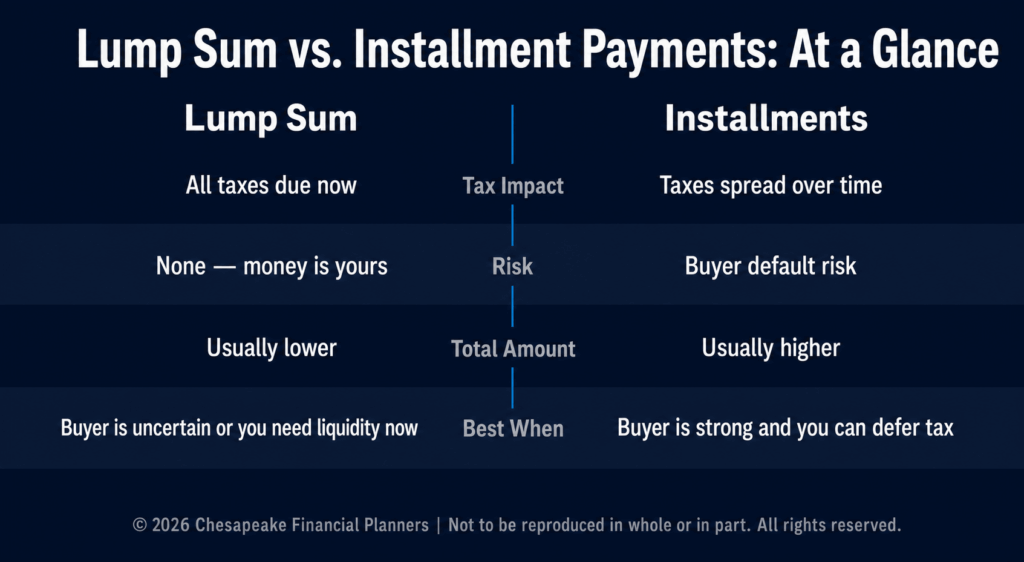
| Factor | Lump Sum | Installment Sale |
|---|---|---|
| Counterparty risk | None after closing | You carry buyer default risk |
| Tax timing | All gain taxed in year of sale | Gain spread over payment years |
| Bracket management | Harder; income spikes | Easier; income smoothed |
| Total payout | Usually lower | Often higher to compensate for risk |
| Interest income | None from buyer | Buyer pays interest on balance |
| Control of capital | Full and immediate | Delayed until payments received |
What happens to my finances after a liquidity event?
How Do You Evaluate Buyer Risk and Security?
You evaluate buyer risk by judging financial strength, then matching the deal structure with security that protects your payments. A strong buyer with an established company, solid financials, and a proven track record makes installments far safer. A leveraged startup planning to pay you out of your own former business cash flow makes a lump sum the defensive play.
Run a simple test Jeff uses with clients: would a bank lend this buyer money on the same terms you are about to extend? If the answer is no, ask yourself why you are comfortable doing it instead. Strong security can change the calculus. A first-position lien on the business assets, a personal guarantee from the buyer, and a confession of judgment all give you recourse if payments stop.
The $500,000 premium in our opening example is a 25% bump over the cash offer. That premium is your compensation for risk and time. Whether 25% is enough depends entirely on the buyer's strength and the quality of your collateral, not on how good the bigger number feels.
What should you do when you suddenly receive a large sum of money?
Frequently Asked Questions
Is a lump sum or installment payment better when selling a business?
Neither is universally better. A lump sum wins when you want certainty, full investment control, and protection from buyer default. Installments win when tax deferral, interest income, and a higher total payout outweigh the risk of waiting years to collect. Your buyer's financial strength is usually the deciding factor.
How does an installment sale reduce my taxes?
An installment sale under Section 453 spreads your capital gain across the years you receive payments instead of taxing the entire gain at once. This can keep you in lower tax brackets each year and defers tax you would otherwise pay immediately, letting that money stay invested and compounding longer.
What is the risk of accepting installment payments?
The main risk is buyer default. When you accept installments, you are effectively lending the buyer money, and if their business fails or they file bankruptcy, you become an unsecured creditor. Strong collateral, a personal guarantee, and a first-position lien reduce this risk but never eliminate it entirely.
Do I pay interest on an installment sale?
The buyer typically pays you interest on the unpaid balance, often between 4% and 8%, taxed as ordinary income separately from your capital gain. On the IRS side, if deferred gain on outstanding obligations exceeds $5 million, Section 453A may charge interest on the deferred tax above that threshold.
Can I take a lump sum if I am worried about taxes increasing?
Yes, and many sellers do exactly that. Taking a lump sum locks in today's capital gains rates and bracket structure. If you expect tax rates or your own income to rise in future years, paying the tax now on the full gain can cost less overall than deferring it into a higher-rate environment later.
What factors matter most in the lump sum vs installment decision?
Buyer financial strength, the quality of your security, your current versus expected future tax brackets, and your need for immediate liquidity matter most. The headline payout number matters least. A 25% premium for installments means little if the buyer cannot make payments past the first year.
If you are weighing a business sale or any major liquidity event, our Wealth Events planning guide walks through the lump sum vs installment decision and the tax questions that follow. Download it at chesapeakefp.com.
Want to go deeper? Our 10 Signs You're Ready for a Certified Financial Planner walks through this step by step.
Disclosures
The information provided is for educational purposes only and should not be construed as investment advice. Investment strategies should be tailored to individual circumstances, risk tolerance, and goals. Past performance doesn't guarantee future results. Consult with qualified financial professionals regarding your specific situation.
This information is not intended to be a substitute for specific individualized tax, investment or legal advice. We suggest that you discuss your specific situation with a qualified tax, legal or financial advisor.
Advisors associated with Chesapeake Financial Planners may be either (1) LPL Financial Registered Representatives offering securities through LPL Financial, Member FINRA and SIPC, and investment advisor representatives offering investment advice through Great Valley Advisor Group; or (2) solely investment advisor representatives offering investment advice through Great Valley Advisor Group and not affiliated with LPL Financial. Great Valley Advisor Group, and Chesapeake Financial Planners are separate entities from LPL Financial.


