

I Bonds vs Treasury Bills: Which Is Right for Your Cash?
Last reviewed: July 2026
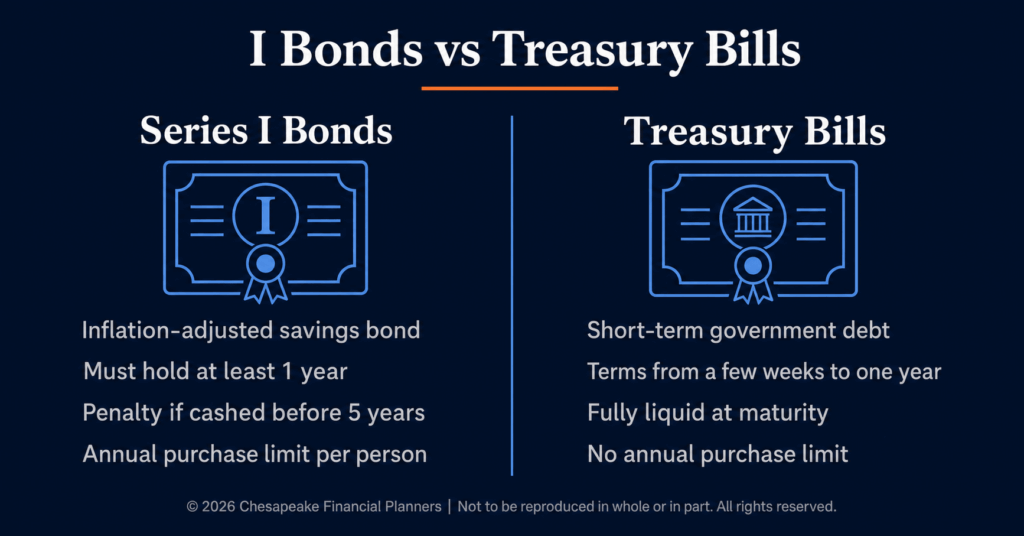
I bonds and Treasury bills are both backed by the full faith and credit of the U.S. government, but they do different jobs. An I bond is an inflation-protected savings bond you must hold at least a year. A Treasury bill is short-term government debt that matures in a year or less and is fully liquid at maturity. The i bonds vs Treasury bills choice comes down to your time horizon and whether you want inflation protection or quick access to your money.
Key Takeaways
- I bonds are inflation-protected savings bonds you must hold 12 months, with a three-month interest penalty if cashed before five years.
- Treasury bills are short-term government debt with terms from a few weeks to one year, fully repaid at maturity.
- You can buy up to $10,000 in electronic I bonds per person each year; Treasury bills have no purchase limit.
- Both are exempt from state and local income tax, so match them to your timeline rather than chasing a rate.
About the Author: Jeff Judge, CFP®, AEP®, ChFC®, CLU® is Managing Partner of Chesapeake Financial Planners in Forest Hill, Maryland. He has been helping families and business owners in Harford County and the Baltimore metro area put idle cash to work since earning his CFP® certification in 2013, by using Chesapeake Financial Planners’ signature process, the R.U.D.D.E.R. method™. Jeff tells clients that with both of these, the structure matters more than this month's rate, because the rate will change but the rules will not.
What's the Difference Between I Bonds and Treasury Bills?
Both are ways to lend money to the U.S. Treasury, but they are built differently. A Series I bond is a savings bond whose return adjusts with inflation, meant to be held for years. A Treasury bill is a short-term security sold at a discount and repaid at full face value when it matures, meant to be held for months.
| Feature | Series I Bonds | Treasury Bills |
|---|---|---|
| What it is | Inflation-adjusted savings bond | Short-term government debt |
| Typical term | Up to 30 years; minimum hold 12 months | 4 to 52 weeks |
| Early access | Three-month interest penalty before 5 years | Fully repaid at maturity |
| Purchase limit | $10,000 per person per year electronic | No purchase limit |
| Minimum purchase | $25 | $100 |
| Inflation protection | Yes, the rate resets with inflation | No, the return is set at purchase |
| State and local tax | Exempt | Exempt |
According to TreasuryDirect, the government's own platform, you buy both directly from the Treasury, though Treasury bills are also available through brokers.
When Do I Bonds Make More Sense?
Series I bonds make more sense when you want to protect cash from inflation and can leave it alone for a while. Because the I bond rate resets with inflation every six months, the money keeps pace with rising prices in a way a fixed-rate option cannot. That makes I bonds a fit for medium-term savings you will not touch for several years.
The trade-offs are real, though. You must hold an I bond for at least 12 months, and if you cash it in before five years, you forfeit the last three months of interest. There is also the $10,000 per person annual electronic limit, plus up to $5,000 in paper I bonds bought with a tax refund. I bond interest is also federal-tax-deferred until you redeem, and may be tax-free if used for qualified education expenses, which the IRS explains in its guidance on investment income.
When Are Treasury Bills the Better Choice?
Treasury bills are the better choice when you want liquidity, a known maturity date, and no purchase cap. With terms from a few weeks to a year, you can match a bill's maturity to exactly when you will need the cash, then get your full face value back. There is no early-withdrawal penalty because you simply wait for the short term to end.
T-bills also shine when the dollar amounts are large. There is no annual purchase limit, so you can place far more than the I bond cap allows, and you can build a rolling ladder of bills that matures on a schedule you control. The main thing to remember is that a Treasury bill does not adjust for inflation; its return is locked in when you buy it, which is fine for short horizons but less protective over longer ones.
I Bonds vs Treasury Bills: How Do You Choose?
Start with one question: when will you need this money? For cash you may need within a year, Treasury bills usually win on liquidity and simplicity. For cash you can commit for at least one to five years and want shielded from inflation, I bonds usually win. If you have more than the $10,000 I bond limit to place, Treasury bills or a mix of both become the practical answer.
Jeff Judge often frames it as a two-part test: time horizon first, inflation protection second. Money you might grab in six months should not sit in a one-year I bond lockup, no matter how attractive the rate looks today. Money earmarked for a goal three years out, on the other hand, benefits from the inflation adjustment an I bond provides. Both live in the same place, TreasuryDirect, so opening one account lets you use either. This pairs well with deciding How Much Cash to Keep: What Belongs Outside Your Emergency Fund? outside your emergency fund and with building a What Is a CD Ladder and How Do You Build One? for the same kind of laddered, predictable cash.
Frequently Asked Questions
Are I bonds or Treasury bills safer?
Both are about as low-risk as savings options get, because each is backed by the full faith and credit of the U.S. government. Neither carries default risk on its principal. The practical difference is timing: a Treasury bill returns your full face value at its short maturity, while an I bond is meant to be held at least a year and ideally five.
Can I lose money on I bonds or Treasury bills?
Held to maturity, neither loses your principal, since both are government-backed. The main way to come out behind on an I bond is cashing it within five years and forfeiting three months of interest, or redeeming before 12 months, which is not allowed at all. A Treasury bill held to its maturity date simply pays its full face value.
How much can I put in I bonds?
You can buy up to $10,000 in electronic Series I bonds per person each calendar year through TreasuryDirect, plus up to $5,000 in paper I bonds using your federal tax refund. That makes the practical maximum $15,000 per person per year. Treasury bills, by contrast, have no annual purchase limit, so large balances often lean toward bills.
Are I bonds and Treasury bills taxed the same?
Both are exempt from state and local income tax, which is a meaningful advantage in higher-tax states. They differ at the federal level: Treasury bill interest is taxed the year it is earned, while I bond interest is federal-tax-deferred until you redeem the bond, and may be tax-free if used for qualified education expenses. Confirm the details with your tax advisor.
Where do I buy I bonds and Treasury bills?
You buy both directly from the government at TreasuryDirect.gov, which is free to use and has no middleman. Treasury bills are also available through most brokerage accounts, which can be convenient if you want them alongside other investments. I bonds, however, are sold only through TreasuryDirect, aside from the paper option via a tax refund.
In the i bonds vs Treasury bills decision, let your timeline lead: reach for Treasury bills when you want liquidity and a near-term maturity, and reach for I bonds when you want inflation protection on money you can leave alone. Both belong to the same low-risk corner of a plan, and many savers use each for what it does best. If you want a simple framework for organizing cash and short-term savings, our What are the fundamentals of personal financial planning? walks through it step by step. Download it at chesapeakefp.com.
Want to go deeper? Our R.U.D.D.E.R Audit for DIY Investors walks through this step by step.
This material is for educational purposes only and should not be considered tax or legal advice. Please consult with your tax advisor or attorney regarding your specific situation.
The opinions voiced in this material are for general information only and are not intended to provide specific advice or recommendations for any individual.
All investing involves risk including loss of principal. No strategy assures success or protects against loss.
There is no guarantee that a diversified portfolio will enhance overall returns or outperform a non-diversified portfolio. Diversification does not protect against market risk.
Government bonds and Treasury bills are guaranteed by the US government as to the timely payment of principal and interest and, if held to maturity, offer a fixed rate of return and fixed principal value.
Disclosures
The information provided is for educational purposes only and should not be construed as investment advice. Investment strategies should be tailored to individual circumstances, risk tolerance, and goals. Past performance doesn't guarantee future results. Consult with qualified financial professionals regarding your specific situation.
Government bonds and Treasury bills are guaranteed by the US government as to the timely payment of principal and interest and, if held to maturity, offer a fixed rate of return and fixed principal value.
Bonds are subject to credit, market, and interest rate risk if sold prior to maturity. Bond values will decline as interest rates rise and bonds are subject to availability and change in price.
Bonds are subject to market and interest rate risk if sold prior to maturity. Bond values will decline as interest rates rise. Bonds are subject to availability, change in price, call features and credit risk. The opinions expressed in this material do not necessarily reflect the views of LPL Financial.
Advisors associated with Chesapeake Financial Planners may be either (1) LPL Financial Registered Representatives offering securities through LPL Financial, Member FINRA and SIPC, and investment advisor representatives offering investment advice through Great Valley Advisor Group; or (2) solely investment advisor representatives offering investment advice through Great Valley Advisor Group and not affiliated with LPL Financial. Great Valley Advisor Group, and Chesapeake Financial Planners are separate entities from LPL Financial.


