

How Do You Start Online Retirement Planning in Virginia?
Last reviewed: July 2026
To start online retirement planning in Virginia, gather your account statements, pull your Social Security estimate, confirm your contribution limits, sketch a rough retirement timeline, and book a virtual fit call with an advisor. You do not need a perfect financial picture to begin. You need the numbers you already have and a willingness to start. The whole process runs by video, so your location in Virginia never limits your access to a qualified planner.
Key Takeaways
- Online retirement planning in Virginia starts with the documents you already have, not a fully organized financial picture.
- The 2026 401(k) employee contribution limit is $24,500, with larger catch-up amounts for workers ages 60 to 63.
- Your Social Security statement at ssa.gov shows benefits at 62, full retirement age, and 70.
- A virtual fit call lets a Virginia resident meet an advisor by video before committing to a full plan.
About the Author: Jeff Judge, CFP®, AEP®, ChFC®, CLU® is Managing Partner of Chesapeake Financial Planners in Forest Hill, Maryland. He has been helping families and business owners in Harford County, the Baltimore metro area, and across state lines navigate retirement planning since earning his CFP® certification in 2013, by using Chesapeake Financial Planners’ signature process, the R.U.D.D.E.R. method™. Jeff has watched too many capable people delay retirement planning for years simply because nobody handed them a clear first step.
The question Jeff Judge hears most from Virginia residents starting a planning relationship is not "What should I invest in?" It is the quieter version: "Where do I even start?" The answer rarely changes. You start with the numbers in front of you. Not a perfect spreadsheet. Whatever is accessible right now.
Online retirement planning has removed the old excuse that a good advisor had to be down the street. A virtual retirement advisor in Virginia can run your full plan by video, which matters in a state where federal employees, military retirees, and Virginia Retirement System members all carry their own quirks. Here is how to begin, step by step.
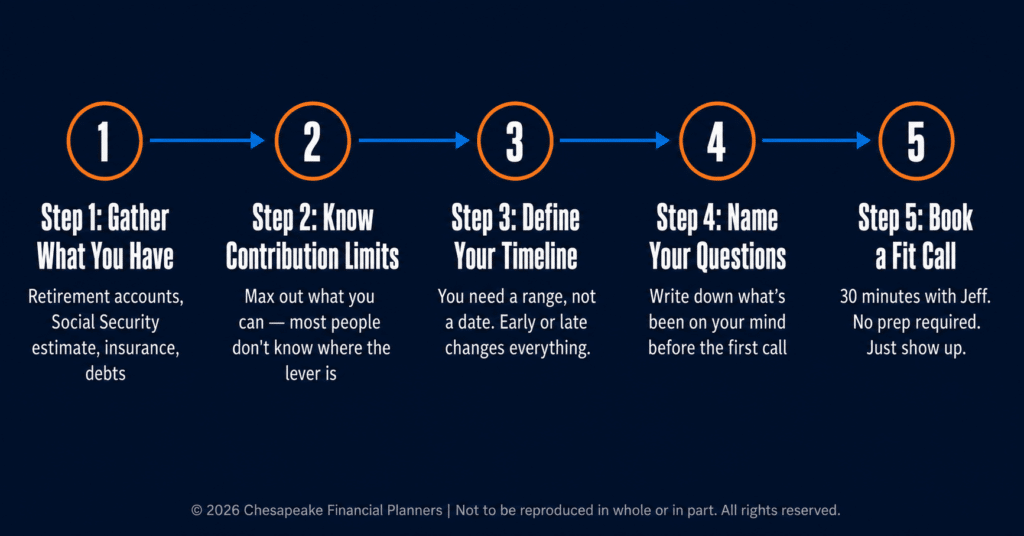
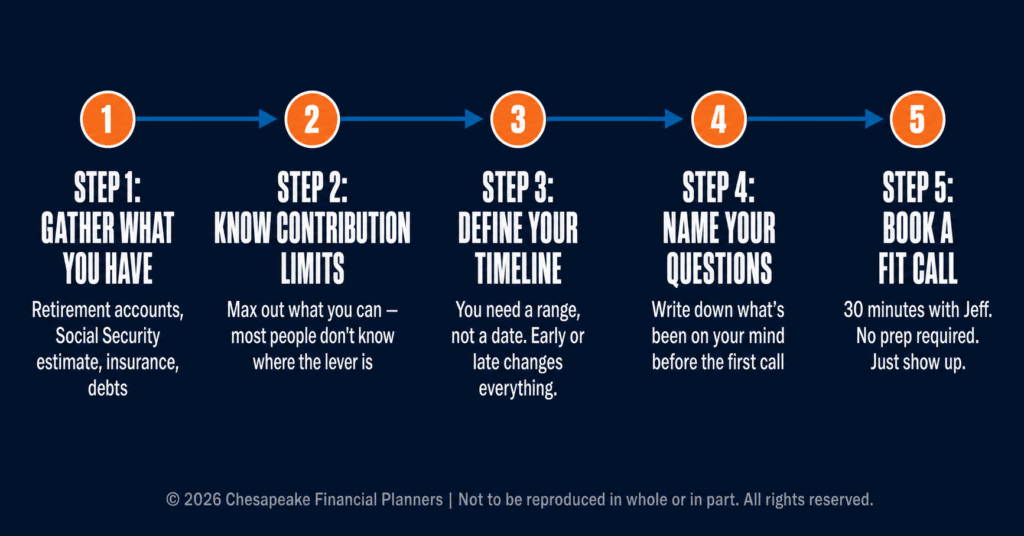
Step 1: How Do You Gather Your Financial Documents?
Start by collecting whatever you can find across six categories. You will not have everything organized, and that is fine. Get what is accessible and move on.
Pull your retirement accounts first: 401(k), 403(b), pension, IRA, and Roth IRA. Note the institution, the rough balance, and whether you are still contributing. Virginia Retirement System members should pull their most recent benefit statement, which projects the pension benefit at different retirement ages.
Next, grab your Social Security estimate, your other income sources (a spouse's pension, rental income, deferred compensation), your debts (mortgage balance and rate matter most), your insurance coverage, and your current savings rate. That last one is simple: gross income and how much you put toward retirement each year across all accounts. Jeff Judge notes: "Pull your Social Security estimate and your current savings rate at minimum — those two numbers alone tell me more about where someone actually stands heading into retirement than almost anything else in their financial picture."
A reader starting from a shoebox of statements and a rough vision of retirement is exactly who this process is built for. Organizing the pile is part of the work, not a prerequisite. This first step gives you a complete starting inventory, even if it is messy.
Step 2: What Are the 2026 Contribution Limits You Should Know?
The 2026 contribution limits are the single most correctable item in most plans. According to the IRS, the 2026 employee deferral limit for a 401(k) or 403(b) is $24,500, with an $8,000 catch-up for workers ages 50 to 59 and 64-plus, and a larger $11,250 catch-up for ages 60 to 63. The 2026 IRA limit is $7,500, with a $1,100 catch-up for those 50 and older.
Many Virginia clients in their peak earning years, roughly 50 to 60, are not maxing these out. The reason is almost never money. It is that nobody told them plainly that this was the priority. "I see clients in their mid-50s contributing 6% to their 401(k) who don't realize they could be putting in 30% if they needed to," Jeff says. "The contribution limits are the lever. Most people just don't know where it is." Knowing your exact 2026 limit tells you how much catch-up room you still have this year.
How can I close the retirement savings gap as a woman?
Step 3: How Do You Set a Retirement Timeline?
You do not need a specific retirement date to plan well. You need a range. Decide, even loosely, whether you want to stop working before 65, between 65 and 70, or phase into part-time work through your late 60s.
Each answer reshapes the plan. Retiring before 65 means bridging the gap to Medicare eligibility on your own. Claiming Social Security early versus at 70 changes your monthly benefit permanently. According to the Social Security Administration, claiming at 62 instead of full retirement age can reduce your monthly benefit by up to 30%. The years before retirement are also when Roth conversions often make the most sense.
The R.U.D.D.E.R. Method™ is Chesapeake Financial Planners' six-step planning process: Review and Recognize, Uncover and Understand, Design and Develop, Discuss and Decide, Execute and Empower, and Reassess and Refine. The timeline you set feeds directly into the Uncover and Understand stage, because when you want to stop working is the input that makes every other number calculable.
Should I Take Social Security at 62 or Wait Until 70?
Step 4: How Do You Identify the Questions Already Bothering You?
Most people starting retirement planning carry one or two specific anxieties. Write them down before your first meeting. These worries are not noise. They are the agenda.
Common ones from Virginia residents sound like this: "I have a VRS pension but I don't know if it's enough." "I don't know when to take Social Security." "I have old 401(k)s from three former employers I've never consolidated." "My spouse and I have never really talked about what retirement looks like for us."
These questions are the real starting point for a planning conversation, and they are exactly what a fit call is designed to surface. Naming your worry turns a vague dread into a solvable problem, which is the whole point of writing it down.
How Do I Create Multiple Income Streams for Retirement?
Step 5: How Do You Book a Virtual Fit Call?
The fit call is a 30-minute video meeting. You bring whatever you gathered in the earlier steps. The advisor learns your situation, your timeline, and what has been on your mind, and you ask whatever you want. If it is a match, the next step is a full intake and a formal planning session. If it is not, you will hear that directly.
For Virginia residents, the fit call is the right moment to flag state-specific variables: a VRS or FERS pension, military retirement pay, a federal job situation, or a recent relocation that created tax questions. A J.P. Morgan Asset Management analysis shows that retirement outcomes hinge heavily on savings rate and claiming timing, both of which surface naturally in a structured first conversation.
This step is where the gathering, the limits, the timeline, and the worries finally connect into a single plan. Booking it is the action that turns preparation into progress.
What Does Online Retirement Planning in Virginia Actually Involve?
Frequently Asked Questions
Can you do retirement planning entirely online in Virginia?
Yes, you can complete retirement planning entirely online in Virginia through video meetings and secure document sharing. A virtual retirement advisor reviews your accounts, builds your plan, and meets with you by video, so your location anywhere in Virginia does not limit your access to a qualified, credentialed planner.
What documents do I need to start online retirement planning?
You need your retirement account statements, a Social Security benefit estimate from ssa.gov, a list of other income sources, your major debts, insurance coverage details, and your current annual savings rate. You will not have everything perfectly organized, and that is fine. Bring what is accessible and organize the rest during the process.
How much can I contribute to my 401(k) in 2026?
In 2026, the employee 401(k) contribution limit is $24,500, according to the IRS. Workers ages 50 to 59 and 64-plus can add an $8,000 catch-up, and those ages 60 to 63 can add a larger $11,250 catch-up. Many people in their peak earning years are not contributing anywhere near these limits.
When should I claim Social Security?
Your best claiming age depends on your health, other income, marital status, and how long you expect to live. Claiming at 62 reduces your monthly benefit by up to 30% versus full retirement age, while waiting until 70 increases it. Your Social Security statement shows benefits at 62, full retirement age, and 70 to compare.
Do I need a Virginia-based advisor for retirement planning?
No, you do not need an advisor physically located in Virginia. You need one licensed to serve Virginia residents who understands state-specific factors like the Virginia Retirement System, FERS pensions, and military retirement pay. A virtual advisor can serve you by video while still addressing every Virginia-specific variable in your plan.
If you found this helpful, our planning resources walk through retirement timelines, Social Security timing, and contribution strategy in more depth. The first step in online retirement planning in Virginia is not having it all figured out. It is starting. Download our retirement planning guide at chesapeakefp.com to take the next step at your own pace.
Disclosures
The information provided is for educational purposes only and should not be construed as investment advice. Investment strategies should be tailored to individual circumstances, risk tolerance, and goals. Past performance doesn't guarantee future results. Consult with qualified financial professionals regarding your specific situation.
Advisors associated with Chesapeake Financial Planners may be either (1) LPL Financial Registered Representatives offering securities through LPL Financial, Member FINRA and SIPC, and investment advisor representatives offering investment advice through Great Valley Advisor Group; or (2) solely investment advisor representatives offering investment advice through Great Valley Advisor Group and not affiliated with LPL Financial. Great Valley Advisor Group, and Chesapeake Financial Planners are separate entities from LPL Financial.


