

How Can I Invest a Lump Sum Without Timing the Market Wrong?
Last reviewed: July 2026
Investing a lump sum without timing the market wrong starts with accepting one truth: nobody can reliably call the top or the bottom. The research says putting all the money in at once beats spreading it out about two-thirds of the time, because markets rise more often than they fall. But the right approach for you depends less on the math and more on whether you can stomach a 20% drop the week after you invest. A staged entry over a few months captures most of the upside while giving you room to breathe.
Key Takeaways
- Lump sum investing beats dollar cost averaging roughly two-thirds of the time, according to Vanguard research.
- Sequence of returns risk matters most for retirees, since early losses on a large balance are hard to recover from.
- The 2026 IRA contribution limit is $7,500, so most lump sums land in taxable or rollover accounts.
- A staged entry over three to six months gets you mostly invested while reducing regret risk.
- Cash is not safe; inflation quietly erodes purchasing power while you wait for the "right moment."
About the Author: Jeff Judge, CFP®, AEP®, ChFC®, CLU® is Managing Partner of Chesapeake Financial Planners in Forest Hill, Maryland. He has been helping families and business owners in Harford County and the Baltimore metro area navigate sudden money and market volatility since earning his CFP® certification in 2013, by using Chesapeake Financial Planners’ signature process, the R.U.D.D.E.R. method™. Jeff has watched more clients lose money sitting in cash waiting for clarity than ever lost it by investing on the "wrong" day.
What Is the Real Risk When Investing a Lump Sum?
The real risk when investing a lump sum is not a single bad day. It is sequence of returns risk: the danger that a steep loss early in your investing window does lasting damage you can't easily recover from. This matters far more if you're in or near retirement, because you don't have decades of new income to make up the gap.
Here's the part that gets ignored. Cash carries its own risk. Sitting on $500,000 in checking feels safe, but inflation eats away at what that money can buy. The Bureau of Labor Statistics tracks the Consumer Price Index, and over time even modest inflation compounds against you. Jeff often tells clients that the fear of investing at the wrong time costs more than the wrong time itself, because waiting in cash is a guaranteed slow loss, not a possible fast one.
The honest answer most people are looking for: yes, you could invest everything on Monday and watch it fall by Friday. That happens. But the data says markets recover, and the longer your money sits idle, the more growth you forfeit while you wait for a signal that never arrives clearly.
How Does Dollar Cost Averaging Compare to Lump Sum Investing?
Dollar cost averaging spreads your investment across several months, while lump sum investing puts everything in at once. The trade-off is simple: lump sum usually earns more, dollar cost averaging usually feels safer. According to Vanguard, immediate lump sum investing outperformed dollar cost averaging about two-thirds of the time across markets and time periods, because markets trend up.
But that statistic misses something real. The one-third of the time it doesn't work can be brutal, especially near retirement. Investing a large balance right before a 30% drop is not a rounding error to the person living through it.
| Approach | When it tends to win | Main drawback |
|---|---|---|
| Lump sum (invest now) | Most of the time; markets rise more than they fall | Full exposure to a near-term crash |
| Dollar cost averaging | Choppy or falling markets early on | Gives up expected return while cash sits idle |
| Staged entry (hybrid) | When regret risk is the real constraint | Slightly lower expected return than lump sum |
The right choice is the one you'll actually stick with. A statistically optimal plan you abandon in a panic is worse than a slightly suboptimal plan you hold through a downturn. This is where Jeff applies the R.U.D.D.E.R. Method™, Chesapeake Financial Planners' six-step planning process: Review and Recognize, Uncover and Understand, Design and Develop, Discuss and Decide, Execute and Empower, and Reassess and Refine. The "Uncover and Understand" step is where a client's true risk tolerance comes out, not the version they think they have.
What happens to my finances after a liquidity event?
What Is a Staged Entry Strategy for a Lump Sum?
A staged entry strategy gets most of your lump sum invested quickly while spreading the final portion over several months to reduce regret risk. Instead of even monthly contributions over a full year, you front-load the deployment. This is the lump sum investing strategy Jeff most often uses with nervous clients holding a windfall.
A practical schedule looks like this:
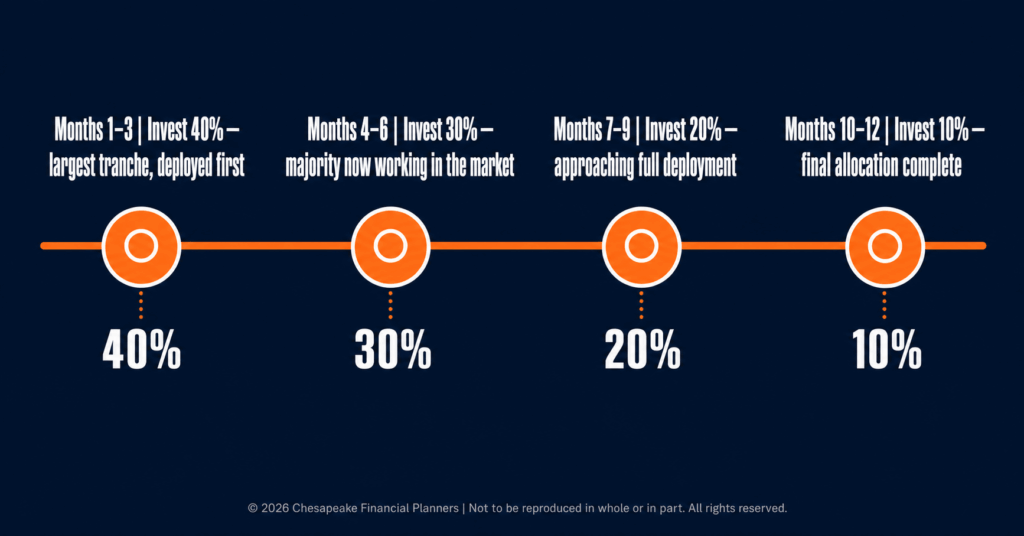
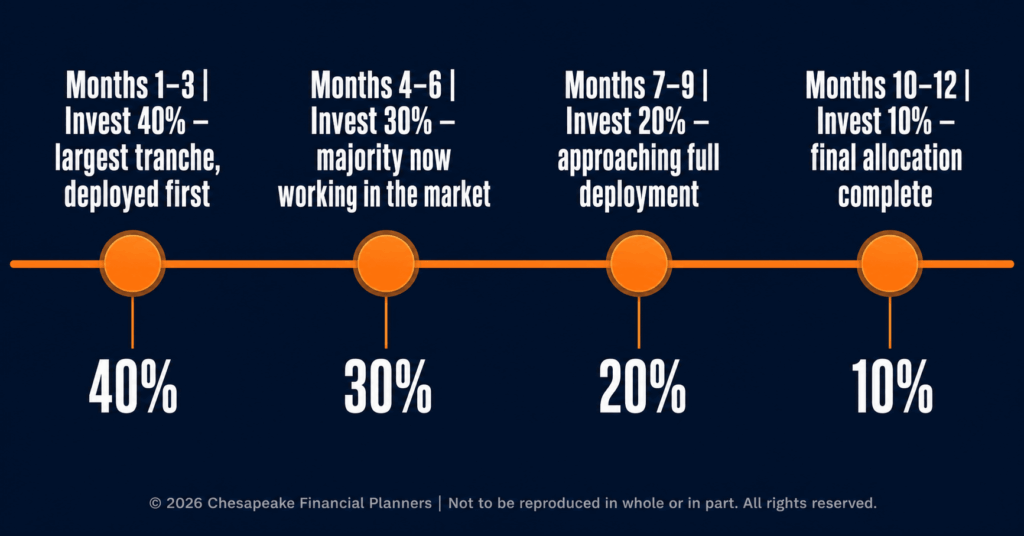
- Months 1 to 3: invest 40% of the lump sum
- Months 4 to 6: invest another 30%, bringing you to 70% invested
- Months 7 to 9: invest 20% more
- Months 10 to 12: invest the final 10%
This gets 70% of your money working within six months, capturing most of the documented lump sum advantage while leaving a cushion that helps you sleep. The point isn't to time anything. It's to bridge the gap between what the data recommends and what your nervous system will tolerate.
One pattern Jeff sees repeatedly: clients who plan to dollar cost average over two or three years almost never finish. After a few good months, they freeze, convinced a pullback is coming. The cash that was supposed to go in over 24 months sits for five years. A shorter, front-loaded schedule with a firm calendar avoids that trap.
What should you do when you suddenly receive a large sum of money?
How Should a Retirement Lump Sum Be Invested Differently?
A retirement lump sum should be invested with sequence of returns risk front and center, because a retiree drawing income can't wait out a long recovery the way a 40-year-old can. The same $500,000 behaves very differently depending on whether you're adding to it for 20 years or pulling income from it next month.
For a retiree, the first job is carving out near-term spending needs before any of the money touches the stock market. A common approach holds one to three years of planned withdrawals in cash and short-term bonds, so a market drop doesn't force you to sell stocks at a loss to pay your bills. The Social Security Administration adjusts benefits for inflation each year, but those benefits rarely cover everything, which is why the lump sum has a job to do.
If the lump sum came from a pension buyout or 401(k) rollover, the tax treatment matters as much as the allocation. A direct rollover keeps the money tax-deferred; a mishandled distribution can trigger a large tax bill in a single year. For retirees, market timing risk and tax timing risk are two sides of the same coin, and both deserve a plan before the money moves.
What should I do with money I inherited from a relative?
Frequently Asked Questions
Is it better to invest a lump sum all at once or spread it out?
Investing a lump sum all at once usually earns more, beating dollar cost averaging about two-thirds of the time according to Vanguard, because markets rise more often than they fall. Spreading it out lowers expected return but reduces the pain of investing right before a drop. The better choice depends on whether you can hold through a near-term loss without panicking.
What is sequence of returns risk?
Sequence of returns risk is the danger that poor investment returns early in your withdrawal years do permanent damage to a portfolio you're drawing income from. The same average return can leave one retiree fine and another short, depending on whether the bad years come first. It matters far more for retirees than for someone still decades from needing the money.
How long should I take to invest a lump sum?
Most investors should get a lump sum mostly invested within three to six months rather than stretching it across years. A front-loaded staged entry captures the bulk of the historical lump sum advantage while giving you psychological room. Spreading deployment over more than a year usually means a meaningful chunk of cash sits idle, quietly losing ground to inflation.
Does dollar cost averaging reduce risk?
Dollar cost averaging reduces the risk of bad timing on any single day, but it does not reduce long-term market risk. By keeping cash on the sidelines, it lowers your expected return in exchange for emotional comfort. It works best in flat or falling markets and underperforms when markets climb steadily, which they do more often than not over long periods.
Should I invest my lump sum if I think the market is about to drop?
If you can't shake the feeling a drop is coming, a staged entry is a reasonable compromise that respects both the data and your nerves. Trying to fully time the bottom rarely works, since the strongest rebound days often cluster near the worst stretches. Investing in tranches over a few months lets you participate while keeping some powder dry.
What should I do with a lump sum before I invest it?
Before investing a lump sum, set aside any money you'll need within the next one to three years and confirm the tax treatment if it came from a pension or retirement account. Pay down high-interest debt first if you have it. Then decide on an allocation and a deployment schedule before you move a single dollar into the market.
A Plan Beats a Prediction
The clients who do best with a windfall aren't the ones who guess the market right. They're the ones who decide on a strategy ahead of time and follow it, even when the headlines get loud. At Chesapeake Financial Planners, we work through lump sum decisions with clients every week, balancing the math against what a person can actually live with. If you're sitting on money you're afraid to invest, a second opinion costs you nothing. Visit chesapeakefp.com to learn more.
Want to go deeper? Our First 90 Days After a Windfall walks through this step by step.
Disclosures
The information provided is for educational purposes only and should not be construed as investment advice. Investment strategies should be tailored to individual circumstances, risk tolerance, and goals. Past performance doesn't guarantee future results. Consult with qualified financial professionals regarding your specific situation.
Dollar cost averaging involves continuous investment in securities regardless of fluctuations in price levels. Investors should consider their ability to continue purchasing through periods of low price levels. Such a plan does not assure a profit and does not protect against loss in declining markets.
Advisors associated with Chesapeake Financial Planners may be either (1) LPL Financial Registered Representatives offering securities through LPL Financial, Member FINRA and SIPC, and investment advisor representatives offering investment advice through Great Valley Advisor Group; or (2) solely investment advisor representatives offering investment advice through Great Valley Advisor Group and not affiliated with LPL Financial. Great Valley Advisor Group, and Chesapeake Financial Planners are separate entities from LPL Financial.


