
How Long Should You Keep My Financial Records?
Last reviewed: July 2026
You should keep most tax records for at least three years after you file, since that is the standard IRS audit window. Some documents need to stay much longer: property records until you sell, retirement account paperwork for life, and anything tied to a loss carryforward until the year it stops mattering. The mistake most people make is treating every document the same. A pay stub from 2019 is clutter. A home improvement receipt from 2019 could save you thousands when you sell.
Key Takeaways
- The general rule for how long to keep tax records is three years from your filing date, matching the standard IRS audit window.
- Keep records six years if you underreported income by more than 25%, and indefinitely if you never filed or filed fraudulently.
- Property and home improvement records should be kept until three years after you sell the asset, since they affect your cost basis.
- The 2026 standard deduction is $16,100 for single filers and $32,200 for married couples filing jointly.
About the Author: Jeff Judge, CFP®, AEP®, ChFC®, CLU® is Managing Partner of Chesapeake Financial Planners in Forest Hill, Maryland. He has been helping families and business owners in Harford County and the Baltimore metro area navigate tax and document retention decisions since earning his CFP® certification in 2013, by using Chesapeake Financial Planners’ signature process, the R.U.D.D.E.R. method™. Jeff sees the same pattern every spring: people either keep nothing and panic during an audit, or keep everything and drown in paper. The right answer sits in the middle, and it depends entirely on the type of document.
What Is the General Rule for How Long to Keep Tax Records?
The general rule for how long to keep tax records is three years from the date you filed your original return. This matches the standard statute of limitations the IRS uses to assess additional tax. After three years, the IRS generally cannot come back and audit that return, so the supporting documents lose their defensive value.
Three years covers the bulk of what most households deal with: W-2s, 1099s, receipts for deductions, and the return itself. According to the IRS, the clock starts on the later of your filing date or the actual due date. If you filed early, the due date controls.
Jeff Judge tells clients to think of the three-year window as the floor, not the ceiling. "It is the minimum, and for a clean W-2 household it is usually enough. The trouble starts when people assume three years applies to everything. It does not."
When Do You Need to Keep Records Longer Than Three Years?
You need to keep records longer than three years in several specific situations, and these are the ones that trip people up. The three-year rule has exceptions written directly into the tax code.
Keep records for six years if you underreported your gross income by more than 25%. The IRS extends the audit window to six years in that case. Keep records indefinitely if you filed a fraudulent return or did not file at all, because there is no statute of limitations on those.
Keep records for seven years if you claimed a loss from worthless securities or a bad debt deduction. And keep employment tax records for at least four years after the tax was due or paid, per the IRS recordkeeping guidance.
If you understand your effective tax rate and how deductions actually move your bill, you keep better records by default. What Is the Difference Between Marginal and Effective Tax Rate?
How Long Should You Keep Property and Investment Records?
You should keep property and investment records until three years after you sell the asset, not three years after you bought it. This is the single most expensive document-retention mistake people make, and it shows up at the worst possible time.
Your cost basis determines your capital gain when you sell. For a home, basis includes the purchase price plus every qualifying improvement: the new roof, the finished basement, the kitchen remodel. Toss those receipts and you may overpay tax on the gain. The 2026 capital gains rules still tax long-term gains at 0%, 15%, or 20% depending on income, so basis records have real dollar value.
The same logic applies to brokerage accounts. Keep purchase confirmations and reinvested dividend records until three years after you sell the position. Smart capital gains tax strategies start with clean basis records.
How Can I Reduce Capital Gains Taxes on My Investments?
Which Financial Documents Should You Keep Forever?
Some financial documents should be kept permanently, full stop. These are the records that prove what you own, what you owe, and what you have already paid tax on.
Keep these for life: tax returns themselves (the returns, not necessarily the backup), records of nondeductible IRA contributions on Form 8606, estate planning documents, marriage and divorce decrees, and records of any Roth conversions. Nondeductible IRA basis is one Jeff flags constantly. Without Form 8606 history, you can end up paying tax twice on the same dollars in retirement.
Also keep permanently: property deeds while you own the property, and any records supporting a tax loss you are carrying forward across multiple years. How do you use the years between retirement and RMDs to reduce lifetime taxes?
How Should You Shred Financial Documents Safely?
You should shred financial documents using a cross-cut shredder rather than tossing them in the trash or recycling. Anything with a Social Security number, account number, or signature is a target for identity theft. According to the Federal Trade Commission, identity theft remains one of the most reported fraud categories year after year.
Before you shred financial documents, scan or photograph anything you might want digitally. A secure, encrypted cloud folder works for long-term records, and it protects against fire or flood destroying the paper. Just make sure the digital copies are legible and backed up. For sensitive originals you cannot replace, a fireproof box at home or a safe deposit box is worth the cost.
Frequently Asked Questions
How long should I keep my tax returns?
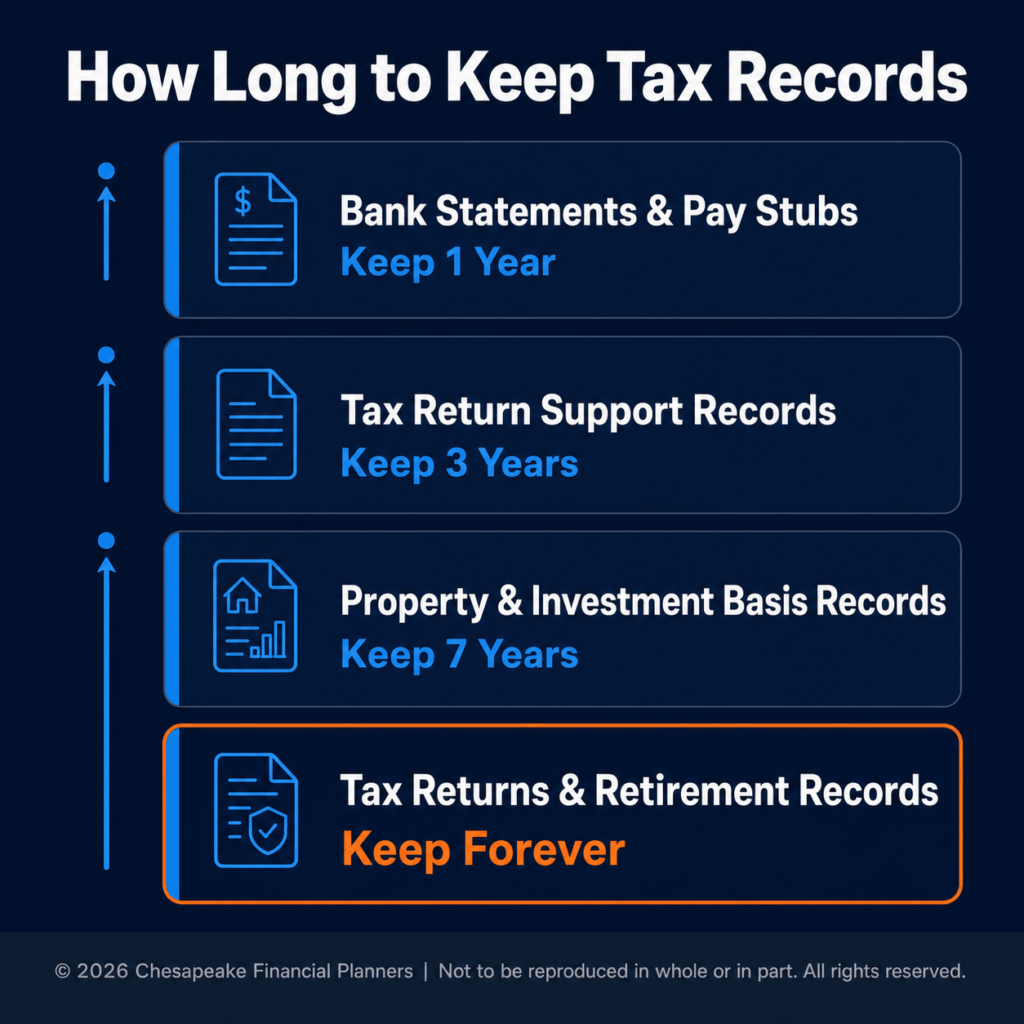
Keep your actual tax returns indefinitely. While the supporting documents can generally be discarded after three years, the returns themselves take up little space and prove your filing history. They become important if the IRS ever questions whether you filed, since there is no statute of limitations on unfiled returns.
How long should I keep bank statements and pay stubs?
Keep bank statements and pay stubs for one year, then discard them once you have confirmed they match your W-2 and tax return. The exception is any statement that documents a tax-deductible expense or supports a major purchase, which you should keep with that year's tax records for the full three-year window.
How long should I keep records after the IRS audit window closes?
You can generally discard tax support documents three years after filing, once the audit window closes. The exceptions are property records, retirement basis records, and any documents tied to a loss carryforward, which you keep longer regardless of the audit window. When in doubt, keep the document; storage is cheaper than reconstruction.
Do I need to keep paper copies or are digital files acceptable?
Digital files are acceptable to the IRS as long as they are legible, complete, and accessible. The IRS accepts scanned and electronic records. Keep a secure, backed-up digital archive and you can shred most paper originals, though irreplaceable documents like deeds and original estate paperwork are worth keeping in physical form too.
How long should I keep records for a deceased family member?
Keep a deceased family member's tax and financial records for at least three years after the final tax return is filed, and longer if the estate involves property or carryforward losses. Estate records, the date-of-death account valuations, and basis step-up documentation should be kept until any inherited assets are sold and reported.
If you found this helpful, our guide on building a year-round tax strategy covers document retention alongside the tax moves that actually move the needle. Download it at chesapeakefp.com.
Want to go deeper? Our Tax-Smart Financial Plan walks through this step by step.
Disclosures
The information provided is for educational purposes only and should not be construed as investment advice. Investment strategies should be tailored to individual circumstances, risk tolerance, and goals. Past performance doesn't guarantee future results. Consult with qualified financial professionals regarding your specific situation.
This information is not intended to be a substitute for specific individualized tax, investment or legal advice. We suggest that you discuss your specific situation with a qualified tax, legal or financial advisor.
Advisors associated with Chesapeake Financial Planners may be either (1) LPL Financial Registered Representatives offering securities through LPL Financial, Member FINRA and SIPC, and investment advisor representatives offering investment advice through Great Valley Advisor Group; or (2) solely investment advisor representatives offering investment advice through Great Valley Advisor Group and not affiliated with LPL Financial. Great Valley Advisor Group, and Chesapeake Financial Planners are separate entities from LPL Financial.


