

How Do High Earners Build Wealth Without Lifestyle Creep?
Last reviewed: July 2026
High earners build wealth without lifestyle creep by automating savings before the money ever hits their checking account, capping spending growth to a fraction of each raise, and anchoring their lifestyle to an older, lower income. The mechanism is simple: when income rises, the savings rate rises faster than the spending rate. That single discipline separates the six-figure earner who retires comfortably from the one who feels broke at $300,000 a year.
Key Takeaways
- Lifestyle creep is the gradual rise in spending that tracks your income, quietly erasing the wealth-building advantage a higher salary should create.
- The IRS 2026 401(k) employee deferral limit is $24,500, giving high earners a large tax-advantaged container to fill first.
- Splitting every raise 50/50 between savings and lifestyle lets you enjoy more income while still accelerating wealth.
- The U.S. personal saving rate sat near 4.5% in early 2026, far below what high earners can and should target.
About the Author: Jeff Judge, CFP®, AEP®, ChFC®, CLU® is Managing Partner of Chesapeake Financial Planners in Forest Hill, Maryland. He has been helping families and business owners in Harford County and the Baltimore metro area navigate income and wealth-building decisions since earning his CFP® certification in 2013, by using Chesapeake Financial Planners’ signature process, the R.U.D.D.E.R. method™. Jeff often tells clients the cruelest thing about a raise is how fast it disappears: most people feel the new spending within 90 days and forget the old salary ever supported them.
What Is Lifestyle Creep for High Earners?
Lifestyle creep, also called lifestyle inflation, is the gradual increase in spending that happens as your income rises, so that a bigger paycheck produces little or no improvement in your net worth. You get a raise, you upgrade the car. You land a bonus, you book the bigger trip. Your income climbs, but your expenses climb right behind it, and your savings rate stays flat.
For high income earners the trap is sharper, not softer. A higher salary creates more room to upgrade, more social pressure to do so, and more convincing justifications for every purchase. Jeff has watched clients earning $400,000 carry less liquid net worth than clients earning $160,000, purely because the higher earners let spending scale with income. The number on the W-2 does not build wealth. The gap between what you earn and what you keep does.
That gap is the whole game. If your spending rises as fast as your earnings, you are running on a more expensive treadmill. Closing the gap, and widening it as income grows, is how high earners turn a strong salary into actual wealth.
How should my investment mix change as I get closer to retirement?
Why Are High Earners Especially Vulnerable to Lifestyle Inflation?
High earners face pressures that lower earners rarely encounter, and each one quietly raises the floor on spending. Social comparison is the loudest: your peer group shifts, and suddenly everyone around you drives a luxury car, takes international vacations, and pays private school tuition. Keeping up feels less like a choice and more like a baseline.
Then there is justification creep. "I work hard, I earned this" is true, but when every purchase becomes a reward, spending spirals without a ceiling. Decision fatigue compounds it. Busy, high-earning professionals default to convenience, outsourcing, and premium options because evaluating each choice costs energy they would rather spend at work.
Geographic cost is a real factor too. In an expensive metro, a $250,000 salary does not stretch the way the headline number suggests once housing, childcare, and taxes take their cut. And income volatility, from bonuses, commissions, or equity compensation, creates feast-or-famine cash flow that tempts people to spend big when the bonus lands and scramble when it does not. The result is a household that looks wealthy and saves like it is not.
How does equity compensation affect my financial plan?
What Is the Real Cost of Lifestyle Creep?
The cost of lifestyle creep is measured in millions of dollars of foregone wealth over a career, not in the price of any single purchase. Consider two hypothetical earners who each make $150,000 a year. Person A lives on $90,000 and invests $60,000 annually. Person B spends $130,000 and invests $20,000 annually. Same income, very different outcomes.
Assuming a 7% average annual return, Person A accumulates roughly $2.6 million over 20 years. Person B accumulates roughly $870,000 over the same period. That is nearly a $1.7 million difference, driven entirely by spending discipline rather than investment skill or a higher salary. (Returns are hypothetical and used to illustrate the math; actual results vary.)
This is why Jeff frames the savings rate as the single most controllable lever in a high earner's plan. You cannot guarantee market returns, and you usually cannot double your income overnight. But you can decide today what percentage of your income you keep. The U.S. personal saving rate hovered near 4.5% in early 2026, a benchmark high earners should comfortably beat. A 30% or 40% savings rate is entirely achievable on a strong income, and it changes the trajectory of everything downstream.

How can I reduce investment fees and keep more returns?
How Do High Earners Build Wealth Without Feeling Deprived?
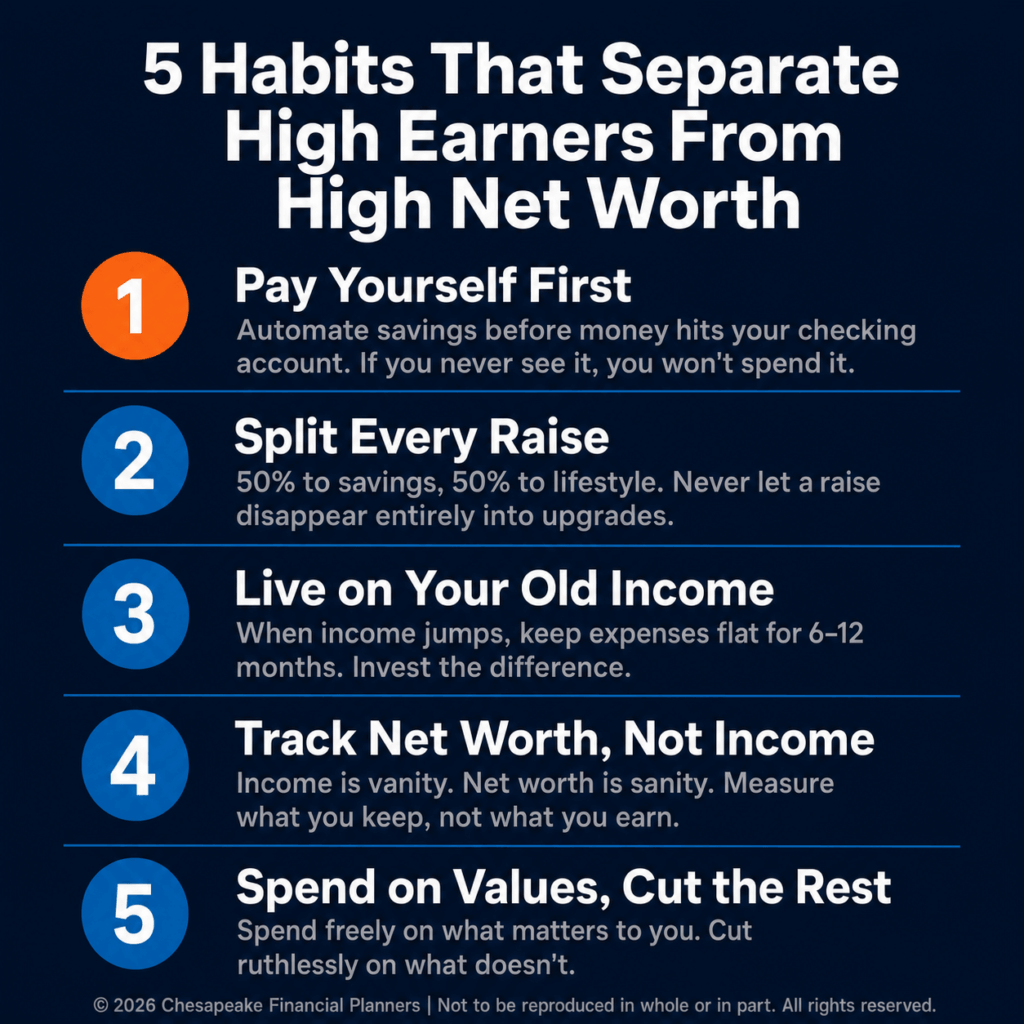
High earners build wealth without lifestyle creep by installing systems that make saving automatic and spending intentional, so the discipline does not depend on willpower. You do not have to live like a monk. You can enjoy a strong income and still accumulate real wealth. The difference is structure, and three moves carry most of the weight.
First, automate wealth building before you see the money. Set up automatic transfers so a fixed percentage of every paycheck routes straight to your 401(k), Roth IRA or brokerage account, and a high-yield savings account for short-term goals, ideally before it ever touches checking. The IRS set the 2026 employee 401(k) deferral limit at $24,500, so high earners have a large tax-advantaged container to fill first. As Vanguard research on saver behavior consistently shows, automation beats intention because money you never see is money you do not spend. Start at 15% to 20% of gross income and raise it over time.
Second, split every raise. When a $10,000 raise arrives, send $5,000 to savings and enjoy the other $5,000. You feel the reward of earning more, and you accelerate wealth at the same time. Too many people let the entire raise vanish into upgrades; capping the lifestyle share at half is what keeps the gap widening.
Third, live on your old income. When your pay jumps, keep living on the prior salary for as long as you reasonably can and bank the difference. This is the highest-impact habit Jeff sees among clients who build serious wealth on ordinary professional salaries.
These habits connect to a broader process. The R.U.D.D.E.R. Method™ is Chesapeake Financial Planners' six-step planning process: Review and Recognize, Uncover and Understand, Design and Develop, Discuss and Decide, Execute and Empower, and Reassess and Refine. Controlling lifestyle creep lives in the Design and Develop and Reassess stages, where the savings system gets built and then tuned every time income changes.
Should I manage my own investments or hire a financial advisor?
How Much of My Portfolio Should Be in One Stock?
Frequently Asked Questions
What savings rate should high earners aim for?
High earners should target a savings rate of 20% to 40% of gross income, well above the national personal saving rate that sat near 4.5% in early 2026. A higher income makes a higher savings rate achievable because basic living costs consume a smaller share of total earnings. Start at 20% and raise it with every income increase.
Is lifestyle creep ever a good thing?
Some lifestyle improvement is healthy and sustainable, which is why splitting raises rather than freezing spending entirely works better long term. The goal is not deprivation; it is keeping spending growth slower than income growth so the gap between earning and saving widens over time. Intentional upgrades you genuinely value are fine. Automatic, unexamined upgrades are the problem.
How do bonuses and equity compensation fit into avoiding lifestyle creep?
Treat bonuses and equity compensation as wealth-building fuel rather than spending money by directing most of each windfall to savings and investments before it reaches checking. Because variable pay arrives in lumps, it is easy to mentally spend it in advance. Decide the savings percentage ahead of time, automate it the day the money lands, and enjoy a defined, smaller share.
Why do high earners still feel broke?
High earners feel broke when spending rises in lockstep with income, leaving little margin despite a large paycheck, a pattern driven by social comparison, justified upgrades, and high-cost living areas. The feeling reflects cash flow, not income. Building margin through automated savings and a capped spending growth rate is what replaces that broke feeling with security.
Does paying off debt count as building wealth?
Paying off high-interest debt counts as building wealth because eliminating an interest rate above roughly 6% to 8% delivers a guaranteed return equal to that rate. For high earners carrying credit card or personal loan balances, clearing them often beats investing the same dollars. Lower-rate debt like a mortgage usually does not require the same urgency.
Putting It Into Practice
Lifestyle creep is not a moral failing, it is a default setting, and high earners beat it with systems rather than willpower. Automate first, split your raises, and anchor to your old income, and a strong salary turns into lasting wealth instead of a more expensive routine.
If this resonated, our free guide on building a savings system that scales with your income walks through the exact automation and raise-splitting framework in detail. Download it at chesapeakefp.com.
Want to go deeper? Our Wealth Without Lifestyle Creep walks through this step by step.
Disclosures
The information provided is for educational purposes only and should not be construed as investment advice. Investment strategies should be tailored to individual circumstances, risk tolerance, and goals. Past performance doesn't guarantee future results. Consult with qualified financial professionals regarding your specific situation.
Growth investments may be more volatile than other investments because they are more sensitive to investor perceptions of the issuing company's growth of earnings potential.
Advisors associated with Chesapeake Financial Planners may be either (1) LPL Financial Registered Representatives offering securities through LPL Financial, Member FINRA and SIPC, and investment advisor representatives offering investment advice through Great Valley Advisor Group; or (2) solely investment advisor representatives offering investment advice through Great Valley Advisor Group and not affiliated with LPL Financial. Great Valley Advisor Group, and Chesapeake Financial Planners are separate entities from LPL Financial.


