

How Does the Federal Reserve Affect My Personal Finances?
Last reviewed: July 2026
The Federal Reserve affects your personal finances by setting the federal funds rate, which ripples into your mortgage, credit card, savings yields, and investment returns. When the Fed raises rates, borrowing gets more expensive and savings pay more. When it cuts rates, loans get cheaper and savers earn less. Understanding the Federal Reserve's effect on your finances helps you time big borrowing and investing decisions instead of reacting to headlines.
Key Takeaways
- The federal funds rate set by the Fed flows into nearly every interest rate you pay or earn, from mortgages to savings accounts.
- As of 2026, the FDIC insures up to $250,000 per depositor, per insured bank, per ownership category.
- Bond prices move opposite to interest rates, so Fed rate hikes lower the value of bonds you already own.
- Business owners feel Fed moves through borrowing costs, hiring conditions, and customer demand simultaneously.
About the Author: Jeff Judge, CFP®, AEP®, ChFC®, CLU® is Managing Partner of Chesapeake Financial Planners in Forest Hill, Maryland. He has been helping families and business owners in Harford County and the Baltimore metro area navigate interest rate decisions and Fed policy since earning his CFP® certification in 2013, by using Chesapeake Financial Planners’ signature process, the R.U.D.D.E.R. method™. Jeff often reminds clients that you can't control what the Fed does, but you can control whether your debt is fixed or floating before the next move.
What Does the Federal Reserve Actually Do?
The Federal Reserve is the central bank of the United States, and Congress gave it a dual mandate: maximum employment and stable prices. In plain terms, the Fed tries to keep the economy growing without letting inflation run away or letting unemployment spike. According to the Federal Reserve, this balancing act guides nearly every policy decision it makes.
Its main lever is the federal funds rate, the interest rate banks charge each other for overnight loans. The Fed doesn't set your mortgage rate directly, but when it moves the federal funds rate, the cost of money shifts across the whole economy. Banks reprice loans. Bond markets react. Savings yields follow.
When inflation runs hot, the Fed raises rates to cool spending. When growth stalls, it cuts rates to encourage borrowing. The Bureau of Labor Statistics tracks the Consumer Price Index that the Fed watches closely when deciding which direction to move. That single decision is why Fed monetary policy lands on your kitchen table whether you follow the news or not.
How Do Interest Rate Changes Affect My Borrowing Costs?
When the Fed raises or lowers rates, the cost of nearly everything you borrow moves with it. Mortgages don't track the federal funds rate one-for-one, but they follow its direction. When the Fed signals higher rates, mortgage rates climb, and a home that was affordable last quarter costs more per month this quarter.
Credit cards react faster and harder. Most carry variable rates tied to the prime rate, which moves directly with the federal funds rate. The moment the Fed hikes, the interest on any balance you carry goes up. Auto loans, personal loans, and home equity lines of credit work the same way.
Here's where business owners pay closest attention. If you're financing equipment, carrying a line of credit, or planning to refinance commercial real estate, interest rate changes hit your bottom line directly. Jeff Judge has watched business owners delay refinancing decisions waiting for a "better" rate, only to watch rates climb instead. The lesson he repeats: when your borrowing is floating and rates are rising, the cost of waiting is real and measurable. If you carry significant business debt, knowing how Fed monetary policy shapes your interest expense is part of running the company well.
How Does the Fed Affect My Savings and Investments?
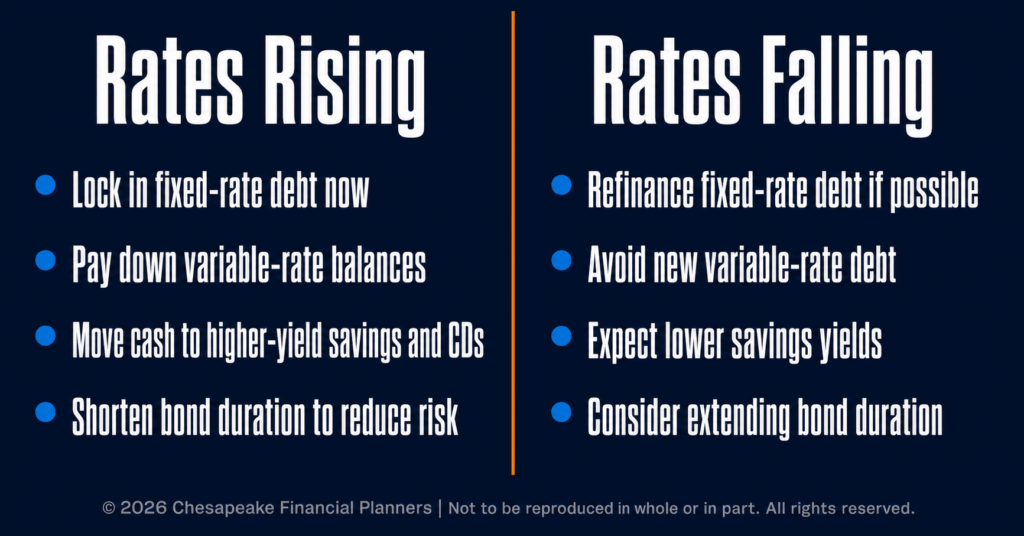
The Federal Reserve affects your savings and investments through the same rate mechanism, just from the other side. When the Fed raises rates, banks pay more on savings accounts, money market accounts, and certificates of deposit. Savers and retirees living on interest income finally earn something on cash. When the Fed cuts rates, those yields fall, sometimes toward zero, forcing income-focused savers to take more risk.
Bond prices behave in a way that surprises people: they move inversely to interest rates. When the Fed raises rates, the bonds you already own lose value because newer bonds pay more. When the Fed cuts rates, your existing bonds gain value. This is why a rising-rate environment can produce losses in a "safe" bond fund, a fact that catches many investors off guard.
| Asset | When the Fed Raises Rates | When the Fed Cuts Rates |
|---|---|---|
| Savings accounts and CDs | Yields rise, better return on cash | Yields fall, less income |
| Bonds you already own | Prices fall | Prices rise |
| Stocks | Often pressured by higher borrowing costs | Often supported by cheaper borrowing |
| Real estate | Affordability drops, prices cool | Affordability rises, prices firm |
Stocks respond to the Fed in less predictable ways. Lower rates generally help stocks because borrowing is cheaper and bonds become less attractive by comparison. Higher rates can pressure valuations. But the relationship isn't automatic. Stocks can climb during rate hikes if the economy is strong, and they can fall during cuts if recession fears dominate. The inflation impact matters too, since the Fed's whole reason for moving rates is to keep prices stable. Jeff Judge notes: "I remind clients that stocks have risen through plenty of rate-hike cycles and fallen during cuts, so using Fed moves as a signal to get in or out of the market is a strategy that tends to create more damage than the rate change itself."
How Does Fed Policy Affect Inflation and My Purchasing Power?
The Fed's core job is keeping inflation under control, and that directly protects your purchasing power. When inflation rises too fast, every dollar you've saved buys less next year than it did this year. The Fed fights this by raising interest rates to slow spending and cool demand.
That protection comes with a tradeoff. Raising rates to tame inflation can slow growth, soften the job market, and rattle investment markets in the short term. Cutting rates does the opposite: it stimulates the economy but risks letting inflation climb again. This constant balancing act is exactly why Fed announcements move markets so sharply.
For your personal plan, the practical takeaway is simple. Holding too much cash during high inflation quietly erodes your wealth, even though the balance looks "safe." A plan built around your goals, not around guessing the Fed's next move, is the more reliable path. That's why we use the R.U.D.D.E.R. Method™, Chesapeake Financial Planners' six-step planning process: Review and Recognize, Uncover and Understand, Design and Develop, Discuss and Decide, Execute and Empower, and Reassess and Refine, to keep client decisions anchored to the long term.
Frequently Asked Questions
Does the Federal Reserve set my mortgage rate?
No, the Federal Reserve does not set mortgage rates directly. The Fed sets the federal funds rate, which influences the broader bond market and lender pricing. Mortgage rates tend to move in the same direction as Fed policy, so when the Fed raises rates, mortgage rates usually rise, and when the Fed cuts, they often fall.
Why do bond prices fall when the Fed raises interest rates?
Bond prices fall when the Fed raises rates because newly issued bonds pay higher yields, making your older, lower-yielding bonds less valuable by comparison. This inverse relationship means a rising-rate environment can produce paper losses even in conservative bond funds. Falling rates reverse the effect and push existing bond prices higher.
How does the federal funds rate affect my credit card?
The federal funds rate affects your credit card because most cards carry variable rates tied to the prime rate, which moves directly with Fed decisions. When the Fed raises rates, your credit card interest rate rises within a billing cycle or two, making any carried balance more expensive. Paying down balances before rate hikes limits the damage.
Should I change my investments based on what the Fed does?
Most investors should not overhaul their portfolio in reaction to a single Fed decision. Trying to time interest rate changes consistently is extremely difficult, and reactive moves often lock in losses. A better approach is building a diversified plan aligned to your goals and time horizon, then reviewing it when your circumstances change rather than when headlines do.
How does Fed policy affect business owners specifically?
Fed policy affects business owners on three fronts at once: borrowing costs on loans and credit lines, the hiring environment and labor costs, and customer demand for your products. When the Fed raises rates, financing expansion gets pricier and customer spending may soften. When it cuts rates, borrowing eases and demand often improves, creating room to invest.
If you're a business owner trying to make sense of how Fed policy fits into your bigger financial picture, our guide on How do business owners plan for retirement differently? walks through the decisions that matter most. You can also explore How Should Business Owners Pay Themselves Salary vs Distributions? and Should I Choose a Solo 401(k) or SEP IRA for My Business? to tighten the parts of your plan you actually control. Download our free Business Owner's Financial Planning Guide at chesapeakefp.com to keep building from here.
Want to go deeper? Our 10 Signs You're Ready for a Certified Financial Planner walks through this step by step.
Disclosures
The information provided is for educational purposes only and should not be construed as investment advice. Investment strategies should be tailored to individual circumstances, risk tolerance, and goals. Past performance doesn't guarantee future results. Consult with qualified financial professionals regarding your specific situation.
Bonds are subject to credit, market, and interest rate risk if sold prior to maturity. Bond values will decline as interest rates rise and bonds are subject to availability and change in price.
Bonds are subject to market and interest rate risk if sold prior to maturity. Bond values will decline as interest rates rise. Bonds are subject to availability, change in price, call features and credit risk. The opinions expressed in this material do not necessarily reflect the views of LPL Financial.
Advisors associated with Chesapeake Financial Planners may be either (1) LPL Financial Registered Representatives offering securities through LPL Financial, Member FINRA and SIPC, and investment advisor representatives offering investment advice through Great Valley Advisor Group; or (2) solely investment advisor representatives offering investment advice through Great Valley Advisor Group and not affiliated with LPL Financial. Great Valley Advisor Group, and Chesapeake Financial Planners are separate entities from LPL Financial.


