
How Does a Business Buyout Affect My Retirement Planning?
Last reviewed: July 2026
A business buyout reshapes your retirement planning by converting your largest illiquid asset into taxable cash, ending your business income overnight, and often accelerating your retirement timeline by years. The proceeds rarely net what the headline number suggests. After taxes and debt payoff, you might keep 55-70% of the gross figure, which changes the math on whether you can actually retire. Smart buyout retirement planning starts before you sign, not after the money lands.
Key Takeaways
- A business buyout ends your income immediately, so you need a withdrawal strategy ready before closing day.
- Long-term capital gains on a qualified business sale are taxed at a top federal rate of 20%, plus a possible 3.8% surtax.
- Retiring before 65 means covering health insurance yourself, often $25,000 or more a year for a couple.
- Early retirees should plan around a 3% to 3.5% withdrawal rate, not the traditional 4%, to make money last 35-plus years.
About the Author: Jeff Judge, CFP®, AEP®, ChFC®, CLU® is Managing Partner of Chesapeake Financial Planners in Forest Hill, Maryland. He has been helping families and business owners in Harford County and the Baltimore metro area navigate business sales and retirement transitions since earning his CFP® certification in 2013, by using Chesapeake Financial Planners’ signature process, the R.U.D.D.E.R. method™. Jeff has watched too many owners accept a buyout offer before running the after-tax math, then discover the number that felt like freedom was actually 40% smaller than they thought.
What Does a Buyout Actually Change About Your Retirement?
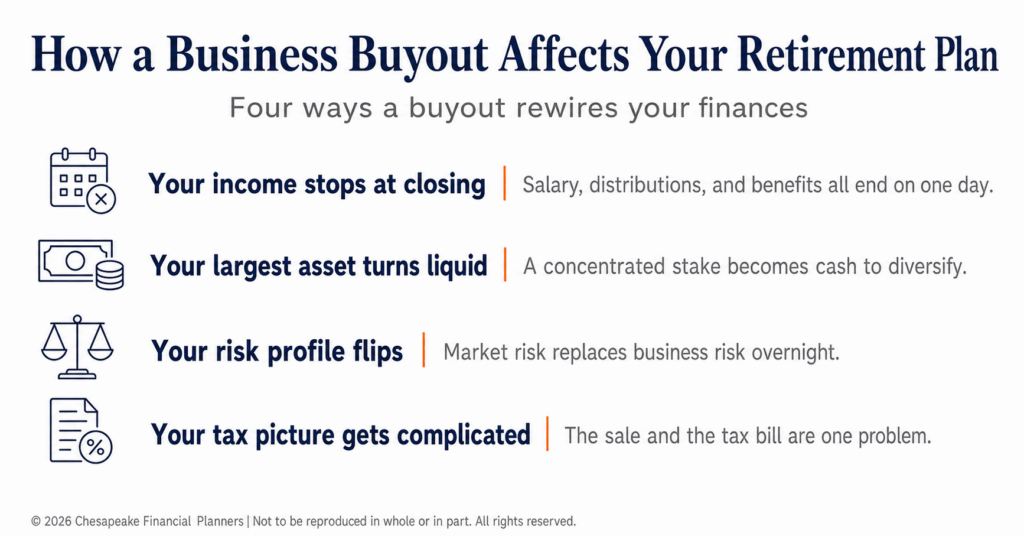
A buyout does more than add a deposit to your accounts. It rewires your entire financial structure in four ways, and each one demands a decision.
Your income stops at closing. When you're bought out, your salary, distributions, and benefits end. Unlike a phased retirement where you wind down over a few years, a buyout typically cuts your earned income to zero on a single day. If you were pulling $200,000 a year out of the business, you now need that $200,000 to come from somewhere else, or your spending has to shrink fast.
Your largest asset turns liquid. For most owners, business equity is 60-80% of net worth. A buyout converts that concentrated, illiquid stake into cash. That's an opportunity to diversify into stocks, bonds, and real estate. It's also a new responsibility: you're managing a portfolio now, not running a company.
Your risk profile flips. Running a business concentrates risk in one entity. After a buyout, market risk replaces business risk. Your retirement security depends on investment performance and a disciplined withdrawal strategy instead of next quarter's revenue.
Your tax picture gets complicated. A sale triggers immediate tax consequences. Jeff often tells clients the single biggest mistake in retiring after a business sale is treating the buyout and the tax bill as separate problems. They are the same problem.
What Will You Actually Net After Taxes?
The headline buyout number is not your retirement number. Run the after-tax math before you accept anything.
If your sale qualifies for long-term capital gains treatment, the top federal rate is 20%, and high earners may owe an additional 3.8% net investment income tax. Asset sales, ordinary-income components, and state taxes can push the effective rate higher. Maryland's top marginal rate adds to the bill for residents here in Harford County and across the state.
Here's a simplified illustration of business buyout tax planning on a $2 million deal:
| Line item | Amount |
|---|---|
| Gross buyout proceeds | $2,000,000 |
| Estimated taxes (capital gains, NIIT, state) | -$520,000 |
| Outstanding business debt payoff | -$200,000 |
| Net available for retirement | $1,280,000 |
That's 36% gone before the money funds a single year of retirement. The structure of the deal matters enormously. An installment sale spreads the gain across multiple years and can keep you in lower brackets. This is exactly the kind of decision the R.U.D.D.E.R. Method™, Chesapeake Financial Planners' six-step planning process of Review and Recognize, Uncover and Understand, Design and Develop, Discuss and Decide, Execute and Empower, and Reassess and Refine, is built to work through before you sign.
How Long Does Your Money Need to Last?
The answer depends on the age you retire, and a buyout often pulls that age forward by a decade.
Retire at 55, and your portfolio may need to last 35 to 40 years. Retire at 65, and you're planning for 25 to 30. That difference changes your safe withdrawal rate. The familiar 4% rule assumes a roughly 30-year horizon at a traditional retirement age. For a 55-year-old funding a 40-year retirement, a starting withdrawal rate of 3% to 3.5% is far safer.
There's a gap most early retirees underestimate: health coverage before Medicare at 65. A couple retiring at 55 can face $25,000 or more annually in premiums and out-of-pocket costs on the individual market, according to research from KFF. Across a ten-year pre-Medicare window, that's a quarter-million dollars your buyout has to absorb. Jeff sees clients build a beautiful spending plan and forget this line entirely.
Your other income sources change the pressure. If your spouse still works, if you have rental income, or if Social Security will eventually replace part of your spending, the buyout proceeds carry less weight. The Social Security Administration lets you model your benefit at different claiming ages, which matters when you're deciding how hard your portfolio has to work in the early years.
What Deal Terms Make Retirement Easier?
You can negotiate for terms that smooth the transition into retirement, and most owners don't realize how much room they have.
Installment payments deliver steady income over five to ten years. That reduces how much you have to invest and then immediately draw down from a single large sum, and it can keep your taxable income lower each year. A consulting or advisory arrangement after the sale gives you ongoing income that takes pressure off your portfolio during the fragile early retirement years, when sequence-of-returns risk does the most damage.
Health insurance continuation is worth real money. If the buyer covers your premiums until Medicare, that can save tens of thousands a year. Every one of these terms is easier to win before you sign than after.
Frequently Asked Questions
Can I retire immediately after a business buyout?
You can retire immediately after a buyout only if the after-tax proceeds, combined with your other income sources, cover your real annual spending for your full life expectancy. Run the net-of-tax number first, subtract debt payoff and pre-Medicare health costs, then test it against a 3% to 3.5% withdrawal rate before deciding.
How are business buyout proceeds taxed?
Business buyout proceeds are typically taxed as long-term capital gains if you held the business over a year, with a top federal rate of 20% plus a possible 3.8% net investment income tax. Asset sales may include ordinary-income components, and state income tax applies on top. Deal structure changes the total significantly.
What is a safe withdrawal rate if I retire early after a sale?
A safe withdrawal rate for an early retiree is generally 3% to 3.5%, lower than the traditional 4% rule. The 4% guideline assumes about a 30-year horizon. If a buyout lets you retire at 55, your money may need to last 40 years, so a more conservative starting rate protects you against running out.
Should I take a buyout as a lump sum or installments?
Installment payments often serve retirement better than a lump sum because they spread the taxable gain across multiple years, can keep you in lower tax brackets, and provide steady income that reduces portfolio withdrawal pressure early in retirement. A lump sum offers full control and immediate liquidity but concentrates the tax hit into one year.
How do I cover health insurance if I retire before Medicare?
If you retire before 65, you can cover health insurance through an ACA marketplace plan, COBRA continuation, a spouse's employer plan, or premium support negotiated into your buyout. A couple should budget $25,000 or more annually, and keeping taxable income modest can qualify you for marketplace subsidies that lower the cost meaningfully.
Does a buyout change how much I should keep in stocks versus bonds?
Yes, a buyout usually means rebuilding your allocation from scratch, since business equity no longer dominates your net worth. Most newly liquid owners shift toward a diversified mix of stocks and bonds sized to their withdrawal rate and timeline, replacing single-company business risk with broad market exposure managed through a withdrawal strategy.
Where to Go From Here
A buyout is one of the few moments where decisions made in a single week shape the next forty years. The proceeds feel like an answer, but they're really a set of questions about taxes, timing, and how long the money has to last. If you found this helpful, our guide to turning a windfall into lasting retirement income covers the next steps in depth. Download it at chesapeakefp.com, and start your buyout retirement planning before the ink dries, not after.
How do I plan for retirement when my wealth is tied up in my business?
What is the best order to withdraw from my 401k, Roth IRA, and taxable accounts in retirement?
Should I update my financial plan after a big life event?
How do I coordinate all my retirement income sources to minimize taxes and maximize income?
Want to go deeper? Our 10 Signs You're Ready for a Certified Financial Planner walks through this step by step.
Disclosures
The information provided is for educational purposes only and should not be construed as investment advice. Investment strategies should be tailored to individual circumstances, risk tolerance, and goals. Past performance doesn't guarantee future results. Consult with qualified financial professionals regarding your specific situation.
Advisors associated with Chesapeake Financial Planners may be either (1) LPL Financial Registered Representatives offering securities through LPL Financial, Member FINRA and SIPC, and investment advisor representatives offering investment advice through Great Valley Advisor Group; or (2) solely investment advisor representatives offering investment advice through Great Valley Advisor Group and not affiliated with LPL Financial. Great Valley Advisor Group, and Chesapeake Financial Planners are separate entities from LPL Financial.


