

How Compound Interest Works: What Will Your Money Become?
Last reviewed: July 2026
Compound interest is interest you earn on both your original money and the interest it has already earned. That second part is the whole game. Understanding how compound interest works is the difference between savings that crawl and savings that snowball, because each year your balance earns a return, and then those returns start earning returns of their own.
Key Takeaways
- Compound interest means earning a return on your returns, so a balance grows faster the longer it stays put.
- The Rule of 72 estimates doubling time: divide 72 by your annual return to get the rough number of years.
- A near-zero account barely compounds; the FDIC pegs the national average savings rate near 0.38% in 2026.
- Starting early usually beats starting big, because time is the most powerful input in compounding.
About the Author: Jeff Judge, CFP®, AEP®, ChFC®, CLU® is Managing Partner of Chesapeake Financial Planners in Forest Hill, Maryland. He has been helping families and business owners in Harford County and the Baltimore metro area put compounding to work since earning his CFP® certification in 2013, by using Chesapeake Financial Planners’ signature process, the R.U.D.D.E.R. method™. Jeff tells clients the math is boring and the patience is hard, and that is exactly why it works for the people who stick with it.
Compound Interest vs Simple Interest
Simple interest pays only on your original principal. Compound interest pays on your principal plus all the interest you have already collected, which is why the two pull apart so dramatically over time. With simple interest, a balance grows in a straight line. With compounding, it curves upward.
Here is the gap on a hypothetical $1,000 earning 5% a year. These figures illustrate the math only and are not a prediction of any actual return.
| Years | Simple interest at 5% | Compound interest at 5% |
|---|---|---|
| 10 | $1,500 | $1,629 |
| 20 | $2,000 | $2,653 |
| 30 | $2,500 | $4,322 |
After three decades, compounding nearly doubles what simple interest produces from the identical starting deposit and rate. Nothing changed except that the interest was left alone to keep earning.
How Compound Interest Works, Step by Step
The mechanics are simpler than the results suggest. Compounding runs on a short loop that repeats.
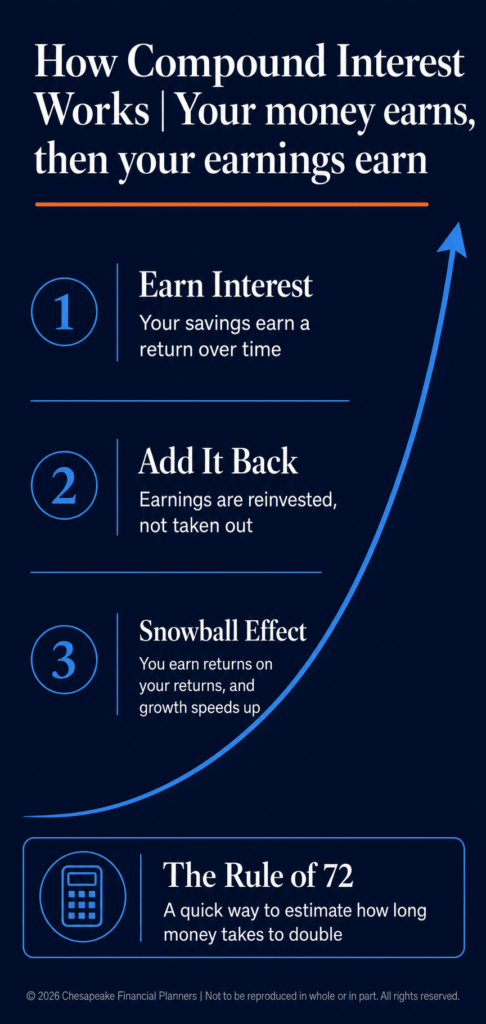
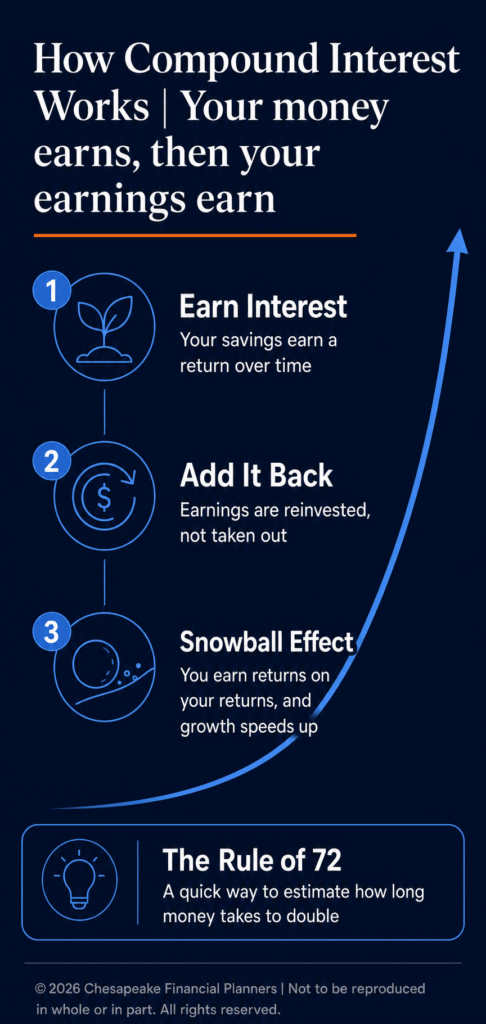
- Your balance earns a return over a period, such as a month or a year.
- That return is added back to your balance instead of being withdrawn.
- The next period, the larger balance earns the return, so each cycle starts from a higher base.
That is the entire engine. The "snowball effect" people describe is just step three repeating many times. The longer the loop runs and the more often interest is added, the more pronounced the curve becomes. Interest that compounds monthly grows a little faster than interest that compounds once a year, because the loop runs twelve times instead of one.
Compound Interest With Real Numbers
Real current rates make the point. As of 2026, the FDIC reports a national average savings account rate near 0.38% and a national average 12-month CD rate around 1.55%. At 0.38%, $10,000 earns about $38 in a year, and compounding barely registers. That is why cash you will not touch for years rarely belongs in a basic savings account.
Now stretch the time horizon and the rate. Imagine $10,000 left to grow at a hypothetical 6% a year (used here only to show the math, not as a forecast). It becomes roughly $17,900 in 10 years, $32,100 in 20 years, and $57,400 in 30 years. You contributed nothing after the first deposit. The growth came entirely from interest earning interest. You can run your own version on the SEC's free compound interest calculator at Investor.gov.
The Rule of 72: Estimating How Long Money Takes to Double
The Rule of 72 is a mental shortcut for compounding. Divide 72 by your annual rate of return, and the answer is roughly the number of years it takes your money to double. At 6%, that is 72 divided by 6, or about 12 years. At 4%, about 18 years. At 9%, about 8 years.
It works in reverse too. If you want your money to double in 10 years, you need roughly a 7.2% return. The Rule of 72 is an approximation, not a guarantee, and it drifts at very high rates, but for everyday planning it is close enough to be useful in your head. Jeff Judge keeps it handy in client meetings precisely because it turns an abstract idea about compounding into a number people can feel.

Why Starting Early Beats Saving More Later
Time is the lever almost no one uses fully. Because compounding rewards the number of cycles, the dollars you invest in your twenties do far more work than the dollars you invest in your fifties.
Consider two savers, both setting aside a hypothetical $300 a month at 6%. The one who saves for 30 years ends near $301,000, having contributed $108,000. The one who waits 10 years and saves for only 20 ends near $138,600, having contributed $72,000. The late starter put in $36,000 less but finished more than $160,000 behind, and the entire gap is lost compounding. This is also why a savings rate matters: many planners, including Vanguard, suggest aiming for 12% to 15% of income toward retirement. If you are just getting organized, our How Much Should I Have in My Emergency Fund? and Where should I keep my cash: high-yield savings, money market, or CDs? explainer cover where to keep money that needs to compound safely.
Frequently Asked Questions
What is compound interest in simple terms?
Compound interest is interest you earn on both your original deposit and the interest that deposit has already earned. Instead of returns being paid out, they get added to your balance, so the next round of interest is calculated on a larger number. Over time, that loop makes savings grow faster and faster.
How is compound interest different from simple interest?
Simple interest is calculated only on your original principal, so it grows in a straight line. Compound interest is calculated on principal plus accumulated interest, so it grows on a curve. On the same deposit and rate over 30 years, compounding can produce nearly double what simple interest does.
What is the Rule of 72?
The Rule of 72 is a shortcut for estimating how long an investment takes to double. You divide 72 by the annual rate of return, and the result is the approximate number of years. At a 6% return, money doubles in about 12 years. It is an estimate for quick mental math, not a guarantee.
How often does interest compound?
It depends on the account. Interest can compound daily, monthly, quarterly, or annually, and more frequent compounding produces slightly faster growth because returns are added back sooner. Savings accounts often compound daily or monthly, while bonds and CDs vary, so check each product's terms rather than assuming.
Does compound interest work against you with debt?
Yes. The same math that grows savings also grows balances on credit cards and other loans, where unpaid interest is added back and then charged interest itself. That is why high-rate revolving debt can snowball quickly, and why paying it down early saves more than the interest rate alone suggests.
Understanding how compound interest works turns time into your most reliable financial tool, whether you are growing savings or escaping debt. The earlier you start the loop and the longer you let it run, the more the math does for you. If you want a simple framework for putting compounding to work across your accounts, our What are the fundamentals of personal financial planning? walks through it step by step. Download it at chesapeakefp.com.
Want to go deeper? Our Why Financial Advice Isn’t Just for Retirees walks through this step by step.
This material is for educational purposes only and should not be considered tax or legal advice. Please consult with your tax advisor or attorney regarding your specific situation.
The opinions voiced in this material are for general information only and are not intended to provide specific advice or recommendations for any individual.
All investing involves risk including loss of principal. No strategy assures success or protects against loss.
There is no guarantee that a diversified portfolio will enhance overall returns or outperform a non-diversified portfolio. Diversification does not protect against market risk.
Disclosures
The information provided is for educational purposes only and should not be construed as investment advice. Investment strategies should be tailored to individual circumstances, risk tolerance, and goals. Past performance doesn't guarantee future results. Consult with qualified financial professionals regarding your specific situation.
Advisors associated with Chesapeake Financial Planners may be either (1) LPL Financial Registered Representatives offering securities through LPL Financial, Member FINRA and SIPC, and investment advisor representatives offering investment advice through Great Valley Advisor Group; or (2) solely investment advisor representatives offering investment advice through Great Valley Advisor Group and not affiliated with LPL Financial. Great Valley Advisor Group, and Chesapeake Financial Planners are separate entities from LPL Financial.


