

Why do high earners feel broke despite making good money?
Last reviewed: July 2026
High earners feel broke because income is not wealth. When you earn six figures but spend nearly every dollar on lifestyle, fixed costs, and taxes, your net worth barely moves. The result is "high income, low wealth," where a strong paycheck masks a weak balance sheet. Closing that gap comes down to one number: how much of each raise you keep.
Key Takeaways
- High income low wealth happens when spending and fixed costs rise as fast as your paycheck, leaving little to save.
- Federal income tax brackets for top earners reach 37% in 2026, shrinking take-home pay sharply.
- Net worth, not salary, measures real progress; two people earning the same can have wildly different balance sheets.
- Automating savings and capping lifestyle inflation are the two fastest levers a six figure income earner controls.
About the Author: Jeff Judge, CFP®, AEP®, ChFC®, CLU® is Managing Partner of Chesapeake Financial Planners in Forest Hill, Maryland. He has been helping families and business owners in Harford County and the Baltimore metro area navigate high-income tax and savings decisions since earning his CFP® certification in 2013, by using Chesapeake Financial Planners’ signature process, the R.U.D.D.E.R. method™. Jeff sees the same pattern constantly: clients who earn $300,000 but save like they earn $80,000, and have no idea it's happening.
What does "high income low wealth" actually mean?
High income low wealth describes someone with a strong salary and a weak balance sheet. You earn well above the median, but your net worth, the total of what you own minus what you owe, stays flat year after year. The paycheck looks impressive. The savings account does not.
This happens because income and wealth are two different things. Income is the water flowing through the pipe. Wealth is what collects in the bucket. If the bucket has holes, the flow rate doesn't matter. Most high earners obsess over the flow and ignore the holes.
Jeff Judge puts it this way with clients: "I've met people earning $400,000 a year with a net worth lower than a teacher who's been saving steadily for twenty years. The difference was never the income. It was what they kept." The fix starts with measuring the right number. Track net worth quarterly, not your paycheck. How Do I Stop Lifestyle Creep from Destroying My Wealth?
Why do taxes take such a big bite from a six figure income?
Taxes take a large share because higher income lands in higher marginal brackets. The 2026 federal tax brackets top out at 37%, and that's before state income tax, payroll taxes, and the additional Medicare tax. A high earner in a high-tax state can lose a meaningful chunk of every additional dollar earned.
Here's the trap most people fall into: they plan around gross income, not take-home pay. You think you're living on $200,000 when your actual spendable income after taxes is closer to $130,000. That $70,000 gap is real money you never see.
This is where tax planning separates wealth builders from high spenders. The same income, structured well, can mean tens of thousands more in your bucket each year. Maxing pre-tax retirement accounts, using an HSA if eligible, and being deliberate about where investments sit all move the needle. The IRS sets the 2026 employee 401(k) deferral limit at $24,500, and every pre-tax dollar contributed lowers your taxable income today.
| Lever | What it does | Who it helps most |
|---|---|---|
| Max 401(k) | Cuts taxable income today | Anyone with a workplace plan |
| HSA | Triple tax advantage | High earners on HDHPs |
| Asset location | Puts tax-inefficient assets in shelters | Anyone with taxable accounts |
How Can I Reduce Taxes When Earning $200K to $500K?
Where does the money actually go for high earners?
The money goes to four places most people underestimate: taxes, fixed costs, lifestyle inflation, and debt service. Fixed costs are the quiet killer. A big mortgage, two car payments, private school tuition, and premium insurance lock you into a high burn rate that's painful to reverse once you've committed.
Lifestyle inflation does the rest. When your income jumps 30%, your spending tends to climb right alongside it. The nicer apartment, the upgraded car, more travel, more subscriptions. You feel like you're treating yourself, but the net effect is that your savings rate never improves. You're just spending at a higher altitude.
A typical $180,000 earner takes home roughly $126,000 after taxes, or about $10,500 a month. Housing at $3,500, childcare at $2,000, cars and insurance at $800, groceries and dining at $1,500, and the rest evaporates into the gaps. Childcare alone can run $30,000 or more per year in many metro areas, according to Child Care Aware of America. When you map it out, the mystery disappears. The money isn't lost. It's allocated, just not toward wealth. Jeff Judge notes: "When I map out a client's actual monthly cash flow, the mystery usually solves itself fast, the income is there but it's all committed to fixed costs before they ever make a savings decision."
How Do I Stop Lifestyle Inflation From Destroying My Savings?
How do I actually start building wealth on a high income?
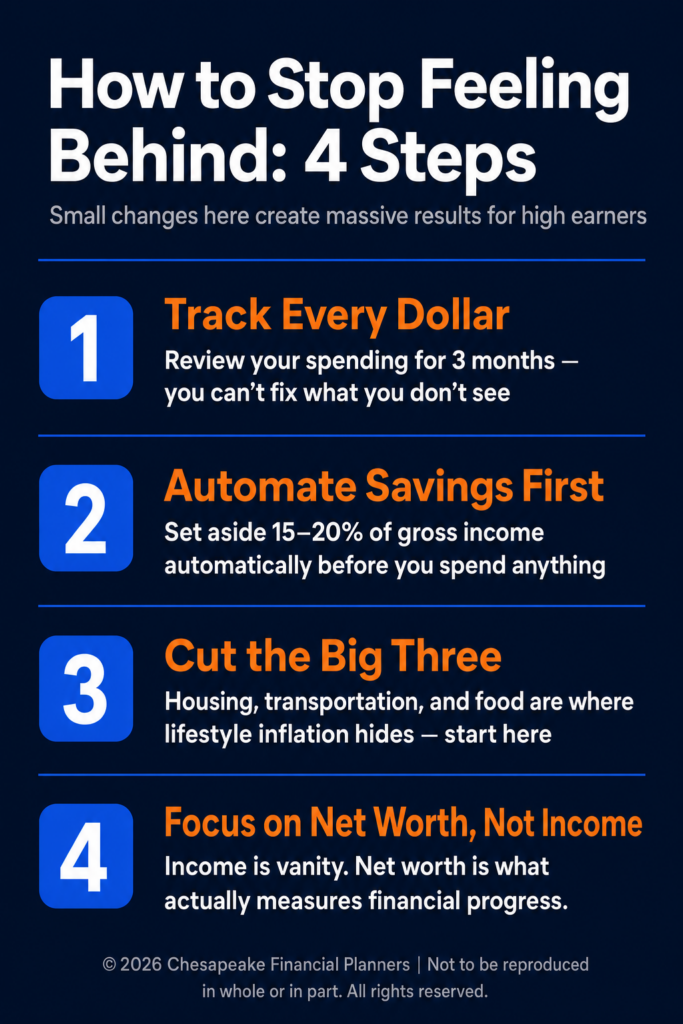
You build wealth by capturing your raises before you ever see them. Automate savings so the money moves to investment and retirement accounts on payday, before it hits your checking account. What you don't see, you don't spend. This single habit does more than any budgeting app.
The second move is capping lifestyle inflation. You don't have to live like you earn $80,000. But the next time your income rises, send at least half of that raise straight to savings and let yourself enjoy the other half. Over a decade, that discipline is the difference between a flat net worth and real financial independence.
At Chesapeake Financial Planners, we run high earners through the R.U.D.D.E.R. Method™, our six-step planning process: Review and Recognize, Uncover and Understand, Design and Develop, Discuss and Decide, Execute and Empower, and Reassess and Refine. The "Review and Recognize" step alone surprises most clients, because it's the first time they've ever seen their full picture on one page. How can I potentially optimize my taxes as my income grows?
Frequently Asked Questions
Why do I make a lot of money but still feel behind?
You feel behind because your spending, fixed costs, and taxes are absorbing almost all of your income, leaving little to build net worth. High income low wealth is common among six figure earners. The fix is measuring net worth instead of your paycheck and automating savings so wealth accumulates regardless of how you feel month to month.
Is a six figure income enough to build wealth?
Yes, a six figure income is more than enough to build significant wealth, but only if your savings rate is high enough. Two people earning $200,000 can have completely different net worths a decade later. The deciding factor is what percentage of income you keep and invest, not the size of the paycheck itself.
What is lifestyle inflation and how do I stop it?
Lifestyle inflation is the tendency for spending to rise alongside income, so raises never translate into higher savings. You stop it by deciding in advance to save at least half of every raise before you adjust your lifestyle. Automating that transfer on payday removes the temptation and locks in the higher savings rate permanently.
Why does net worth matter more than income?
Net worth matters more because it measures what you actually own, while income only measures cash flowing in. You can earn a high salary and have a negative net worth if debt outpaces assets. Wealth, financial security, and the ability to retire all depend on net worth, which is why it deserves your attention each quarter.
How much of my income should I be saving as a high earner?
High earners should generally target saving at least 20% of gross income, and ideally more as income rises. The exact figure depends on your goals, age, and timeline, but the principle holds: as income grows, your savings rate should grow with it rather than staying flat while spending climbs.
Ready to keep more of what you earn?
If this hit close to home, you're far from alone, and the gap between your income and your net worth is fixable. Our free guide breaks down exactly how high earners can plug the leaks and turn a strong paycheck into real wealth. Download it at chesapeakefp.com and start measuring the number that actually matters.
Disclosures
The information provided is for educational purposes only and should not be construed as investment advice. Investment strategies should be tailored to individual circumstances, risk tolerance, and goals. Past performance doesn't guarantee future results. Consult with qualified financial professionals regarding your specific situation.
Advisors associated with Chesapeake Financial Planners may be either (1) LPL Financial Registered Representatives offering securities through LPL Financial, Member FINRA and SIPC, and investment advisor representatives offering investment advice through Great Valley Advisor Group; or (2) solely investment advisor representatives offering investment advice through Great Valley Advisor Group and not affiliated with LPL Financial. Great Valley Advisor Group, and Chesapeake Financial Planners are separate entities from LPL Financial.


