

What Is the Difference Between Fee-Only, Fee-Based, and Commission Advisors?
Last reviewed: July 2026
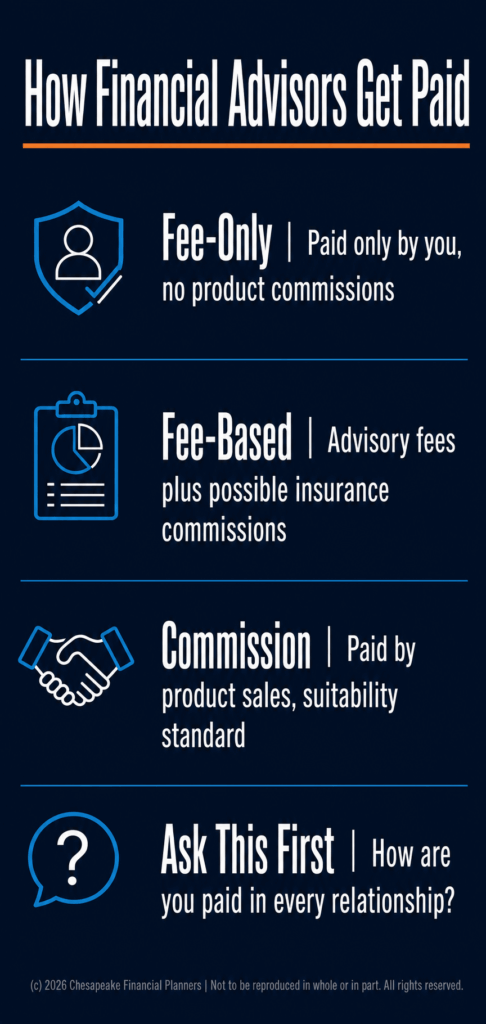
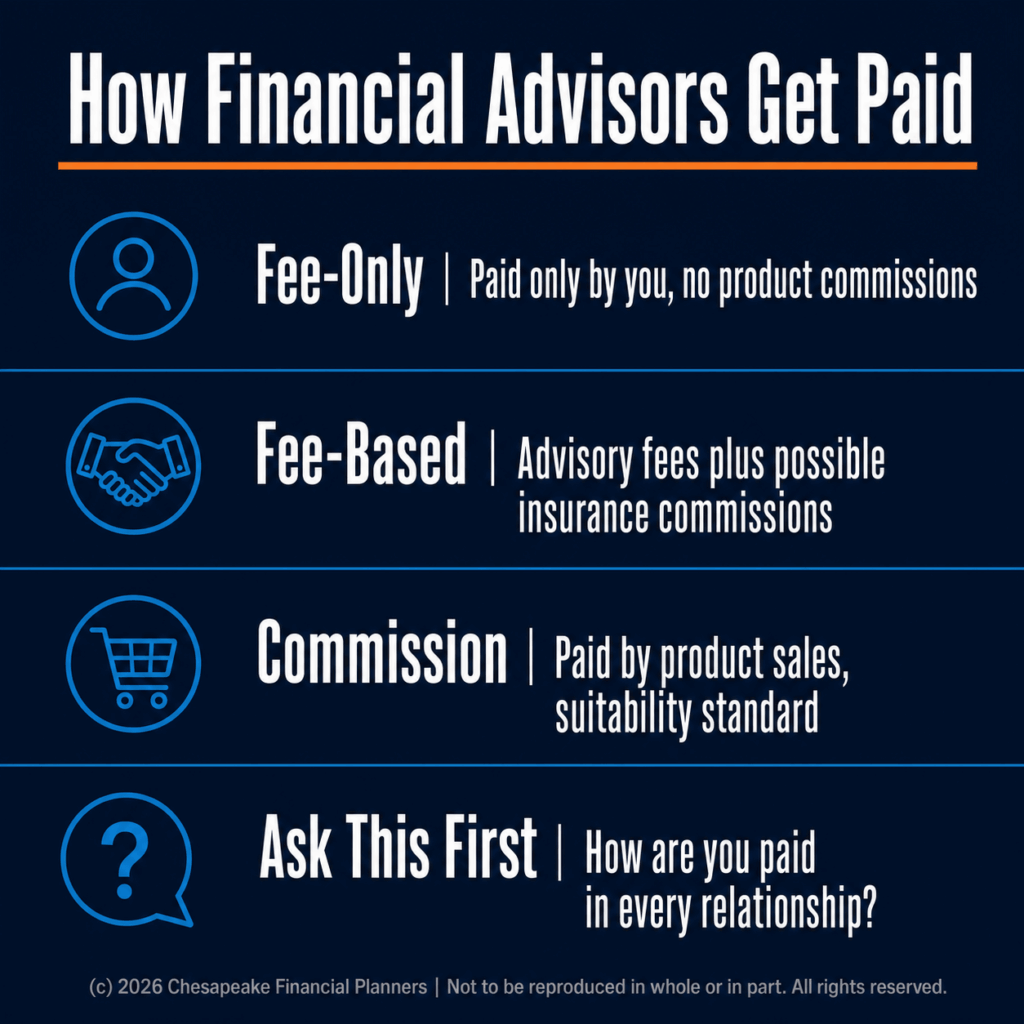
The difference between fee-only vs fee-based advisors comes down to how they get paid. A fee-only advisor earns money only from client fees and never from commissions. A fee-based advisor charges client fees but can also earn commissions on certain products like insurance or annuities. A commission advisor earns money primarily from selling products. Understanding how financial advisors get paid is the single fastest way to spot a conflict of interest before it costs you.
Key Takeaways
- Fee-only advisors are paid solely by clients; fee-based advisors charge fees but may also earn commissions on specific products.
- Commission advisors are paid by the products they sell, which can create an incentive to recommend higher-commission options.
- SEC rules hold registered investment advisers to a fiduciary standard, requiring them to act in your best interest.
- The label matters less than the legal standard: ask whether the advisor is a fiduciary and how, exactly, they are compensated.
About the Author: Jeff Judge, CFP®, AEP®, ChFC®, CLU® is Managing Partner of Chesapeake Financial Planners in Forest Hill, Maryland. He has been helping families and business owners in Harford County and the Baltimore metro area understand advisor compensation since earning his CFP® certification in 2013, by using Chesapeake Financial Planners’ signature process, the R.U.D.D.E.R. method™. Jeff has watched too many people sign with an advisor without ever asking the one question that reveals everything: how do you actually get paid?
What Does Fee-Only Mean for a Financial Advisor?
Fee-only means the advisor is paid only by you, the client. No commissions. No product kickbacks. No third-party payments. The money comes from one place, and that place is your account.
Fee-only advisors typically charge in one of three ways: a percentage of assets under management (often around 1% annually for the industry, per benchmarks tracked by the CFP Board), a flat annual retainer, or an hourly rate. Because there is no product commission in the mix, the incentive to push a specific annuity or insurance policy disappears.
The appeal is structural simplicity. When an advisor only gets paid when you pay them, the math of conflict shrinks. That does not make fee-only automatically better for every situation, but it does make the compensation easier to read.
Worth saying plainly: Chesapeake Financial Planners is fee-based, not fee-only. We will explain exactly what that means below, because the honest version matters more than the marketing version.
How much does it cost to hire a financial planner in 2026?
What Does Fee-Based Mean, and How Is It Different?
Fee-based means the advisor charges client fees, just like a fee-only advisor, but can also earn commissions on certain products such as insurance or annuities. It is a hybrid model, and the word "based" is doing real work in that label.
Here is the distinction people miss. Fee-based is not the same as fee-only, even though the words look almost identical. A fee-based advisor wears two hats. In the advisory relationship, they typically act as a fiduciary and are paid by you. When they place an insurance or annuity product, they may earn a commission from the provider.
That is the honest description of how Chesapeake Financial Planners works. We act as fiduciaries in our advisory relationships through our registered investment adviser. We can also earn commissions on insurance and annuity products when those products genuinely fit a client's plan. Custody runs through LPL Financial. We tell you this up front because hiding it would defeat the entire point of writing about advisor compensation.
Jeff Judge puts it this way to clients: "If an advisor cannot explain their two hats in one minute, that is not a compensation problem, it is a transparency problem." The model is fine. The hiding is not.
| Compensation Model | Paid By | Commissions? | Common Standard |
|---|---|---|---|
| Fee-Only | Client only | No | Fiduciary |
| Fee-Based | Client + product providers | Yes, on some products | Fiduciary in advisory relationship |
| Commission | Product providers | Yes, primarily | Best interest / suitability |
What is the difference between a fee-based and fee-only financial advisor?
How Do Commission-Based Advisors Get Paid?
Commission-based advisors are paid by the products they sell. When you buy a mutual fund, an annuity, or an insurance policy through them, the provider pays the advisor a commission. You may not write a check directly, but you are paying through product costs, surrender charges, or a built-in load.
This is where the fiduciary vs suitability distinction becomes practical. Under the SEC's Regulation Best Interest, brokers must recommend products that are in your best interest at the time of the recommendation. That is a meaningful standard, and FINRA enforces it. But it is not the same as the ongoing fiduciary duty that a registered investment adviser owes you across the entire relationship.
The risk with pure commission is incentive. If two products solve the same problem and one pays the advisor more, a human being feels that pull. Most commission advisors are honest. The structure still tilts the table, and you deserve to know which way.
Fiduciary vs Suitability: Which Standard Applies to You?
A fiduciary must put your interests ahead of their own, always, across the whole relationship. A suitability or best-interest standard requires that a recommendation be appropriate at the moment it is made. The gap between "appropriate right now" and "best for you over time" is exactly where bad outcomes hide.
Ask any advisor a direct question: are you acting as a fiduciary in this relationship, in writing? A genuine fiduciary will say yes without flinching. If the answer wanders, that wandering is your answer. This is the lens Jeff uses inside the Chesapeake planning process, because compensation and standard of care travel together.
How does a CFP differ from a financial advisor?
Frequently Asked Questions
Is a fee-only advisor always better than a fee-based advisor?
No. A fee-only advisor has a simpler compensation structure with fewer conflicts, but fee-based advisors can still act as fiduciaries in their advisory relationships and may offer insurance products a fee-only firm cannot. The better question is whether the advisor is transparent about every way they get paid and whether their advice fits your situation.
How can I tell how my financial advisor gets paid?
Ask directly and request it in writing. A trustworthy advisor will explain their fee structure, any commissions, and any third-party payments without hesitation. You can also review their Form ADV, filed with the SEC, which discloses compensation, conflicts of interest, and the standard of care the advisor owes you across the relationship.
What does fiduciary vs suitability mean for my money?
Fiduciary means the advisor must put your interests ahead of their own across the entire relationship. Suitability, now framed as the best-interest standard, requires a recommendation to be appropriate when it is made. The fiduciary standard is broader and ongoing, which generally offers stronger protection for the advice you receive over time.
Is Chesapeake Financial Planners fee-only or fee-based?
Chesapeake Financial Planners is fee-based, not fee-only. We act as fiduciaries in our advisory relationships through our registered investment adviser, and we can also earn commissions on insurance and annuity products when those products fit a client's plan. We disclose this directly because transparency is the entire point of understanding advisor compensation.
Do commission advisors cost more than fee-only advisors?
It depends on the products and how long you hold them. Commissions can be cheaper for a one-time transaction but more expensive over time if they include surrender charges or higher ongoing product costs. Fee-only and fee-based advisory fees, often near 1% of assets, are more visible but recur annually. Compare total cost, not just the headline.
Why does fee-only vs fee-based matter when choosing an advisor?
Want to go deeper? Our guide to what financial planning costs walks through this step by step.
The distinction matters because it tells you where every dollar of your advisor's income comes from, which reveals potential conflicts before they affect your portfolio. Fee-only removes product commissions entirely; fee-based keeps fiduciary advice while allowing commissions on specific products. Knowing the difference lets you ask sharper questions and judge whether disclosure is honest.
Ready to Work With an Advisor Who Explains Exactly How They Get Paid?
You now know the difference between fee-only vs fee-based and commission compensation, and you know which questions cut through the marketing. Chesapeake Financial Planners is fee-based, fiduciary in our advisory relationships, and direct about every way we earn a dollar. Jeff Judge and the Chesapeake team serve families and business owners across Harford County and the Baltimore metro. Schedule a free fit call at chesapeakefp.com.
Disclosures
The information provided is for educational purposes only and should not be construed as investment advice. Investment strategies should be tailored to individual circumstances, risk tolerance, and goals. Past performance doesn't guarantee future results. Consult with qualified financial professionals regarding your specific situation.
Advisors associated with Chesapeake Financial Planners may be either (1) LPL Financial Registered Representatives offering securities through LPL Financial, Member FINRA and SIPC, and investment advisor representatives offering investment advice through Great Valley Advisor Group; or (2) solely investment advisor representatives offering investment advice through Great Valley Advisor Group and not affiliated with LPL Financial. Great Valley Advisor Group, and Chesapeake Financial Planners are separate entities from LPL Financial.


