

What is the difference between FDIC and SIPC insurance?
Last reviewed: July 2026
FDIC insurance protects the cash you hold in a bank if that bank fails, while SIPC protects the securities and cash in your brokerage account if the brokerage firm fails. They cover different institutions, different account types, and different kinds of loss. Neither one protects you from losing money because an investment dropped in value. That distinction trips people up constantly, and it matters more than most folks realize.
Key Takeaways
- FDIC insures bank deposits up to $250,000 per depositor, per bank, per ownership category.
- SIPC protects brokerage assets up to $500,000, including a $250,000 cash sublimit.
- Neither FDIC nor SIPC covers investment losses caused by market declines or bad investment decisions.
- FDIC covers banks; SIPC covers brokerage firms. The two never overlap on the same dollar.
About the Author: Jeff Judge, CFP®, AEP®, ChFC®, CLU® is Managing Partner of Chesapeake Financial Planners in Forest Hill, Maryland. He has been helping families and business owners in Harford County and the Baltimore metro area navigate account protection and risk management since earning his CFP® certification in 2013, by using Chesapeake Financial Planners’ signature process, the R.U.D.D.E.R. method™. Jeff has watched clients assume their brokerage account is FDIC-insured, which it is not, and that misunderstanding can leave people exposed in ways they never see coming.
What does FDIC insurance actually cover?
FDIC insurance covers deposit accounts at insured banks: checking, savings, money market deposit accounts, and certificates of deposit. The Federal Deposit Insurance Corporation, created in 1933 after a wave of bank failures, backs these accounts with the full faith and credit of the U.S. government. According to the FDIC, the standard coverage limit is $250,000 per depositor, per insured bank, for each account ownership category. Jeff Judge notes: "Most people don't realize that a single account, a joint account, and an IRA at the same bank each get their own $250,000 of coverage, so a married couple can protect well over half a million dollars at one institution just by titling accounts correctly."
That ownership category language is where people leave money on the table. A single account, a joint account, and a retirement account at the same bank are each separately insured. So a married couple can structure accounts at one bank and cover well above $250,000 without ever opening a second institution.
Here is the part that catches people. FDIC does not cover stocks, bonds, mutual funds, annuities, or anything you bought through an investment account, even if you bought it at a bank that also sells investments. If the product is an investment, FDIC stays home.
What does SIPC coverage protect?
SIPC, the Securities Investor Protection Corporation, steps in when a brokerage firm fails and customer assets go missing. It is not a government agency. It is a nonprofit funded by member brokerage firms, created by Congress in 1970. According to SIPC, coverage runs up to $500,000 per customer, which includes a $250,000 limit for cash held in the account.
What SIPC does is return your securities and cash when a covered brokerage fails. If your firm goes under and your shares of an index fund are still there, SIPC works to transfer them to a solvent firm. If they went missing through fraud or failure, SIPC covers the shortfall up to the limit.
What SIPC absolutely does not do is reimburse you for an investment that lost value. If you bought a stock at $100 and it fell to $40, that is a $60 loss SIPC will never touch. Jeff Judge tells clients this plainly: SIPC is failure insurance, not regret insurance. The market risk is yours to own.
What are the fundamentals of personal financial planning?
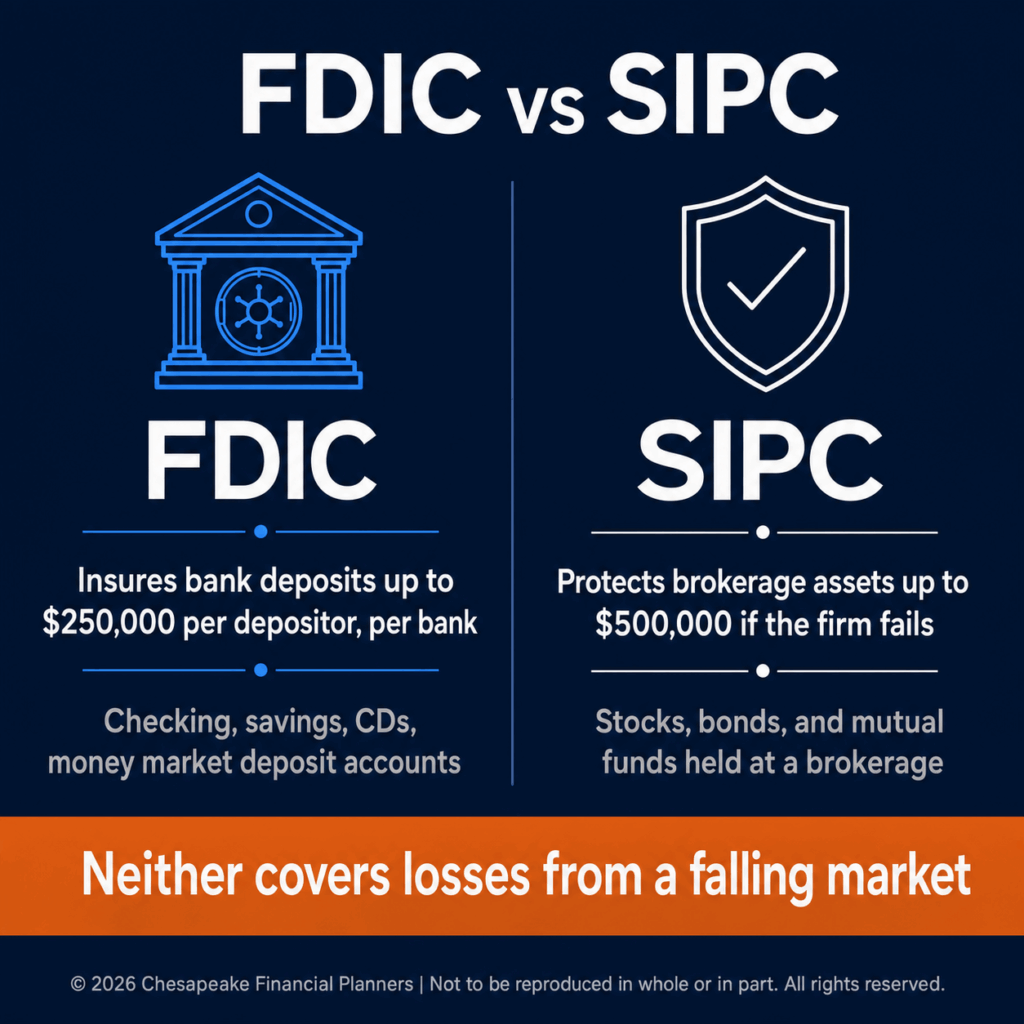
FDIC vs SIPC: a side-by-side comparison
The fastest way to keep these straight is to put them next to each other. Here is how FDIC and SIPC stack up across the dimensions that matter.
| Dimension | FDIC | SIPC |
|---|---|---|
| Covers | Bank deposit accounts | Brokerage securities and cash |
| Backed by | U.S. government | Member brokerage firms (nonprofit) |
| Standard limit | $250,000 per depositor, per bank, per ownership category | $500,000 per customer, including $250,000 cash |
| Protects against | Bank failure | Brokerage firm failure |
| Does NOT cover | Investments (stocks, bonds, funds) | Market losses |
| Created | 1933 | 1970 |
The pattern is clean once you see it. FDIC sits at the bank with your deposits. SIPC sits at the brokerage with your securities. Neither follows your money into the other building.
How Much Should I Have in My Emergency Fund?
What happens to your money in a bank failure or brokerage failure?
When an FDIC-insured bank fails, the FDIC usually arranges for another bank to take over the deposits, often overnight. In most failures, depositors keep access to their insured money with little or no interruption. The FDIC reports that no depositor has lost a single penny of FDIC-insured funds since the agency began operations in 1934.
A brokerage failure works differently. SIPC typically asks a court to appoint a trustee, who then transfers customer accounts to a healthy firm or returns assets directly. The process can take longer than a bank takeover, and the coverage applies to what is missing, not to losses you already had on paper. This is where understanding the difference between FDIC vs SIPC protection pays off, because the timeline and the mechanics are not the same.
How much does it cost to hire a financial planner in 2026?
Frequently Asked Questions
Is my brokerage account FDIC insured?
No, a standard brokerage account holding stocks, bonds, or mutual funds is not FDIC insured. Those assets are protected by SIPC up to $500,000 if the brokerage firm fails. FDIC only insures bank deposit accounts such as checking, savings, and CDs, not investment products.
Does FDIC or SIPC protect me if my investments lose value?
Neither FDIC nor SIPC protects you from investment losses caused by the market. Both programs only cover the failure of the institution holding your money. If a stock or fund drops in value, that loss is yours regardless of which protection applies to the account. Coverage is about institutional failure, not performance.
How much money does FDIC insurance cover?
FDIC insurance covers $250,000 per depositor, per insured bank, for each account ownership category. Because single, joint, and certain retirement accounts count as separate categories, one household can insure well above $250,000 at a single bank by using different ownership structures across their accounts.
What is the difference between FDIC and SIPC coverage limits?
FDIC covers up to $250,000 per depositor per bank per ownership category for deposits. SIPC covers up to $500,000 per customer for brokerage assets, with a $250,000 sublimit on cash. FDIC protects bank deposits while SIPC protects securities, so the limits apply to entirely different account types.
Can the same money be covered by both FDIC and SIPC?
No, the same dollar is never covered by both at once. FDIC protects money sitting in a bank deposit account, while SIPC protects assets in a brokerage account. If you sweep cash from a brokerage into an FDIC-insured bank program, that specific cash may then fall under FDIC rather than SIPC.
Are credit unions covered by FDIC?
No, credit unions are not covered by FDIC. They are insured by the National Credit Union Administration through the National Credit Union Share Insurance Fund, which offers similar protection of $250,000 per share owner, per credit union, per ownership category. The coverage works much like FDIC but comes from a different agency.
Where this leaves you
Knowing the difference between FDIC and SIPC is the kind of basic financial literacy that quietly protects you for decades. The simple version: FDIC guards your bank deposits, SIPC guards your brokerage assets, and neither one rescues you from a bad investment. If you want a clearer picture of how your accounts fit together and where you might be over the limits, our financial foundations guide walks through the building blocks step by step. Download it at chesapeakefp.com.
Disclosures
The information provided is for educational purposes only and should not be construed as investment advice. Investment strategies should be tailored to individual circumstances, risk tolerance, and goals. Past performance doesn't guarantee future results. Consult with qualified financial professionals regarding your specific situation.
Advisors associated with Chesapeake Financial Planners may be either (1) LPL Financial Registered Representatives offering securities through LPL Financial, Member FINRA and SIPC, and investment advisor representatives offering investment advice through Great Valley Advisor Group; or (2) solely investment advisor representatives offering investment advice through Great Valley Advisor Group and not affiliated with LPL Financial. Great Valley Advisor Group, and Chesapeake Financial Planners are separate entities from LPL Financial.


