

ETF or Mutual Fund: What Is the Difference, and Which Is Better?
Last reviewed: July 2026
An ETF and a mutual fund both pool money from many investors to buy a basket of securities, but an ETF trades on an exchange like a stock throughout the day, while a mutual fund prices once after the market closes. For most everyday investors building a long-term portfolio, the practical difference comes down to cost, tax efficiency, and how you actually buy and sell. ETFs usually win on both cost and taxes. Mutual funds still make sense in a few specific situations.
On This Page
- Key Takeaways
- What Is the Difference Between an ETF and a Mutual Fund?
- Which Is Cheaper: ETF or Mutual Fund?
- How Do ETFs and Mutual Funds Compare Side by Side?
- Which Is Better for Your Situation?
- Frequently Asked Questions
- Disclosures
Key Takeaways
- ETFs trade throughout the day at live prices; mutual funds price once daily after market close at net asset value.
- The average index ETF expense ratio runs near 0.15%, while equity mutual funds average closer to 0.40%, per the Investment Company Institute.
- ETFs are generally more tax-efficient in taxable accounts because of their in-kind redemption structure.
- Mutual funds allow automatic recurring investments and fractional dollar amounts, which many ETFs handle less smoothly.
- The fund's strategy and total cost matter far more than the wrapper itself.
About the Author: Jeff Judge, CFP®, AEP®, ChFC®, CLU® is Managing Partner of Chesapeake Financial Planners in Forest Hill, Maryland. He has been helping families and business owners in Harford County and the Baltimore metro area navigate investment decisions since earning his CFP® certification in 2013, by using Chesapeake Financial Planners’ signature process, the R.U.D.D.E.R. method™. Jeff often reminds clients that the ETF-versus-mutual-fund debate gets far more attention than it deserves; the bigger money leaks come from high fees and emotional trading, not the wrapper you choose.
What Is the Difference Between an ETF and a Mutual Fund?
An ETF, or exchange traded fund, is a basket of securities that trades on a stock exchange at a live, fluctuating price during market hours. A mutual fund is also a basket of securities, but it trades only once per day at its net asset value, calculated after the market closes. That single structural difference drives almost everything else.
When you buy an ETF, you buy shares from another investor through the exchange, at whatever the price is that second. When you buy a mutual fund, the fund company creates new shares for you at the day's closing price. ETFs settle like stocks. Mutual funds settle directly with the fund company.
The other big difference is tax behavior. ETFs use an "in-kind" creation and redemption process that lets them shed appreciated securities without triggering a taxable event inside the fund. According to the IRS, capital gains distributions are taxable to you in the year you receive them, even if you reinvest them. Mutual funds distribute those gains more often, which is why ETFs tend to be quieter on your tax bill.
Which Is Cheaper: ETF or Mutual Fund?
ETFs are usually cheaper, though the gap has narrowed. Cost is the single most reliable predictor of long-term fund performance, so this matters more than almost anything else on the list. The lower your expense ratio, the more of the return you keep.
According to the Investment Company Institute, the asset-weighted average expense ratio for index equity ETFs sits near 0.15%, while actively managed equity mutual funds average roughly 0.40% or higher. On a $100,000 balance, that difference is a few hundred dollars a year, and it compounds. Over thirty years the drag from a high expense ratio can quietly cost tens of thousands.
ETFs also carry no sales loads and no minimum investment beyond the price of one share. Many index mutual funds now match ETFs on expense ratio, but some still carry front-end loads or higher minimums. If you want to understand exactly what you are paying and why, read our breakdown of How Do Investment Fees Impact My Long-Term Returns?.
How Do ETFs and Mutual Funds Compare Side by Side?
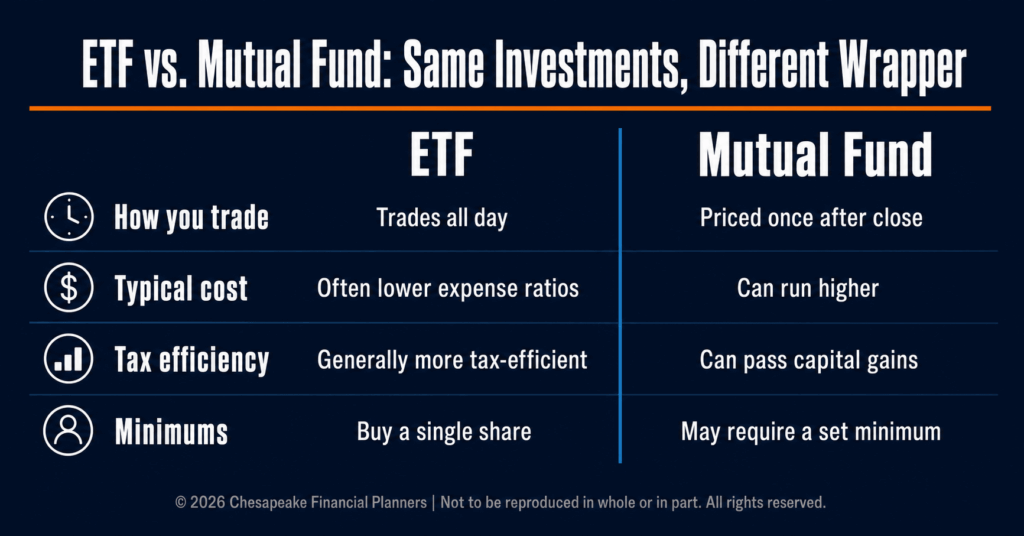
When two products are this similar, a direct comparison clears things up faster than paragraphs. Here is how the two wrappers stack up on the dimensions that actually affect your wallet.
| Feature | ETF | Mutual Fund |
|---|---|---|
| When it trades | Throughout the day at live prices | Once daily at closing net asset value |
| Typical expense ratio | Lower (often near 0.15% for index) | Higher (near 0.40% for active equity) |
| Tax efficiency | Generally higher (in-kind redemptions) | Lower (more frequent capital gains distributions) |
| Minimum investment | Price of one share | Often $1,000 to $3,000 |
| Automatic recurring investing | Sometimes limited | Usually seamless |
| Fractional shares | Broker-dependent | Standard (invest exact dollar amounts) |
| Sales loads | None | Possible (front-end or back-end) |
The table makes the pattern clear. ETFs win on cost, taxes, and flexibility of entry. Mutual funds win on automation and the ability to invest an exact dollar amount without fractional-share workarounds.
Which Is Better for Your Situation?
For most investors in a taxable brokerage account, a low-cost index ETF is the better default. You get lower costs, better tax behavior, and no minimum beyond one share. That combination is hard to beat for a buy-and-hold strategy.
Inside a tax-advantaged account like a 401(k) or IRA, the tax-efficiency advantage of ETFs mostly disappears, because gains aren't taxed year to year anyway. There, a low-cost index mutual fund and an equivalent ETF perform almost identically. The deciding factor becomes whatever is cheaper and easier to automate inside your specific plan.
Jeff Judge has watched clients agonize over this choice and miss the real point. "I've had people spend a month deciding between two nearly identical funds while paying a 1% load on something else in the same account," he says. "The wrapper is a footnote. The total cost and your discipline are the story." That perspective is part of how we work through portfolio decisions using the R.U.D.D.E.R. Method™, Chesapeake Financial Planners' six-step planning process: Review and Recognize, Uncover and Understand, Design and Develop, Discuss and Decide, Execute and Empower, and Reassess and Refine.
If you would rather not sort through the tradeoffs alone, see whether you Should I manage my own investments or hire a financial advisor? before you commit. And if fee reduction is your goal, our guide on How can I reduce investment fees and keep more returns? walks through the levers that move the needle most.
Frequently Asked Questions
Are ETFs riskier than mutual funds?
No, ETFs are not inherently riskier than mutual funds. Risk comes from what a fund holds, not how it trades. An S&P 500 index ETF and an S&P 500 index mutual fund carry essentially identical market risk. The wrapper changes how and when you trade, not the underlying exposure or volatility of the investments.
Can I lose money in both ETFs and mutual funds?
Yes, you can lose money in both ETFs and mutual funds because both hold securities that rise and fall with markets. Neither product is guaranteed or insured against loss. Your actual risk depends on the assets inside the fund, such as stocks, bonds, or a mix, not on whether it is structured as an ETF or a mutual fund.
Which is better for a 401(k) or IRA, an ETF or a mutual fund?
Inside a 401(k) or IRA, the choice barely matters because the tax-efficiency edge of ETFs disappears in tax-advantaged accounts. Pick whichever option in your plan has the lowest expense ratio and lets you automate contributions easily. Most 401(k) plans offer mutual funds, so that is often the practical default anyway.
Do ETFs pay dividends like mutual funds?
Yes, ETFs pay dividends just like mutual funds when the underlying securities generate income. ETF dividends are typically paid quarterly and can be taken as cash or reinvested. The dividend itself is taxable in a taxable account in the year you receive it, the same as it would be with a comparable mutual fund.
Why are ETFs more tax-efficient than mutual funds?
ETFs are more tax-efficient because of their in-kind redemption process, which lets them remove appreciated securities without selling them and triggering capital gains inside the fund. Mutual funds often must sell holdings to meet redemptions, distributing taxable gains to all shareholders. This advantage matters most in taxable accounts and largely disappears inside retirement accounts.
Ready to get smarter about your portfolio without wading through fund prospectuses? If you found this helpful, our free investing fundamentals guide covers expense ratios, asset allocation, and how to build a low-cost portfolio in plain English. Download it at chesapeakefp.com.
Investing in mutual funds and exchange traded funds involves risk, including possible loss of principal. An investment in an ETF or mutual fund involves risk, including the possible loss of principal. ETFs trade like stocks, are subject to investment risk, fluctuate in market value, and may trade at prices above or below their net asset value. Before investing, carefully consider the fund's investment objectives, risks, charges, and expenses, which are contained in the prospectus available from the fund company. Jeff Judge notes: "The in-kind redemption advantage that makes ETFs tax-efficient in a taxable account is real, but it disappears inside an IRA or 401k, so where you hold the fund matters as much as which type of fund you choose."
Want to go deeper? Our R.U.D.D.E.R Audit for DIY Investors walks through this step by step.
Disclosures
The information provided is for educational purposes only and should not be construed as investment advice. Investment strategies should be tailored to individual circumstances, risk tolerance, and goals. Past performance doesn't guarantee future results. Consult with qualified financial professionals regarding your specific situation.
ETFs trade like stocks, are subject to investment risk, fluctuate in market value, and may trade at prices above or below the ETF's net asset value (NAV). Upon redemption, the value of fund shares may be worth more or less than their original cost. ETFs carry additional risks such as not being diversified, possible trading halts, and index tracking errors.
Advisors associated with Chesapeake Financial Planners may be either (1) LPL Financial Registered Representatives offering securities through LPL Financial, Member FINRA and SIPC, and investment advisor representatives offering investment advice through Great Valley Advisor Group; or (2) solely investment advisor representatives offering investment advice through Great Valley Advisor Group and not affiliated with LPL Financial. Great Valley Advisor Group, and Chesapeake Financial Planners are separate entities from LPL Financial.


