

How Does an Employee Stock Purchase Plan (ESPP) Work?
Last reviewed: July 2026
An employee stock purchase plan, or ESPP, lets you buy your company's stock through automatic payroll deductions at a built-in discount, then decide what to do with the shares once they land. It is one of the few places where a paycheck comes with a discount attached, yet ESPP participation is exactly where a surprising number of high earners leave money on the table. The move is not complicated: take the discount, then manage the concentration as a separate decision.
Key Takeaways
- An ESPP buys company stock through payroll deductions at a discount of up to 15%, set by your employer under IRS Section 423.
- The IRS caps ESPP purchases at $25,000 of stock (grant-date value) per calendar year, a real limit for high earners.
- Selling inside the holding-period windows creates a disqualifying disposition, taxing more of your gain as ordinary income instead of capital gains.
- Take the discount, then treat selling and diversifying as their own decision; holding by default is the mistake, not holding on purpose.
About the Author: Jeff Judge, CFP®, AEP®, ChFC®, CLU® is Managing Partner of Chesapeake Financial Planners in Forest Hill, Maryland. He has been helping families and business owners in Harford County and the Baltimore metro area navigate equity compensation decisions since earning his CFP® certification in 2013, by using Chesapeake's signature process, the R.U.D.D.E.R. Method™. "The employees who get the most out of an ESPP are the ones who decide what they will do with the shares before those shares ever hit their account," Jeff says.
How does an employee stock purchase plan actually work?
An ESPP works by setting aside a slice of each paycheck, after tax, and using that money to buy company stock at a discount. You pick a contribution rate once, usually during an enrollment window, and the plan handles the rest across a defined offering period.
Here is the basic sequence:
- You elect a contribution percentage, and the deductions come out of your pay after tax.
- The money accumulates over an offering period, commonly about six months.
- On the purchase date, the plan uses your pooled cash to buy shares at the discounted price.
- The shares land in your account, and the decision about what to do with them becomes yours.
Under a qualified Section 423 plan, the discount can run as high as 15%. Your employer sets the actual number, so read your plan document rather than assuming the maximum.
What is a lookback provision? A lookback prices your purchase off the lower of the stock price at the start of the offering period or the price on the purchase date, then applies the discount on top of that lower figure. When the stock has climbed during the offering period, a lookback can push the effective discount well past the headline 15%. Not every plan offers one, so this is another line to check in your plan document.
There is a ceiling. The IRS does not let you accrue the right to buy more than $25,000 of stock per calendar year, measured at the grant-date price. For a high earner trying to load up, that cap is the binding constraint, not your enthusiasm.

Is the ESPP discount worth the concentration risk?
Yes, the discount is worth capturing, and the concentration worry is real too. The mistake is collapsing two separate decisions into one. Skipping the plan to avoid single-stock risk is not playing it safe; it is turning down a discount to address a problem you can handle another way.
Start with what the discount actually is. Once shares are bought below market, you own something worth more than you paid. That is not a projection or a maybe. It exists the moment the purchase clears.
"In my experience, the tax tail should not wag the risk dog: the discount is locked in the day you buy, but a concentrated position in the company that signs your paycheck is a risk that only grows the longer you hold."
— Jeff Judge, CFP®
The concentration problem deserves its own honest look. For many employees, salary, bonus, unvested RSUs or options, and now ESPP shares all ride on the same company. If that employer stumbles, you can lose income and a chunk of your savings in the same quarter. Concentrated stock risk is one of the most common issues we untangle for tech and executive households.
Cash flow matters here too. Diverting part of each paycheck into stock pinches your budget for a few months until you sell. But that pinch is converting cash into discounted stock, not spending it. If the full contribution is too tight, contribute less. Something almost always beats nothing.
How is an ESPP taxed when you sell?
ESPP taxes split your gain into two buckets: part is ordinary income, taxed at your regular rate, and part may be capital gains. Which is which depends entirely on how long you hold the shares after you buy them.
The IRS draws the line with two holding-period tests, and it states the stakes plainly: if you don't meet special holding period requirements, you'll have to treat income from the sale as ordinary income. Clear both tests and you have a qualifying disposition, with friendlier treatment. Miss either one and you have a disqualifying disposition, with more of the gain taxed at your ordinary bracket.
| Disposition type | Holding period | Tax treatment |
|---|---|---|
| Qualifying | More than 2 years from the offering (grant) date AND more than 1 year from the purchase date | Limited ordinary income; the rest can be long-term capital gains |
| Disqualifying | Anything short of both windows | More of the gain taxed as ordinary income at your marginal rate |
Long-term capital gains are taxed at 0%, 15%, or 20% depending on income, per IRS rate schedules. For 2026, the 15% rate runs up to $545,500 for single filers and $613,700 for married couples filing jointly before the 20% rate applies. High earners can also owe the 3.8% Net Investment Income Tax once modified adjusted gross income tops $200,000 for singles or $250,000 for joint filers.
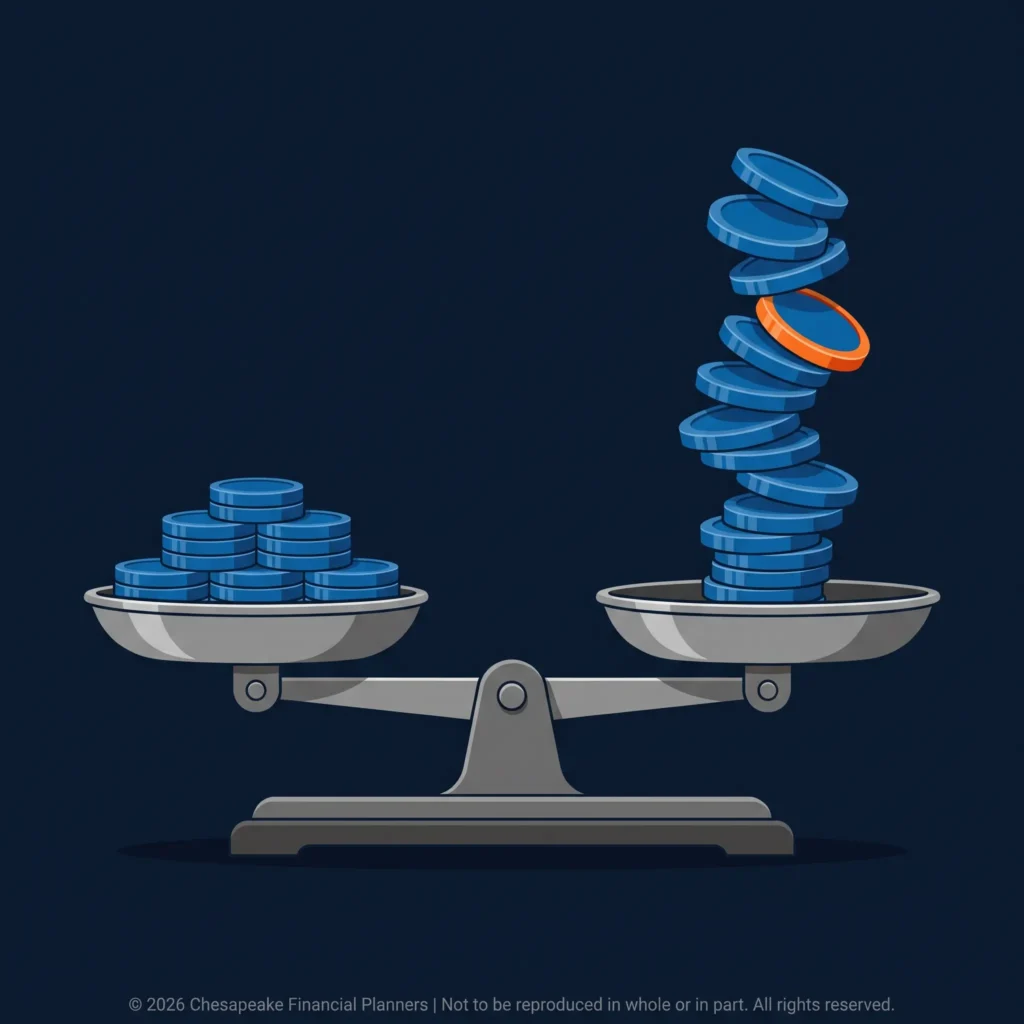
Here is the tension that trips people up. The tax-optimal move is to hold long enough for the qualifying disposition and the lower capital gains rate. The risk-optimal move is to sell and diversify. They pull in opposite directions, because holding for the better tax rate means carrying concentrated single-stock risk for longer.
How should you decide whether to hold or sell your ESPP shares?
Decide your selling rule before the shares land, not after. The moment shares appear in your account, hope and loss aversion take over, and "I'll decide later" quietly becomes "I'll hold forever."
Two disciplined approaches work, and both beat drifting:
- Discount-capture. Treat the ESPP as a discount machine. Sell shortly after each purchase, accept the disqualifying disposition and the ordinary-income tax, and redeploy the proceeds into a diversified portfolio. You keep the discount and shed the single-stock risk almost immediately.
- Selective hold. If your overall position is modest and you have real conviction about the company, hold some shares long enough for the qualifying disposition. This trades tax savings for time spent carrying concentration.
Which approach is right for you? The honest answer is that it depends on how much of your net worth already sits in company stock and how you would feel if it dropped by half. The real mistake I see is not choosing wrong; it is holding by default, with no decision behind it at all.
This is where a repeatable process earns its keep. The R.U.D.D.E.R. Method™ is Chesapeake Financial Planners' six-step planning process: Review and Recognize, Uncover and Understand, Design and Develop, Discuss and Decide, Execute and Empower, and Reassess and Refine. For an ESPP, that means looking at the plan alongside every other slice of your equity compensation, then setting a rule you can actually follow. Run the numbers before year-end, while you still have room to act.
A practical starting point: enroll, contribute what your cash flow allows, and write down your selling rule the day you enroll. Then view the ESPP next to your RSUs, options, and other equity rather than in isolation.
What does ESPP participation mean for Maryland tech and biotech employees?
For the households we work with around Baltimore, ESPP participation shows up constantly. Harford County and the broader Baltimore metro are thick with equity-holding employees: engineers and scientists at Johns Hopkins and the Applied Physics Laboratory, biotech staff along the I-95 corridor, and defense-technology contractors near Aberdeen Proving Ground. Many of them hold RSUs, options, or an ESPP and have never mapped how those pieces fit together.
Maryland adds a wrinkle worth knowing. The state taxes both the ordinary-income portion of your ESPP gain and any capital gain as ordinary state income; Maryland does not offer a preferential long-term capital gains rate the way the federal system does. High earners should also watch Maryland's new 2% capital gains surtax, which can add to the cost of a large sale. That does not change the core advice; it raises the stakes on getting the timing and the plan right.
If you live in Forest Hill, Bel Air, or anywhere in Harford County and you are staring at an enrollment window, the questions are the same: how much to contribute, when to sell, and how the ESPP fits the rest of your plan.
Frequently Asked Questions
Should I participate in my company's ESPP?
For most eligible employees, yes, because the discount is money you would otherwise leave behind. An ESPP lets you buy stock below market, and even after taxes the discount usually beats the alternative of not participating at all. The real work is deciding your selling rule in advance, not whether to enroll.
How much of my paycheck should I contribute to an ESPP?
Contribute as much as your cash flow comfortably allows, up to your plan's cap and the annual IRS limit. Because the deductions come out after tax, an aggressive rate can pinch your budget for a few months until you sell. If money is tight, a smaller contribution still captures the discount.
What is the difference between a qualifying and disqualifying disposition?
A qualifying disposition means you held the shares more than two years from the offering date and more than one year from the purchase date, which limits ordinary income and allows long-term capital gains treatment on the rest. A disqualifying disposition misses one window and taxes more of the gain as ordinary income.
Is the ESPP discount taxed?
Yes. The discount carries tax. Part of your gain is taxed as ordinary income at your regular rate, and part may qualify for capital gains treatment, depending on how long you hold the shares after purchase. Your employer reports the details to you on Form 3922 each year.
Should I sell my ESPP shares right away?
Selling shortly after purchase is a common, defensible approach. You lock in the discount, accept the disqualifying disposition and ordinary-income tax, and redeploy the money into a diversified portfolio. This trades a lower tax rate for lower single-stock risk, which many concentrated employees find is the better trade.
What happens to my ESPP if I leave the company?
Most plans stop your payroll deductions when you leave and either refund your accumulated contributions or make a final purchase, depending on timing. Shares you already own are yours to keep. Review your plan document and consider how the departure affects your broader equity compensation picture before deciding.
ESPP participation comes down to two clear moves: take the discount, then manage the concentration on purpose. Ready to put a plan around your ESPP and the rest of your equity compensation? Jeff Judge and the Chesapeake team serve families and professionals across Harford County and the Baltimore metro. Book a free fit call with Chesapeake Financial Planners.
A version of this article was originally published on Jeff Judge's LinkedIn.
Disclosures
The information provided is for educational purposes only and should not be construed as investment advice. Investment strategies should be tailored to individual circumstances, risk tolerance, and goals. Past performance doesn't guarantee future results. Consult with qualified financial professionals regarding your specific situation.
Stock investing includes risks, including fluctuating prices and loss of principal.
Advisors associated with Chesapeake Financial Planners may be either (1) LPL Financial Registered Representatives offering securities through LPL Financial, Member FINRA and SIPC, and investment advisor representatives offering investment advice through Great Valley Advisor Group; or (2) solely investment advisor representatives offering investment advice through Great Valley Advisor Group and not affiliated with LPL Financial. Great Valley Advisor Group, and Chesapeake Financial Planners are separate entities from LPL Financial.
Chesapeake Financial Planners | 2402 Scotlon Ct, Forest Hill, MD 21050 | (410) 652-7868 | www.chesapeakefp.com
© 2026 Chesapeake Financial Planners | Not to be reproduced in whole or in part. All rights reserved.


