

How Do I Claim Education Tax Credits for College Expenses?
Last reviewed: July 2026
To claim education tax credits for college expenses, you file IRS Form 8863 with your federal return and choose between the American Opportunity Tax Credit (AOTC) or the Lifetime Learning Credit (LLC). The AOTC is worth up to $2,500 per student and the LLC up to $2,000 per return. You can't claim both for the same student in the same year. Education tax credits reduce your tax bill dollar-for-dollar, which makes them far more valuable than a deduction.
Key Takeaways
- The American Opportunity Tax Credit is worth up to $2,500 per student, with 40% (up to $1,000) refundable even if you owe no tax.
- The Lifetime Learning Credit is worth up to $2,000 per tax return and covers undergraduate, graduate, and job-skill courses.
- Both credits phase out at the same income: $80,000 to $90,000 for single filers and $160,000 to $180,000 for joint filers.
- You cannot claim the AOTC and LLC for the same student in the same year, and 529 withdrawals can't pay for expenses you used for a credit.
About the Author: Jeff Judge, CFP®, AEP®, ChFC®, CLU® is Managing Partner of Chesapeake Financial Planners in Forest Hill, Maryland. He has been helping families and business owners in Harford County and the Baltimore metro area navigate college funding and tax planning since earning his CFP® certification in 2013, by using Chesapeake Financial Planners’ signature process, the R.U.D.D.E.R. method™. In Jeff's experience, the families who leave the most money on the table aren't the ones who don't qualify, they're the ones who never realized both a 529 plan and a tax credit could work in the same year if they split the expenses correctly.
What Is the American Opportunity Tax Credit and Who Qualifies?
The American Opportunity Tax Credit is the most generous education credit available, worth up to $2,500 per eligible student per year. According to the IRS, 40% of the credit (up to $1,000) is refundable, meaning you can receive part of it even if you owe no federal income tax. That refundable feature is rare among tax credits and makes the AOTC especially valuable for lower-income families.
The AOTC has strict eligibility rules. The student must be pursuing a degree or recognized credential, enrolled at least half-time for one academic period during the year, and still within the first four years of post-secondary education. You can only claim the AOTC for a maximum of four tax years per student, and the student cannot have a felony drug conviction.
The credit is calculated in two tiers: 100% of the first $2,000 in qualified expenses, plus 25% of the next $2,000. That caps the credit at $2,500 per student. Qualified expenses include tuition, required fees, and course materials such as books and supplies, even if you buy them somewhere other than the school. Room and board, transportation, and insurance do not count.
Here's a quick example. You pay $6,000 in tuition and $800 in required textbooks for your sophomore. Your modified adjusted gross income (MAGI) is $75,000 as a single filer. You qualify for the full $2,500 because your first $2,000 returns 100% and the next $2,000 returns 25%.
What Is the Difference Between Marginal and Effective Tax Rate?
What Is the Lifetime Learning Credit and How Is It Different?
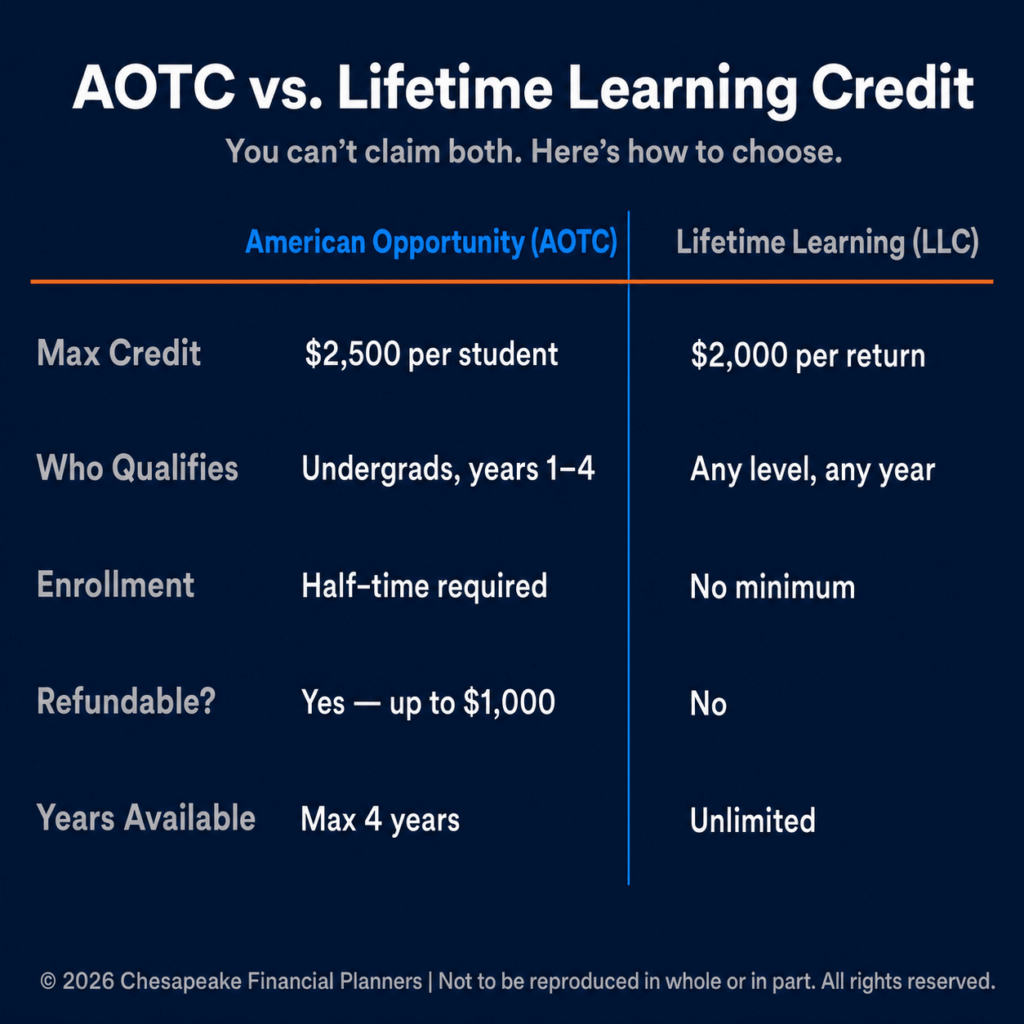
The Lifetime Learning Credit is broader but smaller. It's worth up to $2,000 per tax return, not per student, and it covers undergraduate, graduate, and even non-degree professional development courses. The IRS calculates the LLC as 20% of the first $10,000 in qualified expenses, which is where the $2,000 ceiling comes from.
The LLC has no half-time enrollment requirement and no four-year limit. You can claim it for as many years as you keep paying qualifying tuition. That flexibility makes it the right choice for graduate students, part-time learners, and adults taking courses to sharpen job skills. The trade-off is that the LLC is nonrefundable, so it can only reduce your tax to zero, not below it.
Qualified expenses for the LLC are narrower than the AOTC. Tuition and fees count. Books and supplies generally do not, unless you're required to pay them directly to the institution as a condition of enrollment. That single distinction trips up a lot of families who assume the two credits treat textbooks the same way.
| Feature | American Opportunity Credit | Lifetime Learning Credit |
|---|---|---|
| Maximum credit | $2,500 per student | $2,000 per return |
| Refundable | Yes, up to $1,000 | No |
| Years available | First 4 years only | Unlimited |
| Enrollment | At least half-time | Any level |
| Books and supplies | Qualify | Usually don't qualify |
How Can I Reduce Taxes When Earning $200K to $500K?
How Do Education Tax Credits Work With a 529 Plan?
This is where most families lose money, and it's the question Jeff Judge gets asked every spring. You can use both a 529 plan and an education tax credit in the same year, but you cannot use the same dollar of expense for both. If you withdraw $10,000 tax-free from a 529 to pay tuition and then try to claim that same tuition for the AOTC, the IRS disallows the double benefit.
The fix is simple once you see it. Pay roughly $4,000 of qualified tuition out of pocket (or from non-529 money) to capture the full $2,500 AOTC, then use the 529 for the remaining expenses, including room and board, which the credits don't cover anyway. Jeff often tells clients that this single coordination move recovers more value than years of fretting over which fund the 529 holds.
Income limits apply to both credits and they're identical. Per the IRS, single filers receive the full credit with MAGI of $80,000 or less, phasing out between $80,000 and $90,000. Married couples filing jointly get the full credit at $160,000 or less, phasing out between $160,000 and $180,000. Above those ceilings, the credit disappears entirely.
What is a year-round tax planning calendar for retirees and pre-retirees?
Frequently Asked Questions
Can I claim both the American Opportunity Credit and Lifetime Learning Credit?
You cannot claim both the AOTC and the LLC for the same student in the same tax year. You can, however, claim the AOTC for one student and the LLC for a different student on the same return. Most families with multiple kids in school use this split to maximize total credits across the household.
Which education tax credit is better for me?
The AOTC is better for most undergraduate students because it's worth more ($2,500 versus $2,000), is partly refundable, and covers books and supplies. The LLC is the better fit for graduate students, part-time learners, or anyone past their first four years of college, since it has no enrollment or year limits.
Do education tax credits reduce my refund or my tax owed?
Education tax credits reduce your tax owed dollar-for-dollar, which directly increases your refund or lowers your balance due. The AOTC goes one step further: up to $1,000 is refundable, so you can receive money back even if your tax liability is already zero. The LLC only reduces tax down to zero.
What form do I use to claim education tax credits?
You claim education tax credits using IRS Form 8863, attached to your Form 1040. You'll need Form 1098-T from the school, which reports the tuition you paid. Keep receipts for required books and supplies, since the AOTC covers those even when the 1098-T doesn't list them.
Can I claim a tax credit for expenses I paid from a 529 plan?
No, you cannot use the same expense for both a tax-free 529 withdrawal and an education tax credit. To use both in one year, pay about $4,000 of tuition with non-529 funds to capture the full AOTC, then apply 529 dollars to remaining costs like room and board. This coordination is the single most overlooked planning move for college families.
What are the income limits for education tax credits in 2026?
As of 2026, single filers qualify for the full credit with modified adjusted gross income of $80,000 or less, phasing out completely at $90,000. Married couples filing jointly qualify fully at $160,000 or less, phasing out at $180,000. These thresholds apply identically to both the AOTC and the LLC.
If you're juggling college bills and trying to figure out which credit fits your family, you're not alone, and the coordination between credits and 529 plans is where real savings hide. Download our free college funding tax guide at chesapeakefp.com to see how to sequence these education tax credits with your savings plan and keep more of what you've paid toward your child's degree.
Want to go deeper? Our Why Financial Advice Isn’t Just for Retirees walks through this step by step.
Disclosures
The information provided is for educational purposes only and should not be construed as investment advice. Investment strategies should be tailored to individual circumstances, risk tolerance, and goals. Past performance doesn't guarantee future results. Consult with qualified financial professionals regarding your specific situation.
Prior to investing in a 529 Plan, investors should consider whether the investor's or designated beneficiary's home state offers any state tax or other state benefits such as financial aid, scholarship funds, and protection from creditors that are only available for investments in such state's qualified tuition program. Withdrawals used for qualified expenses are federally tax free. Tax treatment at the state level may vary. Please consult with your tax advisor before investing.
This information is not intended to be a substitute for specific individualized tax, investment or legal advice. We suggest that you discuss your specific situation with a qualified tax, legal or financial advisor.
Advisors associated with Chesapeake Financial Planners may be either (1) LPL Financial Registered Representatives offering securities through LPL Financial, Member FINRA and SIPC, and investment advisor representatives offering investment advice through Great Valley Advisor Group; or (2) solely investment advisor representatives offering investment advice through Great Valley Advisor Group and not affiliated with LPL Financial. Great Valley Advisor Group, and Chesapeake Financial Planners are separate entities from LPL Financial.


