

How Do Economic Cycles Affect My Investment Portfolio?
Last reviewed: July 2026
Economic cycles affect your investment portfolio by driving which asset classes perform well at any given time. The economy moves through expansion, peak, contraction, and recovery, and each phase tends to reward different investments. Stocks usually shine during expansion and early recovery, while bonds often hold up better during contractions. You can't time these cycles perfectly, but understanding economic cycles investing principles helps you set realistic return expectations and avoid panic-selling at the worst possible moment.
Key Takeaways
- Economic cycles move through four phases: expansion, peak, contraction, and recovery, each favoring different asset classes.
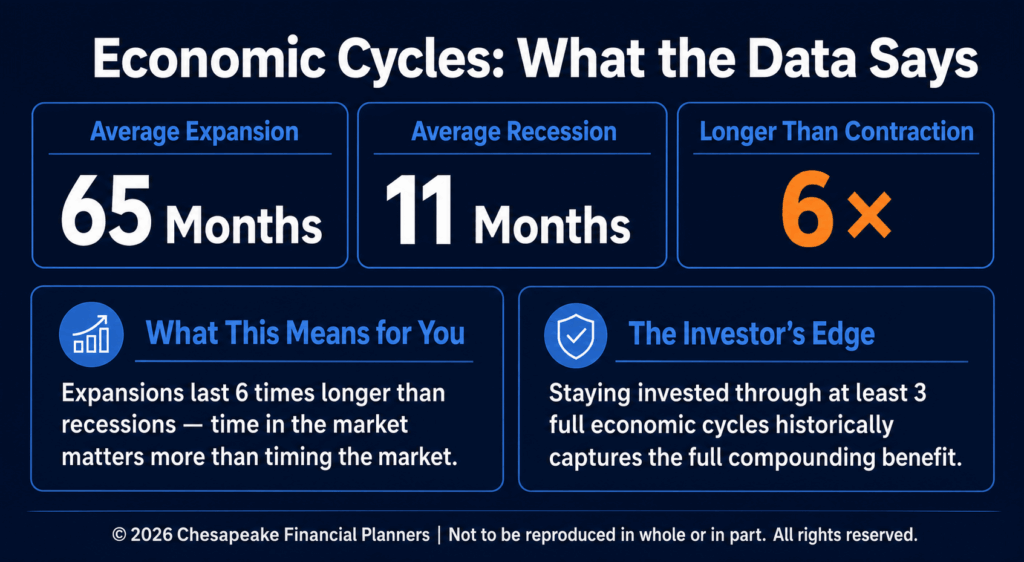
- Since 1854 the average U.S. expansion has lasted about 41 months according to NBER data.
- Stocks tend to lead the recovery, often rising before the economy shows clear improvement.
- Business owners carry pro-cyclical income, so their portfolios should add stability rather than amplify cycle risk.
About the Author: Jeff Judge, CFP®, AEP®, ChFC®, CLU® is Managing Partner of Chesapeake Financial Planners in Forest Hill, Maryland. He has been helping families and business owners in Harford County and the Baltimore metro area navigate market cycles and investment strategy since earning his CFP® certification in 2013, by using Chesapeake Financial Planners’ signature process, the R.U.D.D.E.R. method™. Jeff will tell you the biggest risk in a downturn usually isn't the market itself; it's the investor deciding to sell at the bottom.
The economy doesn't move in a straight line. It expands, peaks, contracts, and recovers in repeating patterns known as economic cycles or business cycle phases. These cycles shape market performance and create both opportunities and risks for investors. Knowing where you are in the cycle won't let you predict the next move with precision. But it changes how you behave, and behavior is where most investors win or lose.
What Are the Four Phases of the Business Cycle?
Economic cycles move through four distinct phases, each with its own conditions and typical market behavior. A reader who understands these four phases has the core framework for everything else.
Phase 1: Expansion. The economy is growing. GDP increases, employment rises, consumer spending strengthens, and business investment expands. Expansions can run for years. Stocks generally perform well as corporate earnings grow, while bonds may lag if interest rates climb to control inflation. The mood is optimistic and business confidence is high.
Phase 2: Peak. Growth reaches its maximum before slowing. Inflation may be elevated and the economy shows signs of overheating. Stock valuations can stretch beyond historical norms, interest rates sit at or near cycle highs, and volatility often rises as investors debate whether the expansion can continue.
Phase 3: Contraction (Recession). Economic activity declines. GDP shrinks, unemployment rises, and business investment pulls back. Recessions have ranged from a few months to over a year. Stocks typically fall as earnings drop, bonds often outperform as investors seek safety, and fear dominates sentiment. The National Bureau of Economic Research is the body that officially dates U.S. recessions, and it does so well after they begin.
Phase 4: Trough and Recovery. The trough is the low point, where activity bottoms and stabilizes before expansion resumes. Stocks often begin recovering before the economy shows clear improvement, interest rates are typically low, and opportunities emerge for investors willing to buy when sentiment is bleak.

Here's the part most people miss: these phases are obvious in hindsight and murky in real time. Nobody rings a bell at the peak. That's exactly why a What Is Market Volatility and How Should I Handle It? matters more than any forecast.
Why Do Economic Cycles Matter for Investors?
Economic cycles influence returns in fairly predictable ways, even though the timing of each cycle is unpredictable. Different investments perform differently in each phase, and recognizing that pattern is the practical payoff.
Stocks tend to do best during expansion and early recovery and struggle during contraction as corporate earnings decline. Bonds typically perform best during late expansion, when central banks stop hiking, and during contraction, when investors flee to safety and rates fall. Real assets like commodities and real estate often do well during late expansion as inflation builds, but can weaken sharply during a downturn.
Understanding this pattern helps you do three things. First, set realistic expectations. If the economy is in late expansion near a peak, counting on stocks to keep delivering above-average returns is wishful thinking. Second, avoid emotional decisions. Recessions are recurring, temporary phases, not permanent breaks; knowing that helps you stay invested. Third, rebalance with intent. If stocks have run hard during an expansion, trimming back toward your target allocation reduces downside before the inevitable correction arrives.
Recoveries reward patience. Stocks have historically bottomed and turned up months before the headlines did, which is why investors who wait for the "all clear" usually buy back in at higher prices. This is the heart of How Can I Avoid Making Emotional Investment Decisions?. Jeff Judge often points out that the clients who do best across a full cycle aren't the ones who predicted the recession; they're the ones who had a plan and didn't abandon it.
What Should Business Owners Do Differently?
Business owners face a double dose of economic cycle risk, and that changes how their portfolios should be built. Your company and your investments can rise and fall together if you're not careful.
Most businesses are pro-cyclical. Revenue grows during expansions and contracts during recessions, which means your income and your business value already swing with the cycle. If your investment portfolio is also packed with the same cyclical exposure, a downturn hits you twice: your business slows just as your portfolio drops, often at the moment you most need liquidity.

So your portfolio should provide ballast, not more of the same bet. That usually means holding a meaningful allocation to high-quality bonds, maintaining a cash reserve outside the business, and avoiding heavy concentration in your own industry's stocks. At Chesapeake Financial Planners, we use the R.U.D.D.E.R. Method™, our six-step planning process of Review and Recognize, Uncover and Understand, Design and Develop, Discuss and Decide, Execute and Empower, and Reassess and Refine, to map a business owner's full risk picture before we touch the portfolio. Jeff Judge frequently sees owners who treat their company and their investments as separate worlds; the moment you view them as one balance sheet, the right allocation becomes obvious. Building a portfolio that complements your business is closely tied to How do financial advisors choose investments for my portfolio? and to How Much of My Portfolio Should Be in One Stock?.
Frequently Asked Questions
Can I time the market using economic cycles?
No, you can't reliably time the market using economic cycles, because the turning points are only clear in hindsight. The NBER dates recessions months after they start. A better use of cycle knowledge is to set realistic return expectations, rebalance on schedule, and stay invested through downturns rather than trying to predict the next peak or trough.
How long does an economic cycle usually last?
A full economic cycle typically lasts several years, though there is wide variation. According to NBER data going back to 1854, the average U.S. expansion has run roughly 41 months, while contractions have averaged about 17 months. Modern expansions have generally been longer than older ones, but no cycle follows a fixed schedule you can count on.
What investments perform best during a recession?
High-quality bonds and cash typically hold up best during a recession, as investors seek safety and interest rates often fall. Defensive stock sectors like consumer staples, utilities, and healthcare also tend to weather downturns better than cyclical sectors. Diversification matters more than prediction here, since recessions rarely announce themselves in advance and recoveries can begin quickly.
Should I sell my stocks before a recession?
Selling stocks before a recession is risky because the market often peaks and bottoms before the economy does, so you can easily sell too early and buy back too high. Most long-term investors are better served by rebalancing to their target allocation and holding through the cycle. If you need cash within a few years, that money should already be in safer assets.
How do interest rates connect to economic cycles?
Interest rates and economic cycles are tightly linked, since central banks raise rates to cool an overheating expansion and cut rates to stimulate a weak economy. Rising rates tend to pressure bond prices and stretch stock valuations, while falling rates can support both. Understanding this link is central to managing your How Do Interest Rates Affect My Investment Portfolio?.
Why are economic cycles riskier for business owners?
Economic cycles are riskier for business owners because their income and company value are usually pro-cyclical, falling during recessions when they may also need cash. This concentration means a downturn can hit both the business and the portfolio at once. The fix is building an investment portfolio that adds stability instead of doubling down on the same cyclical exposure.
Wherever we are in the cycle right now, the decision in front of you is the same: is your portfolio built to match your real risk, or built to chase the last expansion? If you found this helpful, our investment planning guide for business owners walks through positioning your portfolio for every phase of the cycle. Download it at chesapeakefp.com.
Want to go deeper? Our R.U.D.D.E.R Audit for DIY Investors walks through this step by step.
Disclosures
The information provided is for educational purposes only and should not be construed as investment advice. Investment strategies should be tailored to individual circumstances, risk tolerance, and goals. Past performance doesn't guarantee future results. Consult with qualified financial professionals regarding your specific situation.
The economic forecasts set forth in this material may not develop as predicted and there can be no guarantee that strategies promoted will be successful.
Advisors associated with Chesapeake Financial Planners may be either (1) LPL Financial Registered Representatives offering securities through LPL Financial, Member FINRA and SIPC, and investment advisor representatives offering investment advice through Great Valley Advisor Group; or (2) solely investment advisor representatives offering investment advice through Great Valley Advisor Group and not affiliated with LPL Financial. Great Valley Advisor Group, and Chesapeake Financial Planners are separate entities from LPL Financial.


