

Does Maryland Tax Retirement Income? Social Security, Pensions & IRAs
Last reviewed: July 2026
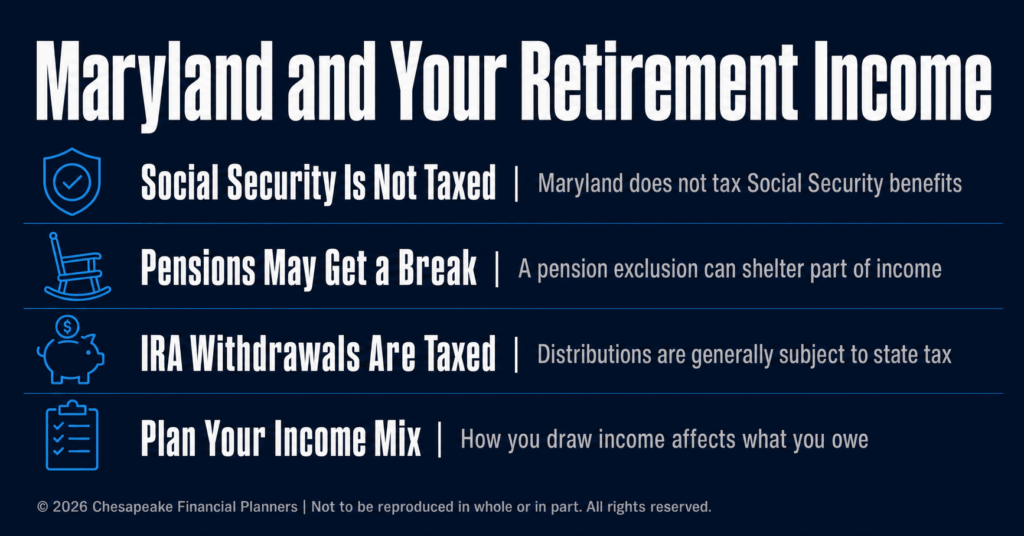
Does Maryland tax retirement income? Partly. Maryland does not tax Social Security benefits at all, but it does tax most other retirement income, including pensions, 401(k) and 403(b) withdrawals, and traditional IRA distributions. The break that matters most for retirees is the pension exclusion: if you are 65 or older (or totally disabled), you can subtract up to $40,600 of eligible employer plan income from your Maryland taxable income in 2026. The catch trips up a lot of people. That exclusion covers employer plans, not IRAs, and the difference can cost you real money if you draw from the wrong account first.
On This Page
- Key Takeaways
- Does Maryland Tax Retirement Income, and Which Types?
- How Does the Maryland Pension Exclusion Work in 2026?
- Why Don't IRAs and Roth IRAs Qualify for the Pension Exclusion?
- How Much Will You Actually Pay, and What Is the Senior Tax Credit Worth?
- How Can Harford County Retirees Lower Their Maryland Tax Bill?
- Frequently Asked Questions
- Plan Your Maryland Retirement Tax Strategy
- Disclosures
Key Takeaways
- Maryland fully exempts Social Security benefits from state income tax, regardless of your income level or age.
- Pensions, 401(k)s, 403(b)s, and traditional IRA withdrawals are taxable in Maryland at rates from 2% to 6.5%, plus your county's local income tax.
- Retirees 65 or older can exclude up to $40,600 of eligible pension income in 2026, but IRAs and Roth IRAs do not qualify.
- Maryland residents 65 and older may also claim a senior tax credit worth up to $1,000 (single) or $1,750 (both spouses 65+), subject to income limits.
- The order in which you tap accounts, Social Security, pensions, then IRAs, can change your Maryland tax bill by thousands over a retirement.
About the Author: Jeff Judge, CFP®, AEP®, ChFC®, CLU® is Managing Partner of Chesapeake Financial Planners in Forest Hill, Maryland. He has been helping families and business owners in Harford County and the Baltimore metro area navigate Maryland retirement taxes since earning his CFP® certification in 2013, by using Chesapeake Financial Planners’ signature process, the R.U.D.D.E.R. method™. Most retirees Jeff meets assume Maryland taxes their retirement the way the IRS does; the state's pension exclusion and its hard line between employer plans and IRAs are where the planning actually happens.
Does Maryland Tax Retirement Income, and Which Types?
Maryland taxes most retirement income but not all of it. The state treats your withdrawals as ordinary income, the same as wages, and applies state rates of 2% to 6.5% plus a county local income tax on top. That covers traditional 401(k) and 403(b) withdrawals, pension and annuity payments, and distributions from traditional IRAs. What Maryland does not tax is Social Security. Benefits are fully exempt at the state level, no matter how high your other income runs.
The practical takeaway is that your federal tax picture and your Maryland tax picture are not the same. The IRS may tax up to 85% of your Social Security; Maryland taxes none of it. Roth IRA and Roth 401(k) qualified withdrawals are tax-free at both levels because you already paid tax on the contributions. Everything else, the money that went in pre-tax, gets taxed on the way out at the state line.
Is Social Security taxed in Maryland?
No, Maryland does not tax Social Security benefits at the state level. You subtract any Social Security or Railroad Retirement income that was taxed federally back out on your Maryland return, so it never reaches your state taxable income. This holds regardless of your total income; there is no phase-out and no income cap on the exemption. Federally, by contrast, the SSA's thresholds can make up to 85% of your benefit taxable once combined income passes $25,000 (single) or $32,000 (married filing jointly). For more detail on the state's treatment of retirees, see the Maryland Comptroller's guidance for individual taxpayers.
Is Social Security Taxable? 2026 Tax Rules Explained
How Does the Maryland Pension Exclusion Work in 2026?
The Maryland pension exclusion lets eligible retirees subtract up to $40,600 of qualifying retirement income from their Maryland taxable income in 2026. To claim it, you must be 65 or older, or totally disabled, or have a spouse who is totally disabled. The income has to come from an employee retirement system: a traditional pension, a 401(k), a 403(b), or a 457(b) plan funded by an employer. You report it on Maryland Form 502 using the Pension Exclusion Computation Worksheet.
There is a moving part most people miss. The exclusion amount is reduced dollar-for-dollar by any Social Security benefits you receive. Because Maryland already exempts your Social Security entirely, the state does not let you double-dip by also sheltering an equal amount of pension income. So a retiree with a $30,000 annual Social Security benefit sees the maximum pension exclusion shrink by that $30,000, leaving roughly $10,600 of pension income that can be excluded. The bigger your Social Security check, the smaller your usable pension exclusion.
Who qualifies for the $40,600 pension exclusion?
You qualify for the pension exclusion if you are 65 or older (or totally disabled) and the income comes from an employer-sponsored retirement plan. The maximum exclusion is $40,600 for tax year 2026, and it applies per qualifying taxpayer, so a married couple where both spouses are 65 and both have pension income may each claim their own exclusion. The income must be from a plan where an employer was involved. A pension from a former employer counts. A 401(k) you rolled into an IRA generally does not, which is the trap covered in the next section.
How does Maryland's $40,600 pension exclusion work for Harford County retirees?
Why Don't IRAs and Roth IRAs Qualify for the Pension Exclusion?
IRAs do not qualify because Maryland limits the pension exclusion to income from an employee retirement system, and an IRA is an individual account, not an employer plan. The Comptroller's guidance is explicit on this point. Per the Maryland Comptroller: "A traditional IRA, a Roth IRA, a simplified employee plan (SEP), a Keogh Plan or an ineligible deferred compensation plan does not qualify." That single sentence is responsible for more surprised retirees than any other line in the Maryland tax code.
The distinction matters because of what people do with old 401(k)s. Rolling a 401(k) into an IRA is the standard move at retirement, and it is often the right one for investment flexibility and consolidation. But the moment that money lands in an IRA, it stops being eligible for Maryland's pension exclusion. Jeff Judge regularly sees retirees who rolled a six-figure 401(k) into an IRA the year before retiring, not realizing they traded away up to $40,600 of annual state tax sheltering in the process. The fix, when there is one, has to happen before the rollover, not after.
What counts as an "employee retirement system"?
An employee retirement system is a plan established and maintained by an employer for its employees, which includes traditional defined-benefit pensions, 401(k), 403(b), and 457(b) plans. Income from these qualifies for the Maryland pension exclusion when you meet the age or disability test. Individual accounts you fund yourself, traditional IRAs, Roth IRAs, SEP-IRAs, and Keogh plans, fall outside the definition and do not qualify, even though the money may have originally come from an employer 401(k) before you rolled it over.
Account Type | Qualifies for the Maryland Pension Exclusion? — | — Employer pension (private or government) | Yes 401(k), 403(b), or 457(b) | Yes Traditional IRA | No Roth IRA | No SEP-IRA | No Keogh plan | No
Should I roll my 401k into an IRA when I retire?
How Much Will You Actually Pay, and What Is the Senior Tax Credit Worth?
Your Maryland tax on retirement income depends on your taxable income after the pension exclusion, the state's graduated rates, and your county's local rate. Maryland's state rates run from 2% on the first $1,000 of taxable income up to 5.75% on income above $250,000 (single), with new high-income brackets of 6.25% on taxable income over $500,000 and 6.5% on income over $1,000,000 (single) added for 2026 under HB 352, the 2025 budget reconciliation act. On top of the state rate, every Maryland county levies a local income tax. The combination is what determines your real bill, and it is why two retirees with identical income can owe different amounts depending on which county they live in.
Two more breaks reduce the total. Maryland offers a higher standard deduction for filers 65 and older, with the standard deduction capped at $2,700 for single filers and $5,450 for joint filers. And the state's senior tax credit gives qualifying residents 65 and older a direct credit against tax owed. A credit beats a deduction dollar-for-dollar because it cuts the tax itself, not just the income it is calculated on.
What is the Maryland senior tax credit worth?
The Maryland senior tax credit is worth up to $1,000 for a single filer 65 or older and up to $1,750 for a married couple filing jointly where both spouses are 65 or older. The credit phases out by income: per the Maryland General Assembly's analysis, eligibility generally requires federal adjusted gross income under $100,000 for single filers and under $150,000 for joint filers. If you qualify, you claim it on Form 502, and it reduces your Maryland tax bill directly.

How Can Harford County Retirees Lower Their Maryland Tax Bill?
Harford County retirees can lower their Maryland tax bill by claiming the full pension exclusion, sequencing withdrawals to keep more income in employer plans, and timing Roth conversions before they start Social Security. Local matters here: Harford County levies a local income tax of 3.06% on top of the state rate, so every dollar you keep out of Maryland taxable income saves you the state rate plus that 3.06%. For a retiree in Forest Hill or Bel Air, that combined marginal rate is the number that actually drives planning decisions, not the federal bracket most people fixate on.
At Chesapeake Financial Planners, we use the R.U.D.D.E.R. Method™, a planning framework that aligns Retirement income, Uncertainty, Debt, Distributions, Estate, and Risk into one coordinated plan, to decide which accounts a Maryland retiree should draw from first. The Maryland angle changes the standard answer. Conventional sequencing says spend taxable accounts first, then tax-deferred, then Roth. But because Maryland shelters up to $40,600 of pension and 401(k) income for those 65 and older while taxing IRA withdrawals in full, keeping money in an employer plan rather than rolling it to an IRA can preserve a state tax break worth real money each year.
Here is a pattern Jeff Judge sees often with Harford County clients. A retiree turns 64, rolls a $400,000 401(k) into an IRA to simplify, and starts Social Security at 65. The next spring, their tax preparer notes they no longer qualify for the pension exclusion because the income now comes from an IRA. Had they left even part of that balance in the 401(k), they could have drawn it under the exclusion. The lever was never the investment return. It was the account the money sat in when the distribution happened.
Does the order you tap accounts change your Maryland taxes?
Yes, the order you tap accounts can meaningfully change your Maryland taxes because the pension exclusion only shelters employer-plan income, not IRA income. A Maryland retiree who draws pension or 401(k) money in years they are 65 or older can exclude up to $40,600 (reduced by Social Security received), while the same dollars pulled from an IRA are fully taxed by the state. Coordinating withdrawals with the federal required minimum distribution age of 73 gives you a window of lower-tax years to convert or draw strategically before RMDs force income onto the return.
What is the right retirement withdrawal order for your accounts?

Frequently Asked Questions
Does Maryland tax Social Security retirement benefits?
No, Maryland does not tax Social Security retirement benefits at the state level, regardless of your income. Any Social Security or Railroad Retirement income that was taxable on your federal return is subtracted back out on your Maryland return, so it never reaches your Maryland taxable income. This exemption has no income cap and no phase-out for higher earners.
Does Maryland tax 401(k) and IRA withdrawals?
Yes, Maryland taxes both 401(k) and traditional IRA withdrawals as ordinary income at state rates of 2% to 6.5% plus your county's local income tax. The key difference is the pension exclusion: 401(k) and other employer-plan income can qualify for the exclusion if you are 65 or older, but IRA withdrawals never qualify, even when the money was originally rolled over from a 401(k).
How much is the Maryland pension exclusion for 2026?
The maximum Maryland pension exclusion is $40,600 for tax year 2026, available to retirees 65 or older or those who are totally disabled. The amount is reduced dollar-for-dollar by any Social Security benefits you receive, and it only applies to income from an employer retirement plan such as a pension, 401(k), 403(b), or 457(b).
Why doesn't my IRA qualify for the Maryland pension exclusion?
Your IRA does not qualify because Maryland restricts the pension exclusion to employee retirement systems, and an IRA is an individual account rather than an employer plan. The Comptroller specifically excludes traditional IRAs, Roth IRAs, SEPs, and Keogh plans. This catches many retirees who rolled a 401(k) into an IRA at retirement, since the rollover converts exclusion-eligible income into income that Maryland taxes in full.
Is Maryland a tax-friendly state for retirees?
Maryland is moderately tax-friendly for retirees: it fully exempts Social Security and offers a pension exclusion up to $40,600 plus a senior tax credit, but it still taxes IRA withdrawals and most other retirement income, and county local taxes add to the bill. Whether it works in your favor depends heavily on where your retirement income sits, employer plans versus IRAs, and which county you live in.
What is the Maryland senior tax credit and who qualifies?
The Maryland senior tax credit is a direct credit of up to $1,000 for single filers and up to $1,750 for joint filers where both spouses are 65 or older. Eligibility generally requires federal adjusted gross income under $100,000 (single) or $150,000 (joint). Because it is a credit, it reduces your Maryland tax owed directly rather than just lowering taxable income.
Do Harford County retirees pay a local income tax on retirement income?
Yes, Harford County retirees pay a local income tax of 3.06% on their Maryland taxable income, charged on top of the state rate. That local tax applies to taxable retirement income such as IRA and pension withdrawals, but not to Social Security, which Maryland exempts entirely. The local rate is one reason coordinating withdrawals to use the pension exclusion matters for Forest Hill and Bel Air residents.
Plan Your Maryland Retirement Tax Strategy
Whether Maryland taxes your retirement income comes down to where that income sits and when you draw it. Social Security stays untaxed by the state, the pension exclusion can shelter up to $40,600 of employer-plan income, and the line between a 401(k) and an IRA can be worth thousands a year in Harford County. The decisions that capture those savings happen in the years before you retire, not after.
Ready to put a plan around whether Maryland taxes your retirement income? Jeff Judge and the Chesapeake team serve families and business owners across Harford County and the Baltimore metro. Schedule a free fit call at chesapeakefp.com.
Want to go deeper? Our Maryland Financial Planning Guide walks through this step by step.
Disclosures
The information provided is for educational purposes only and should not be construed as investment advice. Investment strategies should be tailored to individual circumstances, risk tolerance, and goals. Past performance doesn't guarantee future results. Consult with qualified financial professionals regarding your specific situation.
This information is not intended to be a substitute for specific individualized tax, investment or legal advice. We suggest that you discuss your specific situation with a qualified tax, legal or financial advisor.
Advisors associated with Chesapeake Financial Planners may be either (1) LPL Financial Registered Representatives offering securities through LPL Financial, Member FINRA and SIPC, and investment advisor representatives offering investment advice through Great Valley Advisor Group; or (2) solely investment advisor representatives offering investment advice through Great Valley Advisor Group and not affiliated with LPL Financial. Great Valley Advisor Group, and Chesapeake Financial Planners are separate entities from LPL Financial.


