

Can I Use My Business to Fund My Retirement Plan?
Last reviewed: July 2026
Yes, you can absolutely use your business to fund your retirement plan, and in most cases you can save far more than someone working a corporate job. A business retirement plan lets owners deduct large contributions as a business expense while building personal wealth outside the company. The right plan depends on your age, income, and whether you have employees.
Key Takeaways
- Business owners can contribute up to $72,000 to a SEP IRA or Solo 401(k) in 2026, far above the standard 401(k) limit.
- A Solo 401(k) lets you contribute as both employee and employer, often beating a SEP IRA at the same income.
- Cash balance plans can allow six-figure annual deductions for older, high-income owners with steady cash flow.
- The best plan depends on your age, income, employee count, and how consistent your profits are.
About the Author: Jeff Judge, CFP®, AEP®, ChFC®, CLU® is Managing Partner of Chesapeake Financial Planners in Forest Hill, Maryland. He has been helping families and business owners in Harford County and the Baltimore metro area navigate small business retirement plans since earning his CFP® certification in 2013, by using Chesapeake Financial Planners’ signature process, the R.U.D.D.E.R. method™. Jeff sees the same pattern often: profitable owners overpay taxes for years because nobody ever told them they could deduct $60,000 or more into a retirement plan.
Most business owners assume retirement security comes from one event: selling the company someday. That bet works until it doesn't. The business might sell for less than you hoped, take longer than planned, or your health could force an exit before the company is ready. Building wealth outside your business through a retirement plan removes that single point of failure. And the tax code rewards you for doing it.
What Retirement Plans Can a Business Owner Use?
A business retirement plan is any tax-advantaged account you fund through your company. Owners have access to several, and the contribution limits often dwarf what a corporate employee gets. Here are the four most common options.
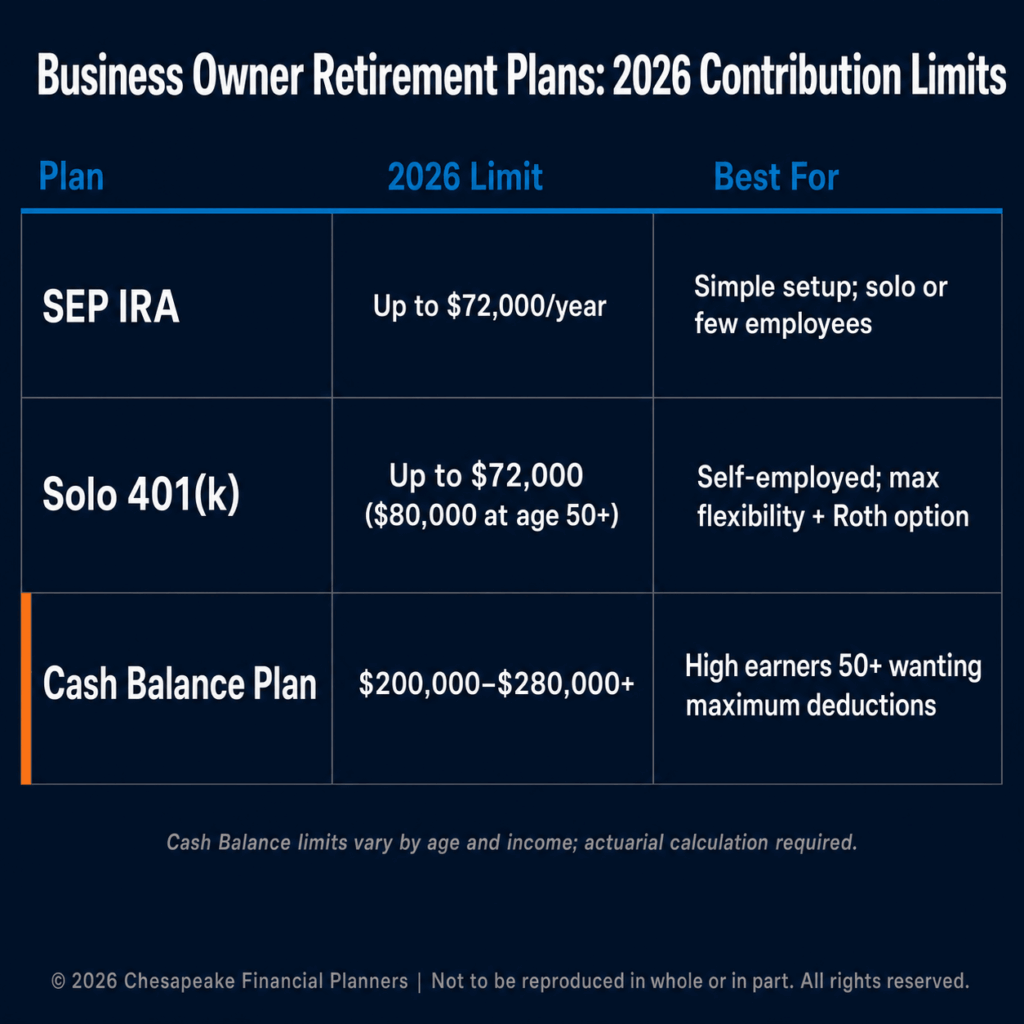
SEP IRA. You contribute up to 25% of compensation (about 20% of net self-employment income) as a business deduction. The 2026 maximum is $72,000. Setup takes minutes. The catch: if you have employees, you must contribute the same percentage for them that you contribute for yourself, which gets expensive fast.
Solo 401(k). You wear two hats. As the employee, you defer up to $24,500 in 2026 ($32,500 if age 50+). As the employer, you add up to 25% of compensation. Total caps at $72,000, or $80,000 with the age-50 catch-up. It often beats a SEP IRA at the same income and offers a built-in Roth option. Best for owners with no employees besides a spouse.
Cash balance plan. This is a defined benefit pension that allows large tax-deductible contributions, sometimes well into six figures for older owners. It demands steady cash flow and professional actuarial administration.
Defined benefit plan. A traditional pension where you target a retirement benefit and an actuary calculates the required funding. Like cash balance plans, it favors older owners with high, stable income.
According to the IRS, self-employed people have access to nearly every plan type a large employer offers, often with more generous limits. Jeff Judge often tells clients the real question isn't whether you can save through your business. It's which plan fits your cash flow and your timeline.
For a side-by-side breakdown, see Should I Choose a Solo 401(k) or SEP IRA for My Business?.
How Much Can a Business Owner Contribute Compared to an Employee?
A business owner can contribute dramatically more than a salaried employee, which is the core advantage most owners overlook. A corporate worker is capped at the standard 401(k) deferral. A business owner can stack employee and employer contributions, and in some cases layer a pension on top.
Here is how the main options compare in 2026.
| Plan | 2026 Limit | Best For | Employee Cost |
|---|---|---|---|
| SEP IRA | Up to $72,000 | Solo owners, few employees | High if many employees |
| Solo 401(k) | Up to $72,000 ($80,000 age 50+) | No employees besides spouse | None |
| Cash balance plan | Six figures for older owners | High income, age 45+ | Varies; needs administration |
| Defined benefit plan | Six figures for older owners | Stable high income, age 50+ | Mandatory funding |
The numbers above for SEP IRA and Solo 401(k) are confirmed by the IRS cost-of-living adjustment tables. Cash balance and defined benefit limits depend on actuarial calculations tied to your age and income, so they are not fixed dollar caps.
The deduction is where this gets powerful. If you contribute $60,000 to a SEP IRA and sit in a 35% bracket, you cut roughly $21,000 off your federal tax bill while the money grows for retirement. That same contribution as a corporate employee simply isn't available.
How do business owners plan for retirement differently? covers the broader strategy behind these choices.
Can You Combine Retirement Plans to Save Even More?
Yes, high-income owners can often stack plans to push deductible savings well past what any single account allows. The most common combination pairs a cash balance plan with a Solo 401(k).
A representative high-income setup might look like this:
- Cash balance plan contribution: a six-figure amount based on age and income
- Solo 401(k) employee deferral: $24,500
- Result: deductible retirement savings far above the standard 401(k) limit
This stacking strategy isn't free. Defined benefit and cash balance plans require mandatory annual funding and professional administration, including actuarial valuations. You generally need consistent cash flow and a commitment to maintain the plan for at least several years. For owners with steady high profits, the tax savings usually dwarf the administrative cost.
Jeff Judge has watched owners in their late 50s use this combination to make up for decades of underfunding their own retirement. The contributions are mandatory once the plan is in place, so the planning has to match real, reliable cash flow. This is exactly the kind of decision the R.U.D.D.E.R. Method™, Chesapeake Financial Planners' six-step planning process of Review and Recognize, Uncover and Understand, Design and Develop, Discuss and Decide, Execute and Empower, and Reassess and Refine, is built to work through.
See How Can Business Owners Use Profit-Sharing Plans for Tax Benefits? for another layer some owners add.
How Do You Choose the Right Plan for Your Business?
The right business retirement plan comes down to four factors: your age, your income, whether you have employees, and how predictable your profits are. There is no single best answer, only the best fit.
Older owners with high, stable income benefit most from cash balance and defined benefit plans, because a shorter runway to retirement allows larger annual contributions. Younger owners or those with variable income usually start with a Solo 401(k) for its flexibility, since you can change contributions year to year. Owners with several employees often lean toward a 401(k) with profit sharing rather than a SEP IRA, where matching costs add up quickly.
Per FINRA, plan selection should weigh both your savings goals and your obligations to employees. Getting this wrong is expensive, and the Department of Labor holds plan sponsors to fiduciary standards once a plan exists.
How do business owners save for retirement without a 401(k)? walks through options when a 401(k) isn't the right fit.
Frequently Asked Questions
What is the best retirement plan for a self-employed business owner?
The best retirement plan for a self-employed owner with no employees is usually a Solo 401(k), because it allows both employee and employer contributions up to $72,000 in 2026 and offers a Roth option. Owners wanting simplicity sometimes choose a SEP IRA instead. The right pick depends on your income and savings goals.
How much can I contribute to a SEP IRA in 2026?
You can contribute up to $72,000 to a SEP IRA in 2026, limited to 25% of compensation or roughly 20% of net self-employment income, according to the IRS. The contribution is fully deductible as a business expense. If you have employees, you must contribute the same percentage of their compensation that you contribute for yourself.
Is a Solo 401(k) better than a SEP IRA for business owners?
A Solo 401(k) is often better than a SEP IRA because it combines an employee deferral with an employer contribution, letting you reach the maximum at a lower income level. It also offers Roth contributions and a loan option. A SEP IRA wins mainly on simplicity, since it has no annual filing requirement until assets grow large.
Can a high-income business owner deduct more than $72,000 for retirement?
Yes, a high-income business owner can deduct well over $72,000 by adding a cash balance or defined benefit pension plan to a Solo 401(k). These pension plans allow six-figure deductible contributions tied to your age and income. They require steady cash flow, mandatory annual funding, and professional actuarial administration to stay compliant.
Do I have to include my employees in my business retirement plan?
Yes, in most cases eligible employees must be included, and the rules vary by plan. A SEP IRA requires the same contribution percentage for qualifying employees as for yourself. A 401(k) with profit sharing offers more flexibility in how you allocate contributions. Excluding eligible employees improperly can disqualify the plan and create serious tax penalties.
How does a business retirement plan reduce my taxes?
A business retirement plan reduces taxes because contributions are deductible business expenses that lower your taxable income for the year. If you contribute $60,000 in a 35% bracket, you save roughly $21,000 in federal tax while the money grows tax-deferred. Roth options trade the upfront deduction for tax-free growth and withdrawals later.
Ready to Put a Plan in Place?
If you're a business owner watching your tax bill climb while your personal retirement savings stay flat, there's almost always a better structure available. Jeff Judge and the Chesapeake team help owners across Harford County and the Baltimore metro choose and build the right plan around their actual cash flow. Schedule a free fit call at chesapeakefp.com to see how much a business retirement plan could save you.
Disclosures
The information provided is for educational purposes only and should not be construed as investment advice. Investment strategies should be tailored to individual circumstances, risk tolerance, and goals. Past performance doesn't guarantee future results. Consult with qualified financial professionals regarding your specific situation.
Contributions to a traditional IRA may be tax deductible in the contribution year, with current income tax due at withdrawal. Withdrawals prior to age 59 ½ may result in a 10% IRS penalty tax in addition to current income tax.
Advisors associated with Chesapeake Financial Planners may be either (1) LPL Financial Registered Representatives offering securities through LPL Financial, Member FINRA and SIPC, and investment advisor representatives offering investment advice through Great Valley Advisor Group; or (2) solely investment advisor representatives offering investment advice through Great Valley Advisor Group and not affiliated with LPL Financial. Great Valley Advisor Group, and Chesapeake Financial Planners are separate entities from LPL Financial.


