

How Do I Build a Dividend Income Portfolio for Retirement?
Last reviewed: July 2026
A dividend income portfolio is a collection of stocks, funds, and REITs selected specifically to generate regular cash payments you can live on in retirement. You build one by combining higher-yielding holdings for immediate income with dividend growth stocks that raise their payouts over time, spread across 20 to 30 positions in different sectors. The goal is reliable income that grows faster than inflation without forcing you to sell shares at the wrong moment.
Key Takeaways
- A dividend income portfolio blends current yield with dividend growth across 20 to 30 holdings in multiple sectors.
- Qualified dividends are taxed at long-term capital gains rates, topping out at 20% federally plus a 3.8% surtax.
- The S&P 500 Dividend Aristocrats require 25 or more consecutive years of dividend increases.
- REITs must distribute at least 90% of taxable income, making their dividends mostly ordinary income.
About the Author: Jeff Judge, CFP®, AEP®, ChFC®, CLU® is Managing Partner of Chesapeake Financial Planners in Forest Hill, Maryland. He has been helping families and business owners in Harford County and the Baltimore metro area navigate retirement income planning since earning his CFP® certification in 2013, by using Chesapeake Financial Planners’ signature process, the R.U.D.D.E.R. method™. Jeff has seen too many retirees chase the highest yield on a screen and end up holding a company that cuts its dividend a year later.
Why Use a Dividend Income Portfolio for Retirement?
A dividend income portfolio works in retirement because it pays you cash without requiring you to sell shares on a fixed schedule. That matters most when markets drop. If you depend on selling stock for income, a bad market forces you to liquidate at low prices. A dividend keeps arriving whether the share price is up or down.
Dividends from quality companies also tend to rise over time. Unlike a bond coupon, which stays fixed, a growing dividend gives you built-in inflation protection. Companies that raise their payouts year after year help your income keep pace with rising costs across a retirement that could last 30 years or more.
There is a tax advantage too. Qualified dividends are taxed at long-term capital gains rates rather than ordinary income rates. According to the IRS, the top federal qualified dividend rate is 20%, plus the 3.8% net investment income tax for high earners. For someone in the top ordinary bracket, that difference is real money kept rather than paid.
Jeff often tells clients the point of dividend investing in retirement is not to win a yield contest. It is to build a paycheck that shows up reliably and grows a little every year.
What is the best order to withdraw from my 401k, Roth IRA, and taxable accounts in retirement?
How Do You Balance Dividend Yield Against Dividend Growth?
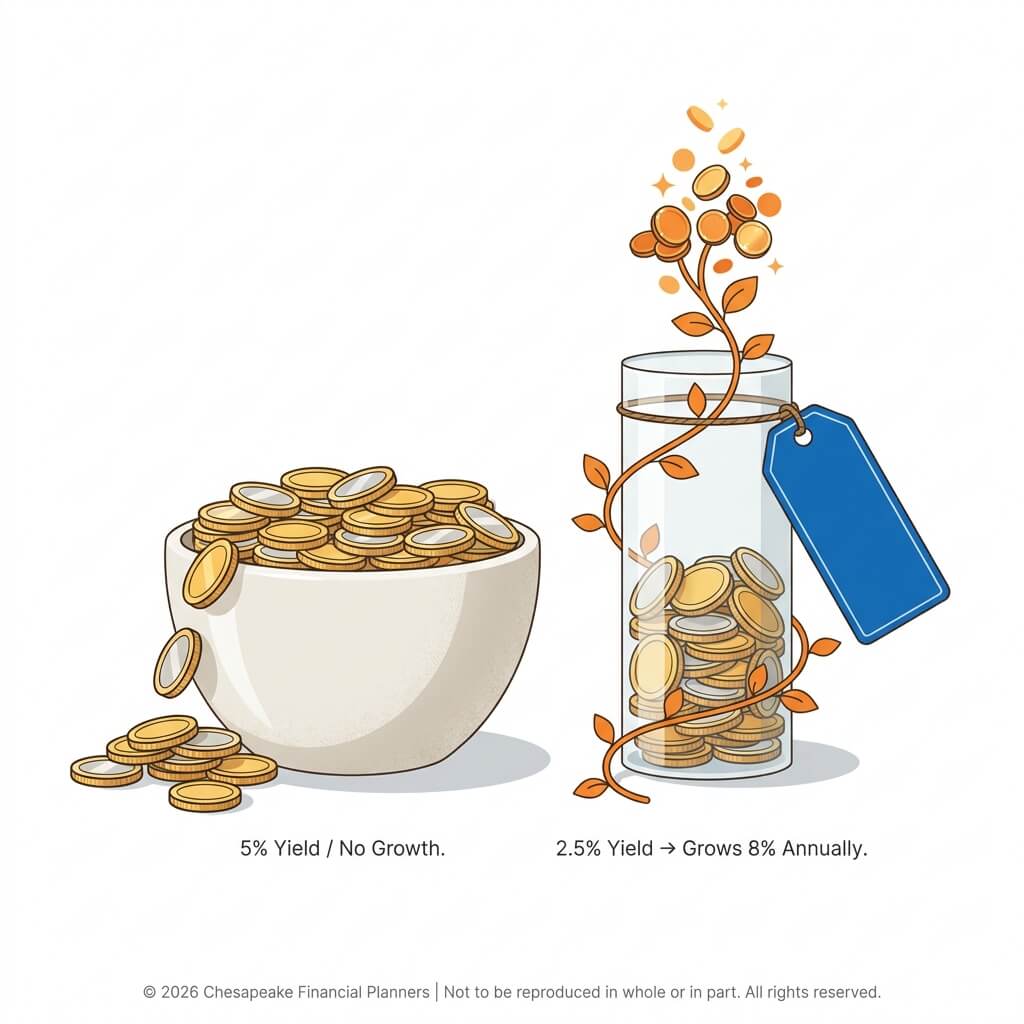
You balance yield against growth by deciding how much income you need today versus how much you want your income to rise tomorrow, then blending both. High current yield gives you more cash now. Dividend growth gives you more cash later. Most retirees need some of each.
High-yield holdings pay 4%, 5%, or more right away. That is useful if you need cash flow immediately. But a very high yield can be a warning sign. When a stock yields 7% or 8%, the market is often pricing in a cut. A yield that looks too good usually is.
Dividend growth stocks may yield only 2.5% today but raise their payouts 7% or 8% a year. A 2.5% yield growing at 8% annually becomes roughly 4% on your original cost within seven years. Over two decades, that same position could yield well into the double digits on what you originally paid. The S&P Dow Jones Indices Dividend Aristocrats index tracks companies with 25 or more consecutive years of raising dividends, a useful starting universe for the growth side of a portfolio.
The blended approach is what works for most people: a slice of higher-yielding names for current income, paired with steady dividend growers that will lift your income for years to come.
What Makes a Dividend Stock Reliable?
A reliable dividend stock has stable cash flow, a reasonable payout ratio, a durable competitive advantage, and a long track record of maintaining or raising its dividend. These four traits separate a sustainable payout from one that looks fine until it suddenly is not.
Cash flow comes first. Companies pay dividends from cash, not from accounting earnings. You want consistent operating cash flow that covers the dividend with room left over. The payout ratio matters too: between 40% and 60% of earnings is often a healthy range, leaving margin to keep paying through a rough patch.
A competitive moat protects profits through economic cycles. Brand strength, regulatory licenses, network effects, or cost advantages all help a company defend its earnings and, by extension, its dividend. Finally, a long history of stability signals management's commitment. The so-called Dividend Aristocrats and Dividend Kings have proven their resilience across multiple recessions.
| Reliability Factor | What to Look For | Warning Sign |
|---|---|---|
| Cash flow | Covers dividend with cushion | Dividend exceeds free cash flow |
| Payout ratio | 40% to 60% of earnings | Above 80%, little margin |
| Competitive moat | Durable advantage | Eroding market share |
| Dividend history | 10+ years of increases | Recent freeze or cut |
Why Does a Financial Planning Process Matter More Than Investment Selection?
How Do You Diversify a Dividend Portfolio and Handle Taxes?
You diversify a dividend portfolio by owning 20 to 30 stocks across several sectors and by placing each holding in the account type that minimizes its tax drag. Concentration is the quiet risk in dividend investing. Loading up on a single sector, even a defensive one, leaves you exposed if that sector or one large holding cuts its payout.
Traditional dividend sectors include consumer staples, utilities, healthcare, financials, and real estate. Each behaves differently across economic conditions, which is the whole point of spreading across them. Real estate investment trusts deserve special attention. The SEC notes that REITs must distribute at least 90% of their taxable income to shareholders, which produces high yields but also means most REIT dividends are taxed as ordinary income, not at preferential rates.
This is where account location matters. Hold tax-inefficient income, like REIT and MLP distributions, inside an IRA or 401(k) where the distinction does not apply, since all withdrawals from those accounts are taxed as ordinary income anyway. Keep your qualified-dividend payers in taxable accounts so you capture the lower rate. This is the kind of coordination the R.U.D.D.E.R. Method™ is built for. The R.U.D.D.E.R. Method™ is Chesapeake Financial Planners' six-step planning process: Review and Recognize, Uncover and Understand, Design and Develop, Discuss and Decide, Execute and Empower, and Reassess and Refine.
One more discipline matters: dividend cuts happen even to good companies. Keeping roughly a year of expenses in cash or short-term bonds means a temporary income reduction never forces you to sell stocks at a low.
How do I coordinate all my retirement income sources to minimize taxes and maximize income?
Frequently Asked Questions
How much money do I need to live on dividends in retirement?
The amount depends on your annual spending and your portfolio's average yield. A portfolio yielding 3% would need roughly $1 million to generate $30,000 in annual dividend income. To replace $60,000 a year at a 3% yield, you would need about $2 million invested in dividend-paying assets, not counting Social Security or other income sources.
Are dividends taxed differently than other investment income?
Yes. Qualified dividends are taxed at long-term capital gains rates, which the IRS caps at 20% federally for top earners, plus a 3.8% net investment income surtax. Non-qualified dividends, including most REIT distributions, are taxed as ordinary income at higher rates. Where you hold each type of stock affects your total tax bill significantly.
How many dividend stocks should I own?
Most retirees should own 20 to 30 dividend-paying stocks spread across multiple sectors. That range gives you enough diversification to survive a dividend cut from any single holding while keeping the portfolio small enough to monitor. Fewer than 15 concentrates your risk; more than 40 becomes hard to manage without a dedicated process or professional help.
Should I reinvest dividends or take the cash in retirement?
Take the cash if you need it for living expenses, and reinvest if you do not. There is no benefit to reinvesting dividends and then selling shares to raise the same cash, which only creates extra transactions. Some retirees reinvest when markets are low and take cash when prices are high, though that requires active judgment.
What is the difference between high-yield and dividend growth investing?
High-yield investing targets stocks paying large current dividends, often 4% or more, for immediate income. Dividend growth investing targets companies that raise their payouts steadily, even if today's yield is modest. High yield gives you more income now; dividend growth gives you rising income over time. A blend of both suits most retirement portfolios.
Can dividend ETFs replace a portfolio of individual stocks?
Yes, dividend-focused ETFs and mutual funds offer instant diversification and professional management in a single purchase. The tradeoff is paying a management fee and giving up control over individual holdings. Many investors combine funds for broad coverage with a few individual stocks they want to own directly, which balances simplicity against control.
Ready to Build Income That Lasts?
A dividend income portfolio is one piece of a larger retirement income plan, and the pieces have to fit together. If this was helpful, our retirement income guide walks through how to turn your assets into a paycheck that lasts. Download it at chesapeakefp.com to see how a dividend strategy fits alongside Social Security, withdrawals, and your tax picture.
Is financial planning worth it if I already have investments?
Want to go deeper? Our Retirement Income Blueprint Workbook walks through this step by step.
Disclosures
The information provided is for educational purposes only and should not be construed as investment advice. Investment strategies should be tailored to individual circumstances, risk tolerance, and goals. Past performance doesn't guarantee future results. Consult with qualified financial professionals regarding your specific situation.
Forward Dividend Yield is calculated as consensus analyst estimates of dividends for the next 12 months divided by price.
Stock investing includes risks, including fluctuating prices and loss of principal.
Growth investments may be more volatile than other investments because they are more sensitive to investor perceptions of the issuing company's growth of earnings potential.
Advisors associated with Chesapeake Financial Planners may be either (1) LPL Financial Registered Representatives offering securities through LPL Financial, Member FINRA and SIPC, and investment advisor representatives offering investment advice through Great Valley Advisor Group; or (2) solely investment advisor representatives offering investment advice through Great Valley Advisor Group and not affiliated with LPL Financial. Great Valley Advisor Group, and Chesapeake Financial Planners are separate entities from LPL Financial.


